T1#research#military#labor
ENIAC Unveiled — The Electronic Computer You Programmed With Cables
Metadata
- Date
- Decade
- 1940s
- Tier
- T1
- Sources
- 07
- Connections
- 01
- Tags
- #research#military#labor
On 14 February 1946 the press was brought to the Moore School of Electrical Engineering at the University of Pennsylvania to see a machine the Army Ordnance Department had spent the war hiding under the codename Project PX. The formal dedication followed the next day, and the New York Times ran its story on 15 February.
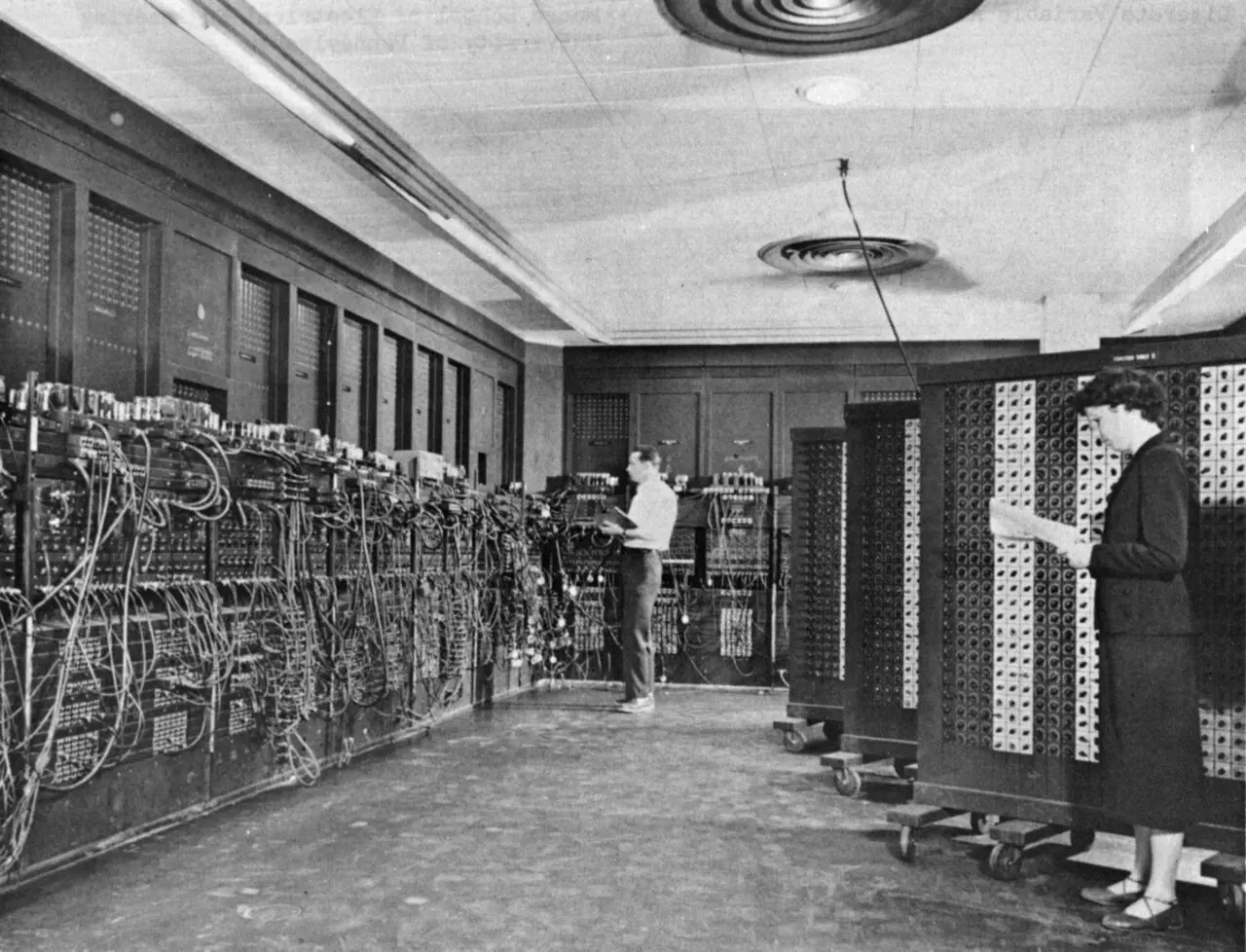
The machine was ENIAC — the Electronic Numerical Integrator And Computer. It held 17,468 vacuum tubes (Penn's own history rounds this to 18,000), 1,500 relays, 70,000 resistors and 10,000 capacitors. It weighed about 30 tons and drew roughly 150 kilowatts. Panels three feet deep and ten feet tall ran a hundred feet in a U around a room of some 1,500 square feet. It added about 5,000 numbers a second, and cost in the region of half a million dollars.
The demonstration
Arthur Burks, the mathematician who ran the demonstration, described it in an account quoted in C. Dianne Martin's study of the press conference. He announced that he would add five thousand numbers together and pushed the button; ENIAC did it in one second, and in Burks's words, "The problem was finished before the reporters had looked up!"
The centrepiece was ballistics. They chose the trajectory of a shell that took thirty seconds to reach its target — three days of work for a human computer, thirty minutes on the differential analyser — and ENIAC produced it in twenty seconds. The machine beat the shell. As a piece of theatre it could not be improved on.
The trajectory program used in that demonstration was written by Betty Snyder and Jean Jennings. Jennings later recalled that the night before, the program ran perfectly except that it would not stop computing when the shell hit the ground. The two checked and rechecked until two in the morning; the next day Snyder flipped one switch on the master programmer and the problem was gone.
The six who vanished from the record
The people who actually operated ENIAC were Kathleen McNulty, Frances Bilas, Betty Jean Jennings, Ruth Lichterman, Elizabeth (Betty) Snyder and Marlyn Wescoff. All six had been "computers" at the Ballistic Research Laboratory — in 1945 that word still meant a person — working desk calculators and the differential analyser, and they were selected to learn to program the machine.
The New York Times of 15 February reported that "The ENIAC was then told to solve a difficult problem that would have required several weeks' work by a trained man. The ENIAC did it in exactly 15 seconds." Jennifer S. Light's study points out that the fifteen seconds silently excludes the days the women spent setting the problem up. The article ran photographs of Eckert and Mauchly, named them as the inventors, and said that had the machine not existed the job "would have kept busy 100 trained men for a whole year" — this at an institution that hired computers almost exclusively from among women. The hypothetical hundred are men.
The photographs behaved the same way. One printed with the story foregrounds a man in uniform plugging in wires; the caption calls the figures "attendants preparing the machine". Two women stand in the background, visible only if you look for them. When that widely reproduced image was reused in an Army recruitment advertisement, the women were cropped out of the frame entirely.
This is not a case of the record being incomplete by accident. The press conference and the coverage that followed made both the labour and the gender of the people who performed it invisible in real time.
What ENIAC was actually first at
ENIAC was not the first electronic computer. Britain's Colossus had been decrypting German traffic electronically since 1943, and the Atanasoff-Berry Computer at Iowa State was solving linear systems electronically in 1942. But Colossus was special-purpose and stayed classified for decades, and the ABC was not programmable at all. Zuse's Z3 (1941) was programmable but electromechanical.
The claim that survives qualification is this: ENIAC was the first general-purpose programmable electronic digital computer to be completed, put into sustained use, and made public. The last of those matters more than it looks. The February 1946 coverage put the phrase "electronic brain" into headlines around the world and set the public image of computing for a generation.
And it was not a stored-program machine. Changing problems meant unplugging cables and resetting switch panels, sometimes for days. The EDVAC draft written in the same building in 1945, which argued for holding instructions in the memory alongside the numbers, was a direct answer to exactly this cost.
Converted, at a price
In the spring of 1947 John von Neumann suggested to R. F. Clippinger that ENIAC could be run in a way completely unlike the one it had been designed for: set instructions into the switches of the function tables and have the machine interpret a repertoire of sixty orders. Clippinger's Ballistic Research Laboratories Report No. 673, dated 29 September 1948, records that the suggestion was worked into a finished regime by von Neumann, Adele Goldstine, Betty Bartik (née Jennings), Clippinger and A. Gehring, with contributions from a list that includes K. McNulty, J. Holberton, E. Snyder and F. Bilas. The women's names survive in an Army technical report rather than in a newspaper.
The price was speed: the same report concedes a reduction in computing speed by a factor of six. What it bought was that a problem could be changed in about an hour instead of a day.
This was still not a program held in writable memory — the orders sat in read-only tables set by hand. The machine that first executed a program out of addressable read-write storage was the Manchester Baby, in June 1948.
Aberdeen, 1955, and a void patent
ENIAC moved to the Ballistic Research Laboratory at Aberdeen Proving Ground, Maryland, in 1947, where it worked on firing tables, weather prediction, atomic-energy calculations, cosmic-ray studies and wind-tunnel design. It was shut down on 2 October 1955.
In 1973 the judgment in Honeywell v. Sperry Rand held the ENIAC patent invalid — partly because of the unrestricted circulation of the EDVAC draft, and partly on a finding that Mauchly had derived ideas from Atanasoff's machine.
Questions this page answers
- Was ENIAC the first computer?
- Not the first electronic computer: Colossus and the Atanasoff-Berry Computer came earlier. What ENIAC was first at is being a general-purpose programmable electronic computer that was actually finished, actually used and publicly known.
- Who programmed ENIAC?
- Six women programmed it. Betty Snyder and Jean Jennings wrote the trajectory program used in the demonstration, and the six are almost entirely absent from the coverage of the day.
- Was ENIAC a stored-program computer?
- Not at its unveiling. Each problem was set up by replugging cables and turning switches.
Sources
Last updated: