T1#research#military
First Draft of a Report on the EDVAC — The Day the Stored Program Was Written Down
Metadata
- Date
- Decade
- 1940s
- Tier
- T1
- Sources
- 05
- Connections
- 01
- Tags
- #research#military
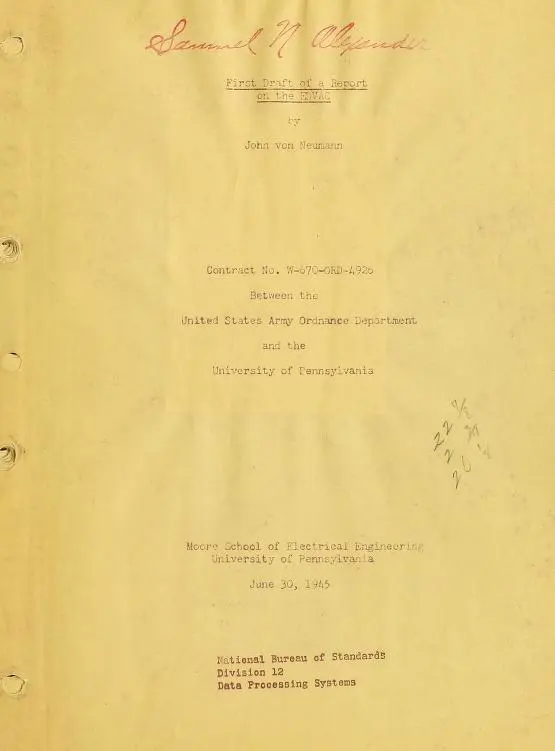
The title page is entirely unglamorous. "First Draft of a Report on the EDVAC / by / John von Neumann", then "Contract No. W-670-ORD-4926 / Between the / United States Army Ordnance Department / and the / University of Pennsylvania", then "Moore School of Electrical Engineering", then the date: June 30, 1945. No abstract, no binding — a typescript.
That typescript became the working drawing for nearly every computer built in the eighty years since.
Five organs and one bullet about memory
The report divides a computing machine into five "specific parts", which it also calls organs: a central arithmetic part CA, a central control CC (together, C), a memory M, an input I and an output O, plus R, the outside recording medium. The division we now say without thinking — processor, memory, I/O — was named here.
The decisive passage is the treatment of M. Section 2.4 enumerates the situations that demand memory, (a) through (h). Item (a) is partial results during arithmetic. Item (c) is function tables. Items (d) and (e) are initial conditions and intermediate results. And item (b) is this: "The instructions which govern a complicated problem may constitute a considerable material… This material must be remembered."
Instructions and numbers in the same store. What would come to be called the stored-program principle enters the document as one bullet in a list, with no fanfare whatever.
The second distinctive thing is the vocabulary. Von Neumann does not begin with vacuum tubes or relays but with an abstraction — the element, a relay-like thing with discrete equilibria — and in section 4.2 he draws the analogy with the neuron: all-or-none behaviour, excitatory and inhibitory synapses, synaptic delay. The report cites exactly one piece of literature in its entire length: Pitts and McCulloch's 1943 paper "A logical calculus of the ideas immanent in nervous activity". Only at 4.3 does he conclude that a very high speed device should use vacuum tubes, and even then he insists on conventional, commercially available types.
Writing the machine as logic rather than as engineering is what made the document portable. It described no particular hardware, so it fit all of it.
The title is not false modesty
The report is unfinished, and conspicuously so. As the editorial note to Michael D. Godfrey's 1993 typeset edition records, forward references to sections after 15.0 — sections von Neumann never wrote — are simply blank in the original. The sections on programming and on the input/output system are among the missing. The handwritten manuscript from which the Moore School typed it has never been found, and the typescript was evidently never proofread.
Godfrey also notes an early measure of the draft's reach: Alan Turing cites it in his proposal for the ACE at the National Physical Laboratory. An incomplete internal document was being read, and cited, as though it were a published paper.
Forty years of argument over credit
The report was circulated by Herman Goldstine, the Army's administrator on the project, and it carried von Neumann's name and no one else's. That is the origin of one of the longest credit disputes in the history of the field.
The editorial introduction to the Charles Babbage Institute reprint draws the line the record will actually bear. Moore School staff had begun considering storing instructions inside the machine at least eight months before von Neumann's involvement; the ideas that went into the report had been discussed in detail by J. Presper Eckert, John Mauchly, Arthur Burks, Goldstine and von Neumann before it was written. It is equally clear, the same passage continues, that von Neumann was an important catalyst and major contributor to those discussions, and that the description of the ideas in theoretical form, stripped of engineering detail, was his contribution alone. Much of the controversy that followed, it argues, comes from the differing values that practising scientists and engineers attach to theoretical constructs on the one hand and to feasibility, design and construction on the other.
So: not "von Neumann invented the stored program", and not "von Neumann took credit for other people's work" either. The record supports neither headline.
The document that killed the patent
Eckert and Mauchly were thinking commercially and expected to hold patents on both ENIAC and EDVAC. A report distributed without restriction, disclosing the design before they had filed, was exactly what they did not want. Their fear was well placed: a federal court later ruled that the 1945 distribution of the draft constituted public disclosure, and their patent claim, filed in 1947, could not stand.
The consequence was that nobody owned the stored-program computer. Teams at Manchester, Cambridge and Princeton could take the same architecture as their starting point without asking anyone's permission — an accident of paperwork with as much effect on the field as anything in the report itself.
The machine, eventually
EDVAC itself ran badly late. The construction contract came in April 1946; the machine was delivered to the Army's Ballistic Research Laboratory in 1949 and only entered limited service in 1951, with a mercury delay-line store of 1,024 words of 44 bits. By then the readers had outrun the subject: the Manchester Baby executed a program from memory in June 1948, and Cambridge's EDSAC went into useful service in 1949.
A design document that reached the world well before the machine it described — that is, in the end, the most accurate summary of what the First Draft was.
Questions this page answers
- Who wrote the First Draft of a Report on the EDVAC?
- The circulated typescript carried John von Neumann's name alone. Eckert and Mauchly disputed the attribution.
- Why did the First Draft void Eckert and Mauchly's patent?
- Because it circulated without restriction. A court later held that this amounted to a prior public disclosure, which voided their patent claim.
Sources
Last updated: