PERSON
John von Neumann
The Budapest-born mathematician who took his doctorate in 1926, came to Princeton in 1930, and in 1933 joined the Institute for Advanced Study as one of the six founding professors of mathematics, remaining until his death. Alongside the mathematical foundations of quantum mechanics (1932) and "Theory of Games and Economic Behavior" (1944) with Oskar Morgenstern, he consulted on the Manhattan Project and proposed the implosion method. His 1945 "First Draft of a Report on the EDVAC" was circulated under his name alone and became the most widely read description of the stored-program design — though how much of what it contains was his has been argued over ever since. The computer built at the IAS ran in 1952, and its design was copied in at least seventeen places.
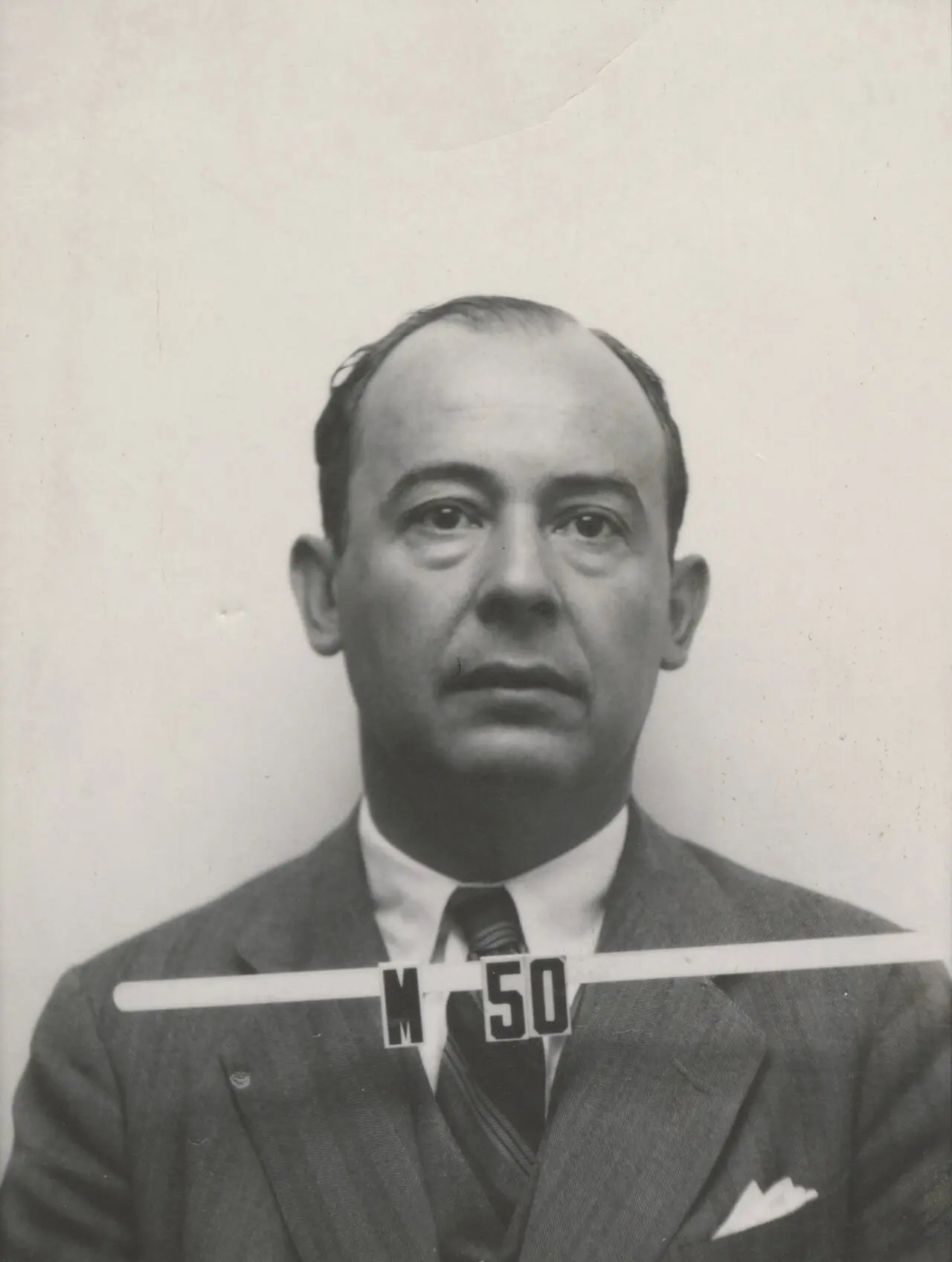
Profile
- Born
- 1903
- Died
- 1957
- Span
- 54 years
- Appearances
- 02
- Name
- ENJohn von NeumannJAジョン・フォン・ノイマン
John von Neumann (28 December 1903 – 8 February 1957) left marks across a startling range of twentieth-century subjects: set theory, quantum mechanics, game theory, numerical analysis, computer design, nuclear weapons. In computing his name survives not as a person but as the name of a shape — the von Neumann architecture.
Budapest, Princeton, Los Alamos
Born in Budapest, he took his doctorate in mathematics from the University of Budapest in 1926, at twenty-two, with a thesis on set theory. He was invited to Princeton to lecture on quantum theory in 1929, became a visiting lecturer in 1930 and a professor in 1931, and in 1933 joined the Institute for Advanced Study as one of the six founding professors of its School of Mathematics. He stayed there for the rest of his life.
Mathematische Grundlagen der Quantenmechanik (1932) gave the then-unruly new quantum mechanics a rigorous mathematical frame. In 1944, with Oskar Morgenstern, he published Theory of Games and Economic Behavior, which established game theory as a field.
During the war he consulted on the Manhattan Project; the proposal of the implosion method for bringing nuclear fuel to detonation is among the contributions credited to him. From 1940 to 1955 he held advisory positions at a series of military laboratories.
How he arrived at computers
Los Alamos got him there. The computing his weapons work required was beyond what Bell Labs or Harvard could supply, and in 1944 he learned by accident that computing instruments were being built at the University of Pennsylvania's Moore School. On his first visit he found ENIAC fully designed but not finished, and work on EDVAC just beginning. He arranged for the Los Alamos calculation to be ENIAC's first major job, and served for the next year and a half as a consultant to the EDVAC project.
Out of that came the First Draft of a Report on the EDVAC, dated 30 June 1945: a machine divided into CA, CC, M, I and O, holding instructions and numbers in the same store, described in the language of logic with the vacuum tubes stripped out. That it went out bearing his name and no one else's is the origin of a forty-year argument over credit. What the record supports is both halves of an uncomfortable answer — the ideas came out of discussions among Eckert, Mauchly, Burks, Goldstine and von Neumann, and the description of those ideas as theory, with the engineering removed, was his alone.
In the spring of 1947 he suggested to R. F. Clippinger that ENIAC could be run in a way completely unlike its design intent, interpreting an order code set into its function tables. Ballistic Research Laboratories Report No. 673 describes his role in working that out as a central one.
The IAS machine
Von Neumann also built. The computer produced by the Institute for Advanced Study's Electronic Computer Project became operational in 1952 and did substantial work for the American atomic weapons programme. Its design was copied in at least seventeen places, which is why the era is full of similar-sounding names: MANIAC at Los Alamos, ILLIAC at Illinois, JOHNNIAC at RAND, SILLIAC in Australia. Unlike a commercial machine, the IAS design was published — which is precisely what made the copying easy.
In his last years he worked on automata theory and the logic of self-reproducing machines.
Honours
The Bôcher Memorial Prize in 1938, the Medal for Merit in 1947, the presidency of the American Mathematical Society from 1951 to 1953, and in 1956 the Enrico Fermi Award, the highest honour in the American nuclear programme. He was hospitalised with cancer the same year and died in Washington, D.C., on 8 February 1957, aged fifty-three.
"Von Neumann architecture" is a convenient label and a slightly false one. What it actually names is not one man's invention but the historical fact that one unfinished draft was read by everybody.
Appearances
Sources
Last updated: