T1
The Expert-Systems Boom
Metadata
- Date
- Decade
- 1980s
- Tier
- T1
- Timelines
- A History of Artificial Intelligence
- Sources
- 11
- Connections
- 01
An expert system is an artificial-intelligence program that captures a specialist's knowledge as if-then rules and follows those rules to give expert-level judgements or advice. It has two main parts: a knowledge base holding the rules, and an inference engine that chains them together to reach conclusions. The line began with DENDRAL at Stanford in the mid-1960s, took its classic form in MYCIN in the 1970s, and became a business when DEC put R1 (later called XCON) to work in January 1980; through the 1980s expert systems were the centre of an industrial AI boom. In the same years Japan's Ministry of International Trade and Industry ran the Fifth Generation Computer project.
Definition: writing down expert judgement as rules
Buchanan and Shortliffe's 1984 book on the MYCIN work describes an expert system as an AI program designed (a) to provide expert-level solutions to complex problems, (b) to be understandable, and (c) to be flexible enough to accommodate new knowledge easily. MYCIN's knowledge was represented mostly as conditional statements of this form:
IF: There is evidence that A and B are true, THEN: Conclude there is evidence that C is true.
Keeping the rules separate from the reasoning procedure meant a system could grow simply by experts adding and correcting rules. Mapping an expert's knowledge into a program's knowledge base was called knowledge engineering. According to the same book, Edward Feigenbaum coined that term, and it — like "expert system" itself — came into general use only around 1975.
Three landmark systems
| System | When | Built by | Domain | What it did |
|---|---|---|---|---|
| DENDRAL | Begun in the mid-1960s | Stanford (Joshua Lederberg, Edward Feigenbaum) | Organic chemistry | Inferred the molecular structure of unknown compounds from analytic data; described as the first AI program to emphasise specialised knowledge over general problem solving |
| MYCIN | 1970s | Stanford (Edward Shortliffe, Bruce Buchanan and others) | Infectious disease | Advised on antimicrobial therapy for bacteremia, later meningitis; written in Interlisp, handling uncertainty with certainty factors |
| R1 (XCON) | In regular use from January 1980 | Carnegie Mellon (John McDermott) with DEC | Computer configuration | Turned customer orders into VAX-11/780 configurations, adding missing components |
DENDRAL was started in the mid-1960s by Lederberg and Feigenbaum as an investigation of AI techniques for forming hypotheses. Buchanan and Shortliffe call it the first AI program to emphasise the power of specialised knowledge over generalised problem-solving methods, and record that, with Feigenbaum's advocacy, much of its knowledge was recoded into rules.
MYCIN advised physicians, through a consultative dialogue, on which antimicrobial drugs to give patients with bacterial infections. In an evaluation published in JAMA in 1979, eight outside experts rated, without knowing who had written them, the prescriptions for ten meningitis cases from MYCIN and from nine human sources: five Stanford faculty members, an infectious-disease fellow, a resident, a student and the therapy actually given. Sixty-five percent of MYCIN's prescriptions were rated acceptable; the five faculty specialists ranged from 42.5% to 62.5%, with a mean of 55.5%. EMYCIN, written largely by William van Melle for his dissertation, answered the question of whether MYCIN could be generalised, and became a tool for building other rule-based expert systems.
R1 stood apart because it was used every day outside the laboratory. McDermott's 1980 paper says R1 took a customer's order and produced diagrams showing how the components fitted together, for the technician who assembled the system; noticing what was missing from an order and adding it was a major part of the job. As of June 1980 it had 772 rules, had configured more than 500 orders since January 1980, was integrated into DEC's manufacturing organisation, and was starting to be used by sales. Inside DEC it was known as XCON.
The 1980s boom
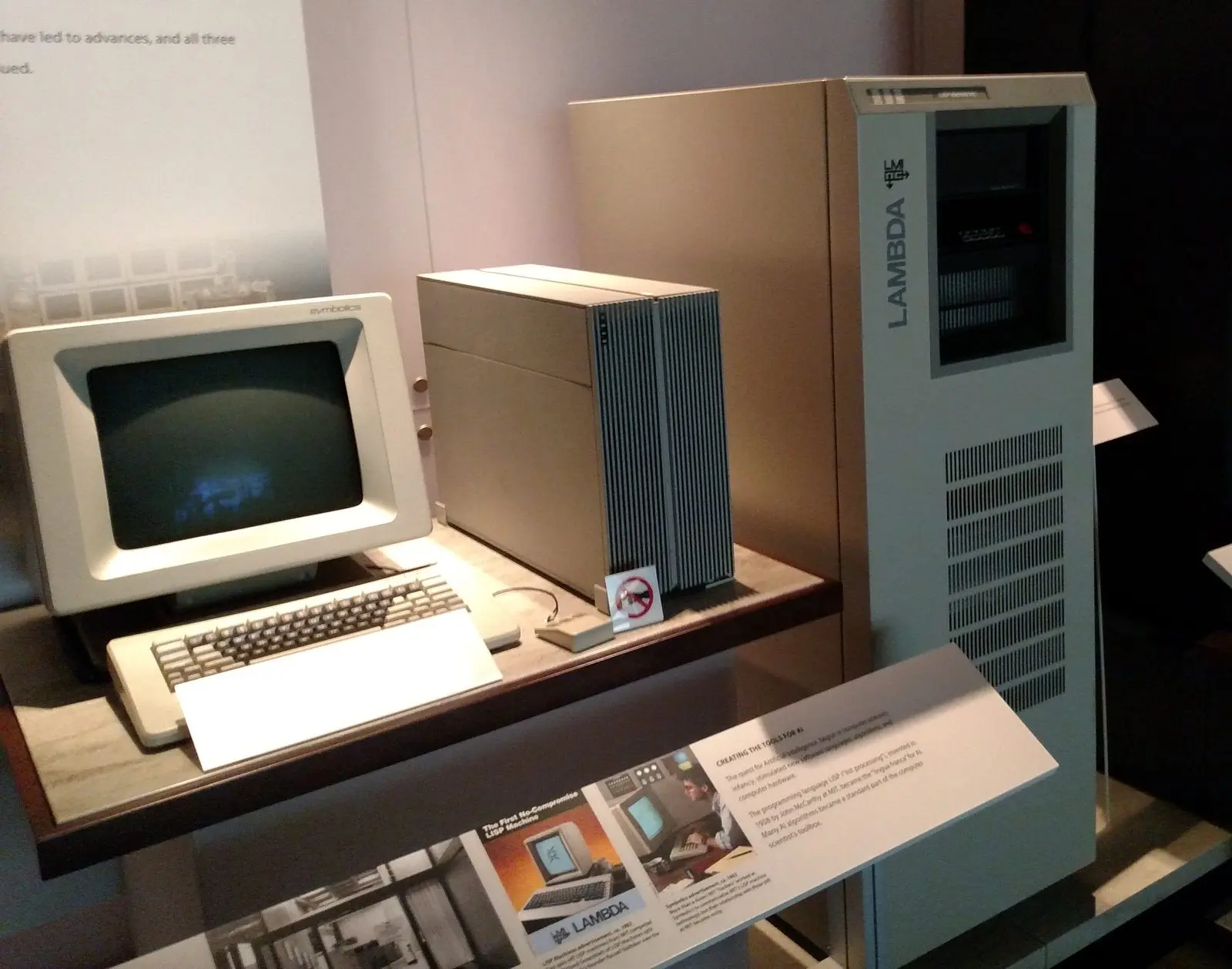
As the successes became known, companies set up in-house AI departments. Wikipedia, citing Daniel Crevier's 1993 history of AI, says that by 1985 corporations were spending over a billion dollars a year on AI, most of it on those in-house departments. Lisp was the language of choice for AI programs, and companies appeared that sold machines built to run Lisp fast; the photograph on this page shows two of them, from Symbolics and LMI.
Expert systems also became a selling point for new hardware. When Acorn announced an evaluation system for its ARM processor in July 1986, the press release listed expert systems among the target applications, alongside communications and microcomputers (history of ARM).
Japan's Fifth Generation project
In 1982 Japan's Ministry of International Trade and Industry started the Fifth Generation Computer project. According to the Information Processing Society of Japan's computer museum, the technical goal was research and development on new computer technology oriented toward knowledge-based information processing, and the Institute for New Generation Computer Technology (ICOT) was set up to drive it. The project built large parallel machines called parallel inference machines (PIM), among them the 512-processor PIM/p and the 256-processor PIM/m.
| Start | 1982 (Ministry of International Trade and Industry) |
| Organisation | Institute for New Generation Computer Technology (ICOT) |
| Technical goal | New computer technology oriented toward knowledge-based information processing |
| Main hardware | Parallel inference machines (PIM/p with 512 processors, PIM/m with 256) |
| Duration and cost | About ¥54 billion over 11 years, ending with fiscal 1992 |
| Today | PIM/p and PIM/m are preserved at the National Museum of Nature and Science, Tokyo |
If expert systems were the technique of writing rules down, the Fifth Generation was a national attempt to build computers that could reason with such knowledge at speed.
Why the boom ended
The boom cooled at the end of the 1980s. Wikipedia's article on the AI winter names two causes. In 1987 the market for specialised Lisp hardware collapsed, as general-purpose workstations from Sun, Apple and IBM did the same work more cheaply. And the expert systems themselves proved too expensive to maintain: hard to update, unable to learn, and brittle when faced with inputs their rules had not anticipated. The slump is called the second AI winter, after the first of the 1970s.
Writing rules by hand meant that the more knowledge a system held, the heavier the burden of writing and maintaining it. From the 2010s the mainstream of AI moved to deep learning, which learns from data rather than from hand-written rules; see AlexNet for the turning point.
The surrounding history is on the AI timeline; the language MYCIN was built on is on LISP.
Questions this page answers
- What is an expert system?
- An AI program that captures a specialist's knowledge as if-then rules and follows them to give expert-level judgements or advice. It consists of a knowledge base holding the rules and an inference engine that chains them into conclusions.
- What are the best-known expert systems?
- DENDRAL, a chemistry program begun at Stanford in the mid-1960s; MYCIN, built at Stanford in the 1970s to advise on antimicrobial therapy; and R1 (called XCON inside DEC), built by John McDermott of Carnegie Mellon with DEC and used to configure VAX-11/780 orders from January 1980.
- What was the Fifth Generation Computer project?
- A national project started by Japan's Ministry of International Trade and Industry in 1982 to develop new computer technology for knowledge-based information processing. ICOT built parallel inference machines (PIM). About ¥54 billion was spent over 11 years, and the project ended with fiscal 1992.
- What ended the expert-systems boom?
- Around 1987 the market for specialised Lisp machines collapsed as general-purpose workstations from Sun, IBM and others took over, and expert systems proved expensive to maintain, hard to update, unable to learn and brittle with unexpected inputs. The slump is called the second AI winter.
Sources
Chapter 1: the definition, knowledge base and inference engine, rule form, origin of knowledge engineering, and DENDRAL's place. Chapter 31: the 1979 evaluation (65% versus faculty 42.5–62.5%)
VAX-11/780 configuration, OPS4, 772 rules, more than 500 orders since January 1980, and regular use in DEC manufacturing
R1 being known inside DEC as XCON
Secondary第五世代コンピュータ — 情報処理学会 コンピュータ博物館
The 1982 start, ICOT, the technical goal, PIM/p and PIM/m, about ¥54 billion over 11 years, the end in fiscal 1992, and preservation at the National Museum of Nature and Science
TertiaryExpert system — Wikipedia
TertiaryAI winter — Wikipedia
The 1987 collapse of the Lisp-machine market, maintenance cost and brittleness, and corporate AI spending in 1985 as cited from Crevier (1993)
Last updated: