T1#labor
AlphaGo Defeats Lee Sedol
Metadata
- Date
- Decade
- 2010s
- Tier
- T1
- Sources
- 08
- Connections
- 05
- Tags
- #labor
On 10 March 2016, in the second game of the match, AlphaGo placed its 37th move on the right-hand side of the board, and the professional commentators did not know what to make of it. "That's a very strange move," said one, according to WIRED's report from the venue; "I thought it was a mistake," said the other. Lee Sedol left the match room and took nearly fifteen minutes to answer.
The match is usually summarised by its score. The more instructive record is what happened around two moves — one by the machine, one by the man — and what the people who built the machine said about them afterwards.
Before Seoul: AlphaGo and Fan Hui
AlphaGo's first public result came from a match nobody watched live. In October 2015 it played Fan Hui, the three-time European champion, behind closed doors and won five games to none. DeepMind submitted the paper describing the system to Nature on 11 November 2015; it was published online on 27 January 2016 as "Mastering the game of Go with deep neural networks and tree search", with twenty authors led by David Silver and Aja Huang and including Demis Hassabis.
The abstract made two claims that framed everything that followed. Against other Go programs, AlphaGo had won 99.8% of its games. And the Fan Hui result was "the first time that a computer program has defeated a human professional player in the full-sized game of Go, a feat previously thought to be at least a decade away." Fan Hui was a professional; Lee Sedol was one of the strongest players in the world. The March match was the test of whether the paper's result would survive contact with the top of the game.
How AlphaGo Chose Its Moves
The Nature paper describes three ingredients.
- Policy networks that propose promising moves. They were first trained by supervised learning to predict the moves of human experts, then improved by reinforcement learning from games the program played against itself.
- A value network that looks at a position and estimates who is winning, so the program does not have to play every line out to the end.
- Monte Carlo tree search, the search method that had driven the strongest Go programs before AlphaGo, now guided by the two networks.
The paper notes that the networks alone, with no lookahead at all, already played at the level of the best search-based programs. The combination is what beat professionals. This is the important distinction from IBM's Deep Blue in chess two decades earlier: Deep Blue's evaluation was mostly written and tuned by hand, while AlphaGo's judgement of a position was learned.
The Five Games of AlphaGo vs Lee Sedol
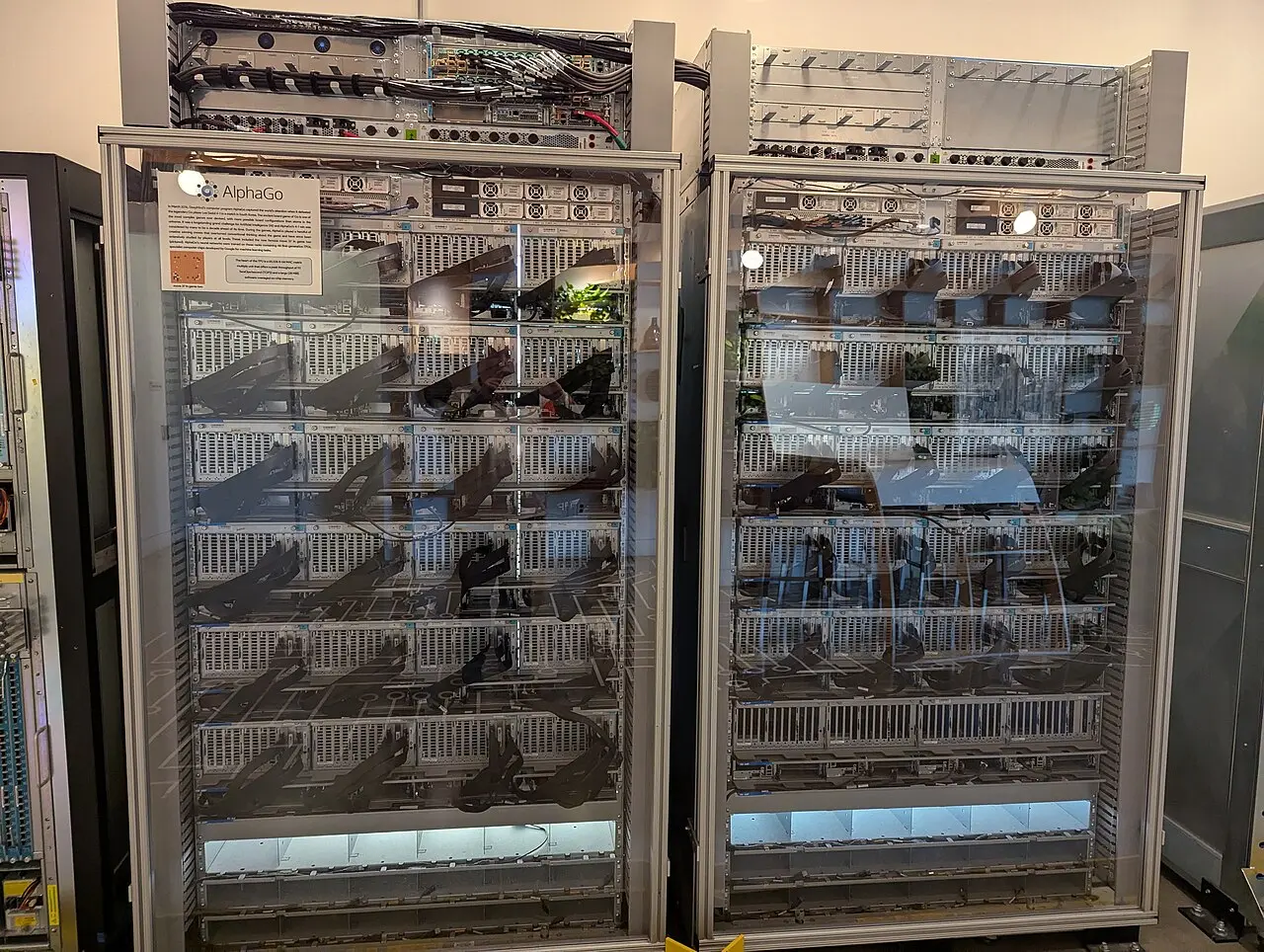
The match was played at the Four Seasons Hotel in Seoul under Chinese rules with 7.5 points of komi. Each side had two hours plus three 60-second overtime periods. Aja Huang sat across from Lee and placed AlphaGo's stones; the distributed version of the program ran on 1,920 CPUs and 280 GPUs.
| Game | Date | Winner | Moves |
|---|---|---|---|
| 1 | 9 March | AlphaGo (White) | 186 |
| 2 | 10 March | AlphaGo (Black) | 211 |
| 3 | 12 March | AlphaGo (White) | 176 |
| 4 | 13 March | Lee Sedol (White) | 180 |
| 5 | 15 March | AlphaGo (White) | 280 |
By the end of game 3 AlphaGo had won the series, but the remaining games were played out. The fifth, which The Korea Times described as close until the end, went 280 moves before Lee resigned.
Move 37 and Move 78
What made move 37 of game 2 notable was not only that it worked. According to David Silver, who led the project, AlphaGo had itself calculated that there was a one-in-ten-thousand chance that a human player would make that move, and played it anyway because its own search and evaluation preferred it. It was a shoulder hit, a familiar kind of move played in an unfamiliar place, and it turned the game in AlphaGo's favour. Fan Hui, who had by then spent five months playing the program, kept repeating "So beautiful" to WIRED's reporter.
Game 4 produced the mirror image. With Lee 0–3 down, he thought for about thirty minutes before playing move 78, a wedge in the centre of the board. AlphaGo responded badly on the next move while still believing it was ahead; by move 87 its own estimate of its chances collapsed, and it played a run of weak moves before resigning. Go players called Lee's move "God's Touch" — the name DeepMind uses for it too — and the Chinese professional Gu Li called it a divine move. Afterwards Hassabis explained that AlphaGo had not been prepared for it, because it had put the chance of a human playing it at one in ten thousand. The same odds, in the other direction.
Prize, Rank and Audience
The prize was US$1 million, and because AlphaGo won it, DeepMind donated it to charities, including UNICEF and Go organisations. The Korea Baduk Association gave AlphaGo an honorary 9-dan rank, which DeepMind describes as the highest possible certification and the first awarded to a computer Go player. DeepMind's own figure for the audience is over 200 million people worldwide.
After the Match
DeepMind did not stop at the version that played Lee. In October 2017 Nature published "Mastering the game of Go without human knowledge", introducing AlphaGo Zero, which learned only from self-play, with no human games and no domain knowledge beyond the rules. The abstract reports that it won 100–0 against "the previously published, champion-defeating AlphaGo". The supervised-learning stage that had seemed essential in 2016 turned out not to be.
For Lee Sedol, the match became the frame for the rest of his career. In November 2019 he retired from professional Go and told Yonhap that the rise of AI was the reason: even if he became the best player, there would be an entity he could not defeat.
The lab's own trajectory after Go — through protein structure prediction to a Nobel Prize — is covered on the DeepMind and Hassabis pages rather than repeated here. Where the match sits in the longer history of AI is on the AI timeline, between the ImageNet result of 2012 that revived deep learning and the Transformer paper of the following year.
Questions this page answers
- When did AlphaGo play Lee Sedol, and who won?
- The five-game series ran in Seoul from 9 to 15 March 2016, and AlphaGo won it 4-1. Lee Sedol took only game 4, on 13 March.
- Why is move 37 of game 2 famous?
- It was a shoulder hit that AlphaGo itself rated a one-in-ten-thousand human choice, so unusual that commentators first suspected a mistake, and it helped win game 2. In game 4 Lee answered with move 78, which AlphaGo had rated at the same odds, and which came to be called the divine move.
- How did AlphaGo learn to play?
- According to the 2016 Nature paper, it combined policy networks trained by supervised learning on human expert games and by reinforcement learning from self-play, plus a value network that evaluated positions, with Monte Carlo tree search. Its successor AlphaGo Zero, announced in 2017, used no human games at all.
Sources
PrimarySilver, D. et al. (2017). Mastering the game of Go without human knowledge. Nature 550, 354–359
Reports AlphaGo Zero beating the champion-defeating AlphaGo 100-0
SecondaryMetz, C. In Two Moves, AlphaGo and Lee Sedol Redefined the Future — WIRED, 16 March 2016
Both moves 37 and 78 rated one in ten thousand by AlphaGo (as explained by David Silver and Demis Hassabis); move 78 as a central wedge
Last updated: