PERSON
Jensen Huang
Co-founder of NVIDIA, and its president, chief executive officer and a board member since the company's inception in 1993. Born in Taiwan and brought to the United States as a child, he took a BSEE at Oregon State University in 1984 and an MSEE at Stanford in 1992. He was a microprocessor designer at AMD from 1983 and at LSI Logic from 1985 before founding NVIDIA with Chris Malachowsky and Curtis Priem. In March 2026 he was appointed to the President's Council of Advisors on Science and Technology.
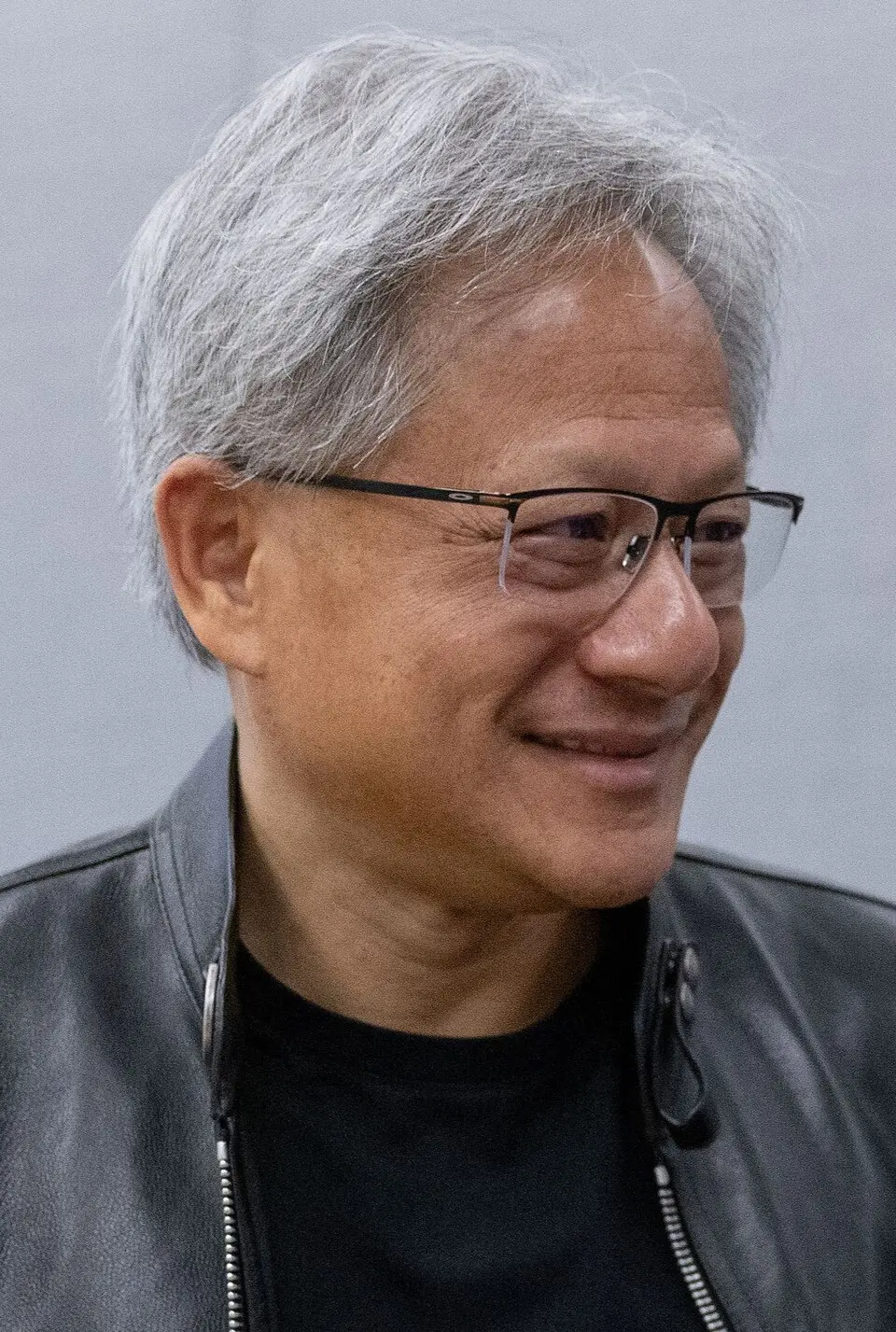
Profile
- Born
- 1963
- Status
- Living
- Span
- 1963–
- Appearances
- 03
- Name
- ENJensen HuangJAジェンスン・フアン
Jensen Huang (Huang Jen-Hsun, 黃仁勳; born 17 February 1963) co-founded NVIDIA and has been its president, chief executive officer and a member of its board since the company's inception in 1993. NVIDIA's fiscal 2026 Form 10-K lists his age as 63 as of 20 February 2026. Few founders in the semiconductor industry have run the same company for thirty-three years. NVIDIA's official biography and Oregon State University say only that he came from Taiwan; the English Wikipedia names Taipei as his birthplace and says he moved to Tainan as a child.
Childhood and education
His family later moved to Thailand, and amid unrest there he and his older brother were sent to relatives in the United States. Believing it to be a prestigious boarding school, those relatives enrolled the boys at the Oneida Baptist Institute in Kentucky. Oregon State University's published biography describes him as "inadvertently placed with his older brother in a reform school in rural Kentucky," and quotes him: "I loved going to school there and it's where I first learned about America."
His first job, at fifteen, was at a Denny's in Portland. "I was a dishwasher, I was a busboy, I waited tables," he told NVIDIA's own blog years later, adding that no one can carry more coffee cups than he can.
Once the family was reunited in Oregon he became a nationally ranked junior table tennis player and finished high school in Beaverton. At Oregon State he read electrical engineering; his lab partner in the fundamentals course was Lori Mills, whom he married five years later. He took his bachelor's degree in 1984. "I enjoyed computers growing up, but OSU opened up my eyes to the magic behind them," he has said.
His employment history is recorded precisely in SEC filings. From 1983 to 1985 he was a microprocessor designer at AMD; from 1985 to 1993 he was at LSI Logic, where his roles included Director of Coreware, the business unit responsible for the company's system-on-chip work. He completed his Stanford MSEE in 1992, while working full time.
Founding
In 1993 Huang, Chris Malachowsky and Curtis Priem met at a Silicon Valley Denny's to discuss a chip that would enable realistic 3D graphics on personal computers. Huang, who lived nearby at the time, has given a practical reason for the venue: "It had all the coffee you could drink and no one could chase you out." On 26 September 2023 a plaque was unveiled at that restaurant.
The corporate arc — the failure of the NV1, the recovery through RIVA 128, the January 1999 listing, the pivot to the data centre — is set out on the NVIDIA page.
Thirty-three years as CEO
Even the count of founders is inconsistent inside the company's own documents. The newsroom biography says "Jensen Huang founded NVIDIA in 1993"; the 10-K says "Jen-Hsun Huang co-founded NVIDIA in 1993." His signature on SEC filings is consistently Jen-Hsun Huang.
The technical milestones — CUDA, the H100, Blackwell B200, the brief run to the world's largest market capitalisation — have each been delivered as a keynote by him, at GTC or CES. The technical explanation, the demand forecast and the industry narrative all issue from the same person, and should be read alongside the fact that the performance figures quoted for NVIDIA GPUs are almost always the company's own.
His decisions run on long clocks. Roughly five to six years separated the launch of general-purpose computing on the GPU from AlexNet demonstrating that it worked, and more than a decade separated that from the data centre becoming the bulk of NVIDIA's revenue.
Awards and honours
The following are as listed in NVIDIA's official biography, which does not date them.
- Elected to the US National Academy of Engineering
- The Semiconductor Industry Association's Robert N. Noyce Award
- The IEEE Founder's Medal
- The Dr. Morris Chang Exemplary Leadership Award
- Honorary doctorates from National Chiao Tung University, National Taiwan University, Oregon State University, Huazhong University of Science and Technology, and Linköping University
- Named the world's best CEO by Fortune, The Economist and Brand Finance, and one of TIME's 100 most influential people
Two entries can be dated: induction into the Oregon State University College of Engineering Hall of Fame in 2013, and appointment to the President's Council of Advisors on Science and Technology, announced by the White House on 25 March 2026.
Current activities
He now sits on PCAST while running the company most directly exposed to US export controls on China — a position that requires him in both Washington and Beijing. Delivering the keynote at Carnegie Mellon University's 128th commencement in May 2026, he told the graduates, "You are entering the world at an extraordinary moment," and went on: "A new industry is being born. A new era of science and discovery is beginning."
Legacy
What makes Huang difficult to assess is that the industry's narrator and its principal beneficiary are the same person. The scale of AI compute demand is described, the products that meet that demand are sold, and the benchmarks for those products are published, by one company — and the voice has not changed since 1993. It is a rare case of individual judgement shaping an industry over decades, and equally a structure in which that judgement is hard to audit from outside. The financial and geopolitical figures are set out on the organization page.
Appearances
Questions this page answers
- Who is the CEO of NVIDIA?
- Jensen Huang, its co-founder. He has been NVIDIA's president, chief executive officer and a board member since the company's founding in 1993.
- Where is Jensen Huang from?
- He was born in Taiwan; the English Wikipedia gives Taipei and says he moved to Tainan as a child, while NVIDIA's official biography names no city. As a child he and his older brother were sent to relatives in the United States, and after a school in Kentucky he grew up in Oregon.
- What did Jensen Huang do before NVIDIA?
- He was a microprocessor designer at AMD from 1983 to 1985 and worked at LSI Logic from 1985 to 1993. He holds an electrical engineering bachelor's from Oregon State (1984) and a master's from Stanford (1992).
- Where was NVIDIA started?
- In 1993 Huang, Chris Malachowsky and Curtis Priem met at a Denny's in Silicon Valley to discuss a chip for realistic 3D graphics on PCs. A plaque was unveiled at that restaurant on 26 September 2023.
Sources
PrimaryJensen Huang — NVIDIA Newsroom Executive Bios
NVIDIA's official biography
PrimaryNVIDIA Corporation, Annual Report on Form 10-K for the fiscal year ended January 25, 2026
Ages and careers of the executive officers
SecondaryJen-Hsun Huang: Engineering Hall of Fame - 2013 — Oregon State University College of Engineering
Education, childhood, and his own remarks
TertiaryJensen Huang — Wikipedia
Date of birth, birthplace (Taipei) and childhood move to Tainan, and the Oneida Baptist Institute
Last updated: