T1#research
AlphaFold 2 — Reading a Protein's Shape from Its Sequence
Metadata
- Date
- Decade
- 2020s
- Tier
- T1
- Timelines
- A History of Artificial Intelligence
- Sources
- 10
- Connections
- 06
- Tags
- #research
AlphaFold is an AI system from DeepMind (now Google DeepMind) that predicts the three-dimensional structure of a protein from its amino-acid sequence. Its turning point came on 30 November 2020, when the results of CASP14, the fourteenth round of the international blind assessment of structure prediction, were released: AlphaFold scored a median GDT of 92.4 across all targets. The CASP organisers concluded that AlphaFold2 produced models competitive with experimental accuracy for at least two-thirds of the targets. The peer-reviewed methods paper appeared in Nature on 15 July 2021, and a free database of predicted structures opened the same month.
If you want a one-line answer to "what is AlphaFold", it is software that brought computed structures close enough to experiment to be useful, for a task that could take years in the laboratory. Note the order of events, though: in November 2020 what was published was the assessment result and a blog post. The paper and the code came the following July.
The problem of predicting a protein's shape
A protein is a chain of amino acids, and much of what it does depends on the 3D shape into which that chain folds. DeepMind's announcement traces the problem to Christian Anfinsen's lecture for the 1972 Nobel Prize in Chemistry, in which he postulated that the amino-acid sequence should fully determine the structure.
The experimental methods, X-ray crystallography, nuclear magnetic resonance and cryo-electron microscopy, can take years per structure and need multi-million-dollar equipment. According to DeepMind, in 2020 the UniProt sequence database held 180 million protein sequences, while the Protein Data Bank (PDB), which collects experimentally determined structures, held only around 170,000.
CASP14: the results of 30 November 2020
CASP (Critical Assessment of protein Structure Prediction) is a biennial blind assessment founded in 1994 by John Moult and Krzysztof Fidelis. Its targets are structures that have only just been determined experimentally and are not yet public, so teams submit predictions without knowing the answer. The main metric is the Global Distance Test (GDT), which runs from 0 to 100 and can be read roughly as the percentage of amino-acid residues within a threshold distance of their correct position.
| Measure | AlphaFold at CASP14 | Source |
|---|---|---|
| Median GDT, all targets | 92.4 | DeepMind, 30 Nov 2020 |
| Median GDT, hardest free-modelling category | 87.0 | Same |
| Average error (RMSD) | About 1.6 Å | Same |
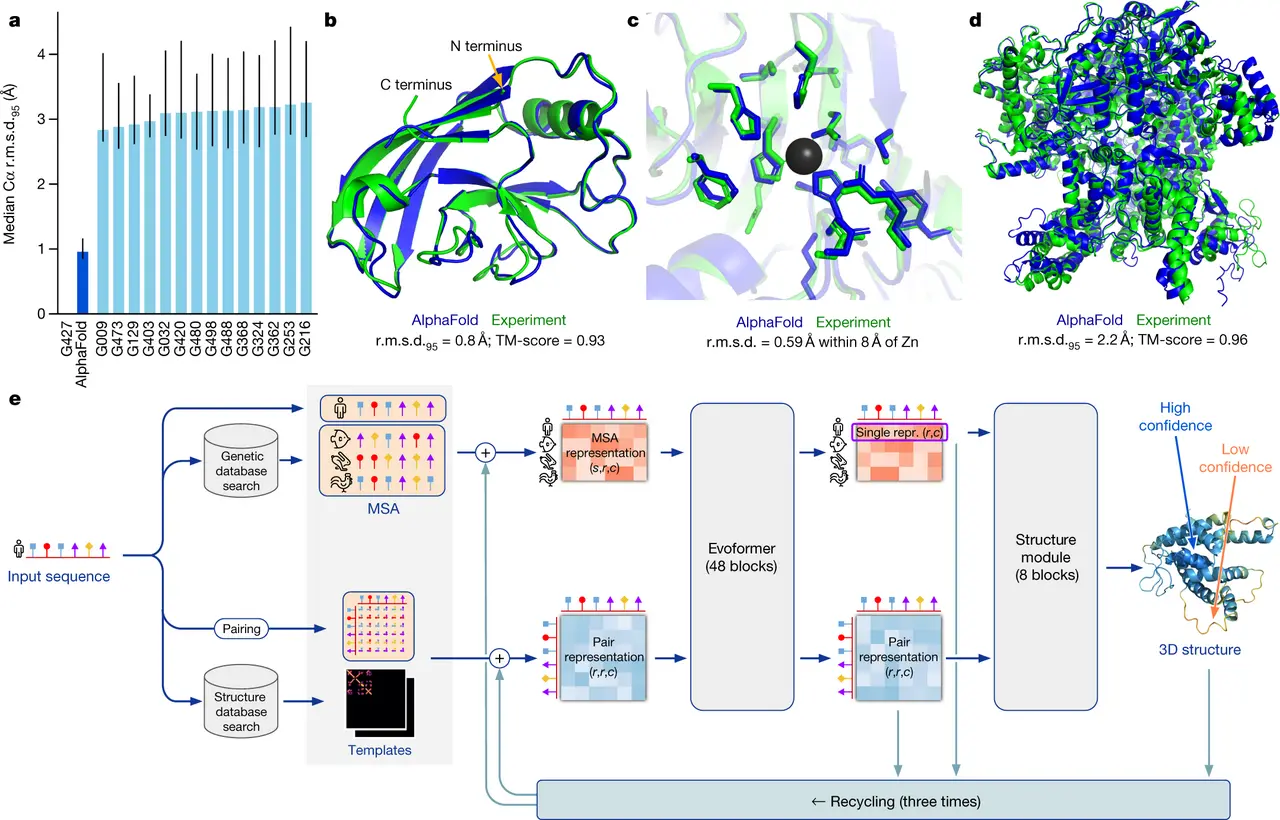
| Median backbone accuracy (r.m.s.d.95) | 0.96 Å (next best method: 2.8 Å) | Nature paper, 2021 |
| Models competitive with experiment | At least two-thirds of targets | CASP organisers' summary |
According to DeepMind, Moult explained that a GDT of around 90 is informally considered competitive with results obtained from experimental methods. The Nature paper offers a yardstick: a carbon atom is about 1.4 Å wide. The organisers' summary records that about two-thirds of the 96 targets passed a GDT_TS of roughly 90, that this performance was dominated by AlphaFold2 (group 427 in the results tables), and that other groups had also improved substantially.
DeepMind's announcement carried this comment from Moult: "We have been stuck on this one problem – how do proteins fold up – for nearly 50 years."
What changed since the 2018 version
DeepMind first entered CASP in 2018, at CASP13. That first AlphaFold also achieved the highest accuracy among participants, and its methods were published in Nature with code. The CASP14 system, in DeepMind's words, was driven by new deep-learning architectures.
DeepMind described a folded protein as a "spatial graph", with residues as nodes and edges joining residues in close proximity, and built an attention-based neural network, trained end to end, to interpret it. The inputs are a multiple sequence alignment (MSA) of evolutionarily related sequences and a representation of pairs of residues. The Nature paper names the core of the network the Evoformer and shows information passing repeatedly between the MSA representation and the pair representation. The system also outputs a confidence measure that says which parts of a predicted structure are reliable.
It was trained on about 170,000 public structures from the PDB together with large databases of sequences of unknown structure, using about 16 TPUv3s (128 TPUv3 cores) over a few weeks, which DeepMind called a relatively modest amount of compute for a state-of-the-art machine-learning model.
COVID-19, the paper and the database
Earlier in 2020 DeepMind had published predicted structures for several SARS-CoV-2 proteins whose structures were unknown, including ORF3a, and at CASP14 it predicted another coronavirus protein, ORF8. Experimentalists later determined both structures, and the predictions matched them with high accuracy.
| Date | Event |
|---|---|
| 2018 | First AlphaFold achieves the highest accuracy at CASP13 |
| 30 Nov 2020 | CASP14 results released; median GDT 92.4 |
| 15 Jul 2021 | Methods paper in Nature; source code published around the same time |
| Jul 2021 | AlphaFold Protein Structure Database opens with EMBL-EBI (over 350,000 structures) |
| 28 Jul 2022 | Database expanded to over 200 million structures |
| 8 May 2024 | AlphaFold 3 announced |
| Nov 2024 | AlphaFold 3 code and weights released for academic use |
When the database opened in July 2021, Demis Hassabis wrote that it would share predictions for every protein in the human body and for 20 other organisms that scientists rely on. According to EMBL, it launched with more than 350,000 predictions including the entire human proteome, and in July 2022 it grew to over 200 million, covering nearly all catalogued proteins known to science.
On the same day as the AlphaFold paper, 15 July 2021, David Baker's lab at the University of Washington reported RoseTTAFold in Science, a "three-track" network that reasons over sequence, residue-pair relationships and 3D structure together, and released its code. Structure prediction had become a field, not a single company's method.
AlphaFold 3 and after
On 8 May 2024 Google DeepMind and the drug-discovery company Isomorphic Labs announced AlphaFold 3, which predicts not only proteins but their interactions with DNA, RNA, ligands and other molecules. The developers claim at least a 50% improvement over existing methods for interactions between proteins and other molecule types; that is their own assessment. The model code and weights were released for academic use six months later, in November 2024.
The same year, AlphaFold2's structure prediction was cited in the 2024 Nobel Prize in Chemistry; that page covers the award and the committee's words.
In a five-year retrospective in November 2025, Google DeepMind said the database had been used by over 3 million researchers in more than 190 countries. From the start, though, DeepMind's own announcement said that not every predicted structure would be perfect, and that much remained to learn about how proteins form complexes and interact with DNA, RNA and small molecules. AlphaFold 3 can be read as an attempt to answer part of that list. On 19 June 2026 it was reported that John Jumper, who led the AlphaFold team, was leaving Google DeepMind to join Anthropic.
The lab's wider history is on the DeepMind and Demis Hassabis pages, and the surrounding events are on the AI timeline. For an earlier DeepMind landmark, see AlphaGo.
Questions this page answers
- What is AlphaFold?
- It is an AI system from DeepMind (now Google DeepMind) that predicts a protein's three-dimensional structure from its amino-acid sequence. The first version entered CASP13 in 2018; a heavily revised version, AlphaFold 2, reached accuracy competitive with experiment at CASP14 in 2020.
- When was AlphaFold 2 announced?
- On 30 November 2020, when the CASP14 results were released and DeepMind announced the result on its blog. The peer-reviewed methods paper followed in Nature on 15 July 2021, together with the source code.
- How many structures are in the AlphaFold database?
- It opened in July 2021 with more than 350,000 predictions, including the entire human proteome. In July 2022 it expanded to over 200 million, covering nearly all catalogued proteins. It is run jointly by DeepMind and EMBL-EBI and is free to use.
- How is AlphaFold 3 different?
- Announced by Google DeepMind and Isomorphic Labs on 8 May 2024, it predicts not just single proteins but their interactions with DNA, RNA, ligands and other molecules. Its developers claim at least a 50% improvement over existing methods for protein interactions with other molecule types. The model code and weights were released for academic use in November 2024.
Sources
PrimaryAlphaFold: a solution to a 50-year-old grand challenge in biology — Google DeepMind, Nov 30, 2020
Release of the CASP14 results; median GDT 92.4, 87.0 in free modelling, about 1.6 Å error; Moult on GDT 90; training on about 170,000 PDB structures with about 16 TPUv3s over a few weeks; ORF3a and ORF8
Median backbone accuracy of 0.96 Å at CASP14 against 2.8 Å for the next best method; a carbon atom about 1.4 Å wide; the Evoformer
The organisers' summary: AlphaFold2 (group 427) competitive with experiment for at least two-thirds of targets; about two-thirds of the 96 targets above roughly GDT_TS 90
The database launch; paper and source code published the previous week; every human protein plus 20 other organisms
Expansion from more than 350,000 structures in July 2021 to over 200 million
PrimaryAlphaFold 3 predicts the structure and interactions of all of life's molecules — Google, May 8, 2024
The AlphaFold 3 announcement, the developers' at-least-50% claim, and the November 2024 release of code and weights for academic use
PrimaryAlphaFold: Five years of impact — Google DeepMind, Nov 25, 2025
Used by over 3 million researchers in more than 190 countries (Google DeepMind's figure)
TertiaryAlphaFold — Wikipedia
Last updated: