T1#award#energy
Nobel Prizes for AI — Physics and Chemistry in the Same Week
Metadata
- Date
- Decade
- 2020s
- Tier
- T1
- Timelines
- A General History of Information Technology · A History of Artificial Intelligence · AI in Medicine: A History
- Sources
- 06
- Connections
- 05
- Tags
- #award#energy
The 2024 Nobel Prizes produced an outcome without precedent in the award's 123-year history.
On Tuesday 8 October, the Physics Prize was awarded in equal shares to John Hopfield and Geoffrey Hinton for foundational work on artificial neural networks—the basis of modern machine learning.
On Wednesday 9 October came a separate prize: the Chemistry Prize, one half to David Baker for protein design, the other half jointly to Demis Hassabis and John Jumper for structure prediction.
These are two prizes, not one. Different days, different committees, different citations, no overlap between the laureates—"AI won two Nobels" flattens something worth keeping distinct. But it is true that for the first time, two basic-science Nobel Prizes went to AI-related work in the same week.
8 October — Physics
Hopfield (Princeton, then 91) was honoured for the 1982 paper introducing the Hopfield network—a system of interconnected binary neurons that updates its state to minimise an energy function, implementing associative memory by carrying ideas from statistical mechanics (the Ising model) into a mathematical model of neural circuits.
Hinton (Toronto, then 76; he had left Google in 2023) was honoured for the Boltzmann machine (1983–85), which extended the Hopfield network with hidden units and stochastic updating. The press release credits him with inventing "a method that can autonomously find properties in data". Backpropagation (1986) and AlexNet (2012) are not in the citation, though the committee notes that Hinton "has built upon this work, helping initiate the current explosive development of machine learning."
The citation: "for foundational discoveries and inventions that enable machine learning with artificial neural networks." The prize amount was 11 million Swedish kronor, split equally.
"A Physics Prize for computer scientists?" The debate began immediately. The committee's grounds: the Hopfield network is described in a manner equivalent to the energy of an atomic spin system, and Hinton drew on the tools of statistical physics. Ellen Moons, chair of the Nobel Committee for Physics, put the case for utility rather than pedigree: "The laureates' work has already been of the greatest benefit. In physics we use artificial neural networks in a vast range of areas, such as developing new materials with specific properties."
Hopfield's own formulation is blunter: "the brain is a large physical system, and the principles of its operation must be ultimately describable in physical terms."
9 October — Chemistry
The Chemistry Prize was split. Half went to David Baker (University of Washington and the Howard Hughes Medical Institute) "for computational protein design". The other half went jointly to Demis Hassabis and John Jumper (both Google DeepMind) "for protein structure prediction".
Baker's starting point was 2003, when he designed a protein unlike any other then known. Hassabis and Jumper presented AlphaFold2 in 2020, cracking a 50-year problem: predicting a protein's three-dimensional structure from its amino-acid sequence. By the committee's account, the model has since predicted the structures of virtually all the roughly 200 million proteins researchers have identified, and has been used by more than two million people in 190 countries.
Heiner Linke, chair of the Nobel Committee for Chemistry: "One of the discoveries being recognised this year concerns the construction of spectacular proteins. The other is about fulfilling a 50-year-old dream: predicting protein structures from their amino acid sequences. Both of these discoveries open up vast possibilities."
Continuity Across the Two Prizes
There is a genealogy connecting them. The idea Hopfield and Hinton imported—training a network by minimising an energy function—became the substrate of deep learning, and AlphaFold2 stands on that substrate.
But the committees did not say so. There is no official statement linking the two prizes, and no cross-reference between the laureates in the announcement materials. The soil-and-fruit reading is one imposed afterwards, not the intent of either award. What the same week does establish, unarguably, is that machine learning was being treated as an independent scientific discipline.
Hinton's Lecture and Banquet Speech
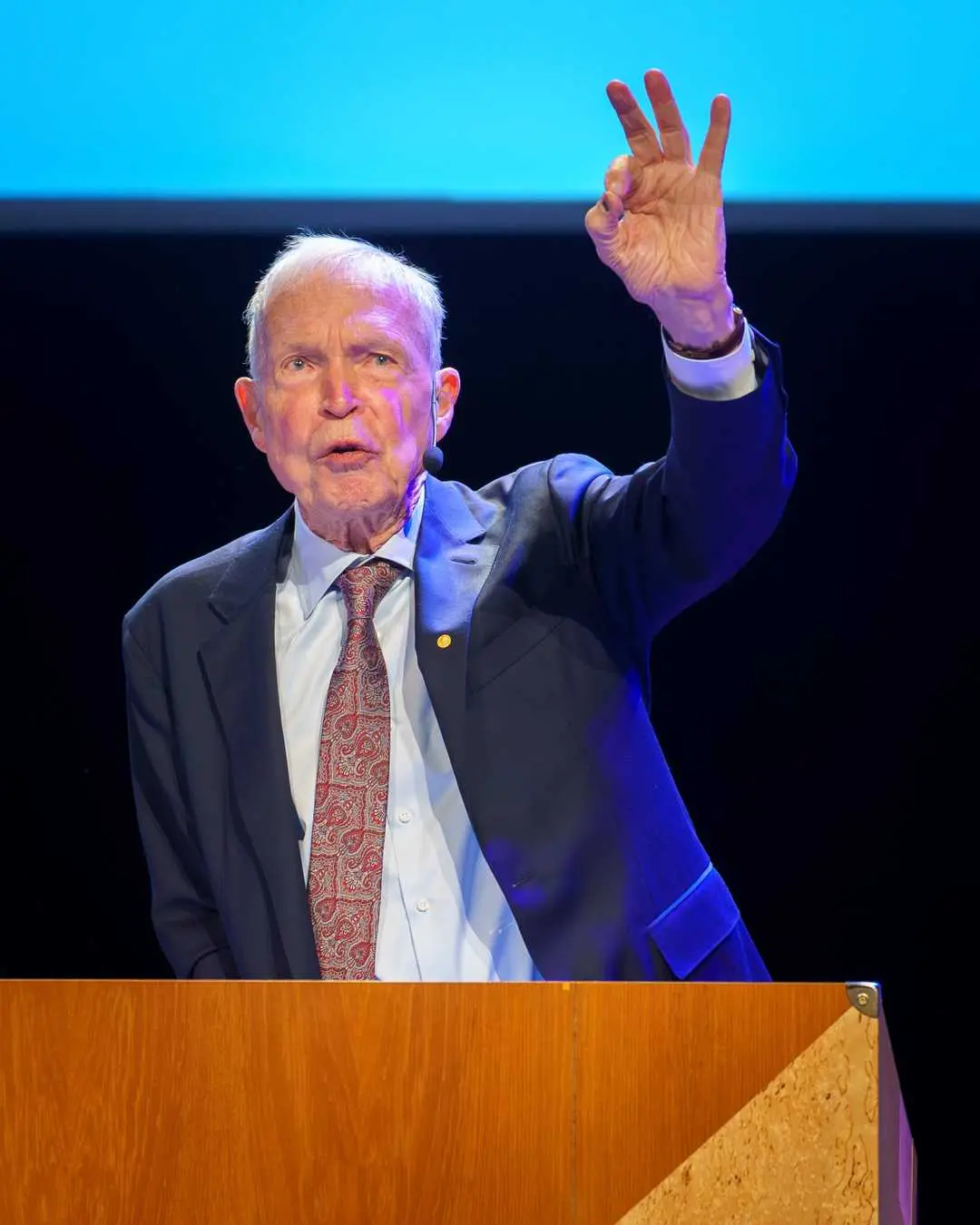
Hinton's Nobel lecture was not in October. It was delivered on 8 December at the Aula Magna, Stockholm University, under the title "Boltzmann Machines"—an almost entirely technical talk in which he attempted what he called something very foolish: explaining Boltzmann machines to a general audience without equations.
The risk argument came in the banquet speech on 10 December. After listing near-term harms—divisive echo chambers, mass surveillance by authoritarian governments, phishing by cyber criminals—he continued:
In the near future AI may be used to create terrible new viruses and horrendous lethal weapons that decide by themselves who to kill or maim.
There is also a longer term existential threat that will arise when we create digital beings that are more intelligent than ourselves. We have no idea whether we can stay in control. But we now have evidence that if they are created by companies motivated by short-term profits, our safety will not be the top priority.
In his laureate interview, recorded 6 December, he put a number on it: "My guess is in between five and 20 years from now, there's a good chance, a 50% chance, we'll get AI smarter than us"—adding that this had been his guess a year earlier, and "I guess my guess now is between four and 19 years." On the confidence of others: "Anybody who says it's all going to be fine, it's crazy. Anybody who says they're inevitably going to take over, they're crazy too. We really don't know."
A Nobel laureate's words carry a particular weight with politicians and the press. Hinton was clearly aware of it, and used Nobel week to sound the alarm.
Cultural Impact
2024 will be recorded as the year AI was acknowledged not as an abstract "latest technology" but as a fundamental enlargement of human knowledge. That recognition, formalised through the highest scientific honour humanity has, mattered beyond the industry itself.
Whether 2024 was a turning point or a one-off is not yet settled: the 2025 science prizes went to macroscopic quantum tunnelling, metal–organic frameworks and regulatory T cells, with no AI among them. But with Physics and Chemistry already conceded, no one will be especially surprised when the Physiology or Medicine Prize is awarded for AI-driven drug discovery, or the Economics Prize for AI-driven economic models, in some near year.
Questions this page answers
- Which AI researchers won Nobel Prizes in 2024?
- The Physics Prize of 8 October went in equal shares to John Hopfield and Geoffrey Hinton. The Chemistry Prize announced the next day went one half to David Baker and the other half jointly to Demis Hassabis and John Jumper of Google DeepMind.
- What was Hinton's Physics Nobel awarded for?
- The citation reads 'for foundational discoveries and inventions that enable machine learning with artificial neural networks'. Hinton's contribution there is the Boltzmann machine, Hopfield's the Hopfield network.
- Were the Physics and Chemistry prizes the same award?
- They are separate prizes. What was unprecedented is that both basic-science prizes went to AI work in the same week; the Chemistry award covered computational protein design and protein structure prediction with AlphaFold2.
Sources
Last updated: