PERSON
Linus Torvalds
Author of the Linux kernel (1991) and still the final merger who signs its releases. He studied computer science at the University of Helsinki and moved to the United States in 1997. When the free BitKeeper licence was withdrawn in 2005 he wrote Git in about ten days, and distributed version control became the world standard. He has not received the ACM Turing Award, but holds the 2012 Millennium Technology Prize (shared with Shinya Yamanaka) and the 2014 IEEE Computer Pioneer Award.
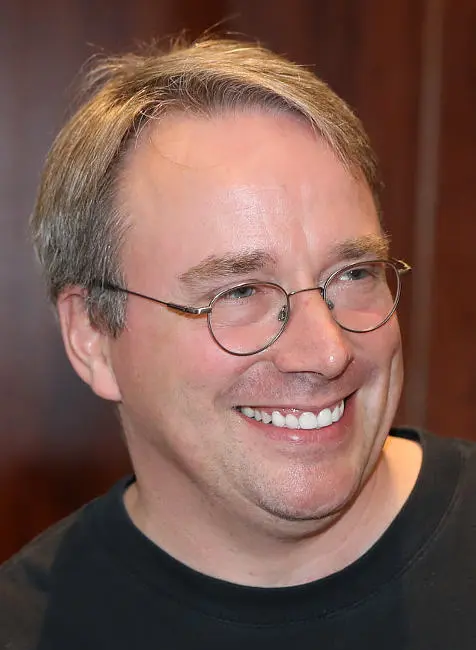
Profile
- Born
- 1969
- Status
- Living
- Span
- 1969–
- Appearances
- 03
- Name
- ENLinus TorvaldsJAリーナス・トーバルズ
Linus Benedict Torvalds (b. 28 December 1969) is the Finnish-American software engineer who wrote the Linux kernel in 1991 and, thirty-five years on, still signs its releases. In 2005 he also wrote Git, again for his own use, in about ten days. He has not received the ACM Turing Award, but he holds the Millennium Technology Prize (2012, shared with Shinya Yamanaka) and the IEEE Computer Pioneer Award (2014).
A VIC-20 from a statistician grandfather
Torvalds was born on 28 December 1969 in Helsinki to a family of journalists; his grandfather, Leo Törnqvist, was a statistician at the University of Helsinki who gave the boy a Commodore VIC-20 — Torvalds's first computer. He spent most of his school years writing BASIC and assembler, first on the VIC-20 and then on a Sinclair QL with a Motorola 68008.
He entered the University of Helsinki in 1988 to read computer science. In the summer of 1989 he joined the Finnish Navy's Nyland Brigade for the eleven-month officer-training programme, and was commissioned as a second lieutenant serving as an artillery observer; he then returned to study. On 5 January 1991 he took delivery of an Intel 80386 PC clone, bought on instalments — the machine on which Linux was written.
On 25 August 1991 he posted to the comp.os.minix newsgroup: "I'm doing a (free) operating system (just a hobby, won't be big and professional like gnu)". That self-deprecating notice is the event this site records in full.
He married Tove Monni, a six-time Finnish national karate champion, in the 1990s; they have three daughters. In 1997 he moved to Silicon Valley and joined Transmeta, which built low-power x86-compatible processors — a VLIW core paired with a "Code Morphing" software layer that translated x86 instructions at run time. He left Transmeta in 2003 to work full-time, vendor-neutrally, on the kernel through the Open Source Development Labs (later the Linux Foundation).
A hobby on a 386, joined to the GNU userland
The Linux Kernel (1991-)
The kernel began as a hobby project on Torvalds's own 386 and became, with the GNU userland from Richard Stallman's project, the basis of a complete free-software operating system. The licence change to the GPL took effect on 1 February 1992, and copyleft is what kept the result from being enclosed by any single vendor.
Linux went on to run web servers, mobile devices (Android), embedded systems, every machine on the TOP500 supercomputer list since November 2017, and the bulk of public-cloud infrastructure.
The scale of what he now presides over is the point. The kernel tree passed 43 million lines in 2026, a release cycle of roughly ten weeks absorbs many thousands of patches, and kernel.org tracks a mainline, a stable series and six longterm branches at once. Torvalds remains the person who takes the final merges and tags the releases.
Git (2005-)
In April 2005 the free BitKeeper licence that Linux development had depended on since 2002 was withdrawn, after Andrew Tridgell built a client that recovered revision metadata the free version would not show. Torvalds began designing a replacement on 3 April; the first commit landed on 7 April, and on 16 April the kernel tree itself — 6,718,755 lines — went in as a single commit. His own summary, given to the GitHub Blog on Git's twentieth anniversary: "it was about 10 days until I could use it for the kernel".
The design choice that carried everything else was content-addressable storage. The first README is careful about what that does and does not buy you: "'git' itself only handles content integrity, the trust has to come from outside." Torvalds handed the maintainer role to Junio Hamano on 26 July 2005 and has not taken it back. The full story is here.
The Rust Controversy (2022-2025)
Initial Rust support was merged into Linux 6.1 in December 2022 — the first second language in a kernel that had been C plus assembly since 1991. Tension between veteran C maintainers, most prominently Christoph Hellwig of the DMA subsystem, and the Rust-for-Linux side came to a head in early 2025.
Torvalds's rulings that February are frequently reported backwards, so they are worth stating exactly. To Hector Martin of Asahi Linux, who had defended public criticism of hostile maintainers, he wrote on 6 February: "Technical patches and discussions matter. Social media brigading - no thank you." And on 20 February he drew the line on the maintainers' side of the argument as well:
You can't have it both ways. You can't say "I want to have nothing to do with Rust", and then say the Rust code cannot use the C interfaces I maintain.
No maintainer is obliged to read Rust; no maintainer may block Rust code from calling the C interfaces they own. Martin resigned as Asahi Linux project lead on 13 February 2025.
Awards and honours
| Year | Award |
|---|---|
| 2012 | Millennium Technology Prize, Technology Academy Finland — the Grand Prize split for the first time, with Shinya Yamanaka |
| 2014 | IEEE Computer Society Computer Pioneer Award |
| 2018 | IEEE Masaru Ibuka Consumer Electronics Award |
The ACM Turing Award has, to date, eluded him.
Full-time on the kernel, from Dunthorpe
Torvalds works full-time on the kernel as a fellow of the Linux Foundation, from Dunthorpe outside Portland, Oregon. He restricts public appearances to a few each year and communicates mainly through the kernel mailing lists.
He has noticeably moderated the "flame mail" style of his younger days. On 16 September 2018, releasing 4.19-rc4, he apologised and stepped back from kernel development for a period: "My flippant attacks in emails have been both unprofessional and uncalled for." The kernel adopted a code of conduct in the same window, and the change has held: the Rust rulings of 2025, however blunt, were free of personal abuse.
The longest-running benevolent dictatorship
Torvalds is the most durable proof that an individual can start something that rewrites the world's computing foundations, and the longest-running real-world example of a "Benevolent Dictator For Life" — the title Guido van Rossum coined for himself and, in 2018, gave up. Torvalds still holds the final-merge gavel after thirty-five years.
He also wrote, almost by accident, the tool that records nearly all the rest of it. Linux runs the servers; Git records the source. A majority of guest operating systems on Microsoft Azure are Linux, and Microsoft itself now ships the Windows Subsystem for Linux and, since 2018, owns GitHub. What began in a Helsinki student flat in 1991 ended up inside the products of what was once its bitterest opponent.
Appearances
Sources
TertiaryLinus Torvalds — Wikipedia
Last updated: