PERSON
Bjarne Stroustrup
Designer and original implementer of C++. Born in Aarhus, Denmark in 1950. He began the work at AT&T Bell Labs in 1979 as 'C with Classes'; the first commercial implementation shipped in October 1985. After Bell Labs (1979-2002), Texas A&M University (2002-2014) and Morgan Stanley (2014-2022), he has been a professor of computer science at Columbia University since July 2022. He has worked on ANSI/ISO standardisation since 1989 and co-edits the C++ Core Guidelines with Herb Sutter.
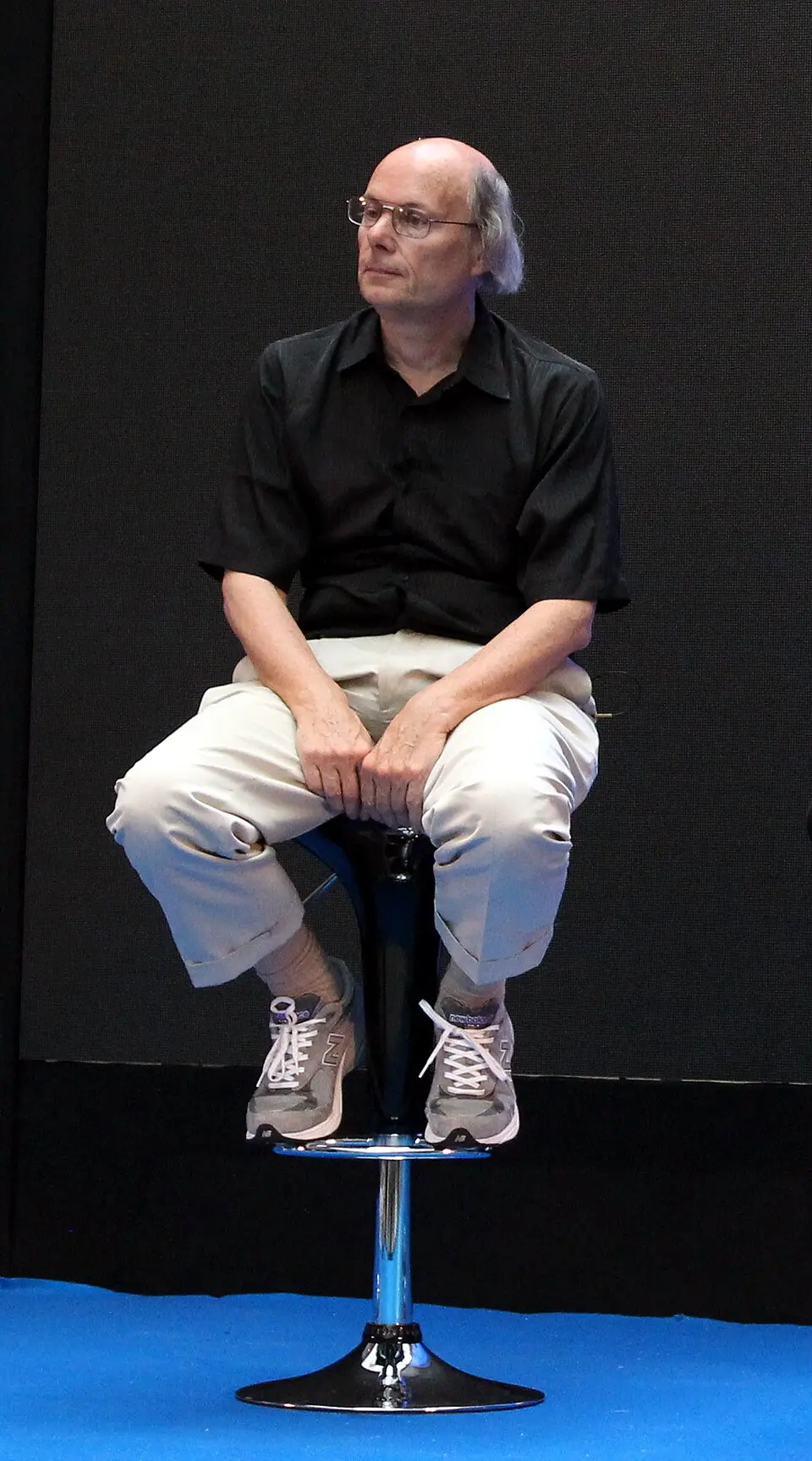
Profile
- Born
- 1950
- Status
- Living
- Span
- 1950–
- Appearances
- 01
- Name
- ENBjarne StroustrupJAビャーネ・ストラウストラップ
Bjarne Stroustrup (born 1950 in Aarhus, Denmark) is the designer and original implementer of C++. He took a Cand.Scient. in mathematics and computer science at the University of Aarhus in 1975 and a PhD in computer science at Cambridge in 1979, working on the design of distributed systems under David Wheeler of EDSAC. He has published dated accounts of the language's history for decades, and his own record is more accurate than the folklore that has grown around it.
Career
In 1979 Stroustrup moved with his wife and daughter to New Jersey to join the Computer Science Research Center of Bell Labs — colloquially 1127. Asked in his FAQ why he went there, his answer runs to three words: "Because I could."
| Period | Position |
|---|---|
| 1979-2002 | Bell Labs, later AT&T Labs - Research. Head of the Large-Scale Programming Research Department from its creation until late 2002. AT&T Bell Laboratories Fellow, 1993 |
| 2002-2014 | Texas A&M University, College of Engineering Chair in Computer Science Professor; University Distinguished Professor from 2011 |
| January 2014 - April 2022 | Managing Director in the technology division of Morgan Stanley; the firm's first Technical Fellow in 2019; retired 2 April 2022 |
| July 2022 - | Professor of Computer Science, Columbia University |
Of leaving the labs he wrote that "the steam had run out of Bell Labs and its successors, AT&T Labs and Lucent Bell Labs"; of leaving academia for a bank, "I felt it was time to get back to industry." The motive is consistent — proximity to work whose scale, and whose consequences in success and failure, are real.
From C with Classes to C++
"I started work on what became C++ in 1979," he writes; "the initial version was called 'C with Classes'." The motive comes in two layers. The general aim was "to design a language in which I could write programs that were both efficient and elegant"; the specific tasks that started him "had to do with distributing operating system facilities across a network." He wanted to write efficient systems programs in the styles Simula67 encouraged.
The choice of C as the base was equally deliberate: at the time, he says, he considered C the best systems programming language available. Of the corridor he worked in, which held Dennis Ritchie, Brian Kernighan, Doug McIlroy and Steve Johnson, he writes that without their help and advice, and without C, C++ would have been stillborn. He has repeatedly denied the persistent rumour that he was ever told he had to use C.
The name was suggested by Rick Mascitti. The account in chapter 1 of The C++ Programming Language dates the coinage to the summer of 1983; it was first written into documents that December, when it was edited into the final copies of two papers. The first commercial implementation was released in October 1985, alongside the first edition of that book. AT&T, he notes, "made enough money on Cfront, my original C++ compiler, to pay for the development of C++ several times over."
Standardisation and discipline
Stroustrup took an active role in the creation of the ANSI/ISO standard from 1989 and has worked on its revision ever since. C++98 was the first ISO standard; the current one is C++23, formally ISO/IEC 14882:2024. Since 2015 he has co-edited the C++ Core Guidelines with Herb Sutter — a rule set for writing code inside existing C++ that is statically type safe and free of resource leaks.
He is equally exact about vocabulary, devoting a FAQ entry to opposing the phrase "C/C++": "There is no language called 'C/C++'." Collapsing two distinct languages into one label, he argues, does practical harm.
Books
The C++ Programming Language (first edition 1985, fourth 2013), The Design and Evolution of C++ (1994), A Tour of C++, and Programming: Principles and Practice using C++. He has also contributed to ACM's History of Programming Languages conference three times — 1993, 2007 and 2020 — writing the design history of his own language as a participant. Few language designers have kept a peer-reviewed record of their own decisions across a quarter of a century.
Awards and honours
- 1993 — ACM Grace Murray Hopper Award; ACM Fellow
- 2004 — Elected to the US National Academy of Engineering
- 2005 — IEEE Fellow; Sigma Xi William Procter Prize
- 2015 — Fellow of the Computer History Museum; Dahl-Nygaard Senior Prize
- 2017 — IET Faraday Medal
- 2018 — Charles Stark Draper Prize (NAE); IEEE Computer Society Computer Pioneer Award; John Scott Legacy Medal
- 2019 — Honorary doctorate, Universidad Carlos III de Madrid
He has not received the ACM Turing Award.
Current activities
He continues ISO standardisation work alongside the Columbia professorship. His own biographical page records him as a technology advisor to Metaspex since 2021, a senior advisor to YetiWare since February 2026, and a part-time Technical Fellow at Susquehanna International since June 2026 — in each case, by his account, to keep contact with the real-world development that teaching and design require.
Legacy
The central design commitment of C++ — that abstraction should cost as close to nothing as possible, and that you should not pay for what you do not use — produced the default choice in domains that demand low-level control and high-level structure at once: game engines, trading systems, embedded devices, browser implementations. Citing a 2015 survey, Stroustrup puts the user community at around 4.4 million programmers and suspects it is now larger.
The criticism that has sharpened most in recent years concerns memory safety, and C++ is now routinely contrasted with languages such as Rust that enforce safety through the type system. Stroustrup's answer has not been replacement but discipline: making a safe subset usable inside the enormous body of code that already exists. The Core Guidelines are that answer in practice, part of what he describes as a project to give "modern C++" meaning as a completely type-safe and resource-safe language.
Appearances
Sources
PrimarySome Information about Bjarne Stroustrup — stroustrup.com
His own account of his career, affiliations and awards
PrimaryBjarne Stroustrup's FAQ — stroustrup.com
The start of C with Classes, the naming of C++, and the date of the first commercial implementation
PrimaryThe Standard — isocpp.org
The current ISO C++ standard
Last updated: