ORGANIZATION
AMD (Advanced Micro Devices)
American semiconductor company incorporated in Delaware on 1 May 1969 and public since 1972. It makes processors compatible with Intel's x86, and the two companies' patent disputes ended in settlements and cross-licences in 1995 and 2009. It launched Athlon in 1999 and Opteron in 2003, bought the graphics company ATI in 2006, and in 2009 spun its manufacturing off as GLOBALFOUNDRIES, leaving it without fabs of its own. The Zen architecture of 2017 revived its CPUs, and in 2022 it bought the FPGA maker Xilinx in an all-stock deal. In October 2025 it agreed to supply OpenAI with 6 gigawatts of GPUs. Revenue for fiscal 2025 was US$34.6 billion, of which the Data Center segment contributed US$16.6 billion.
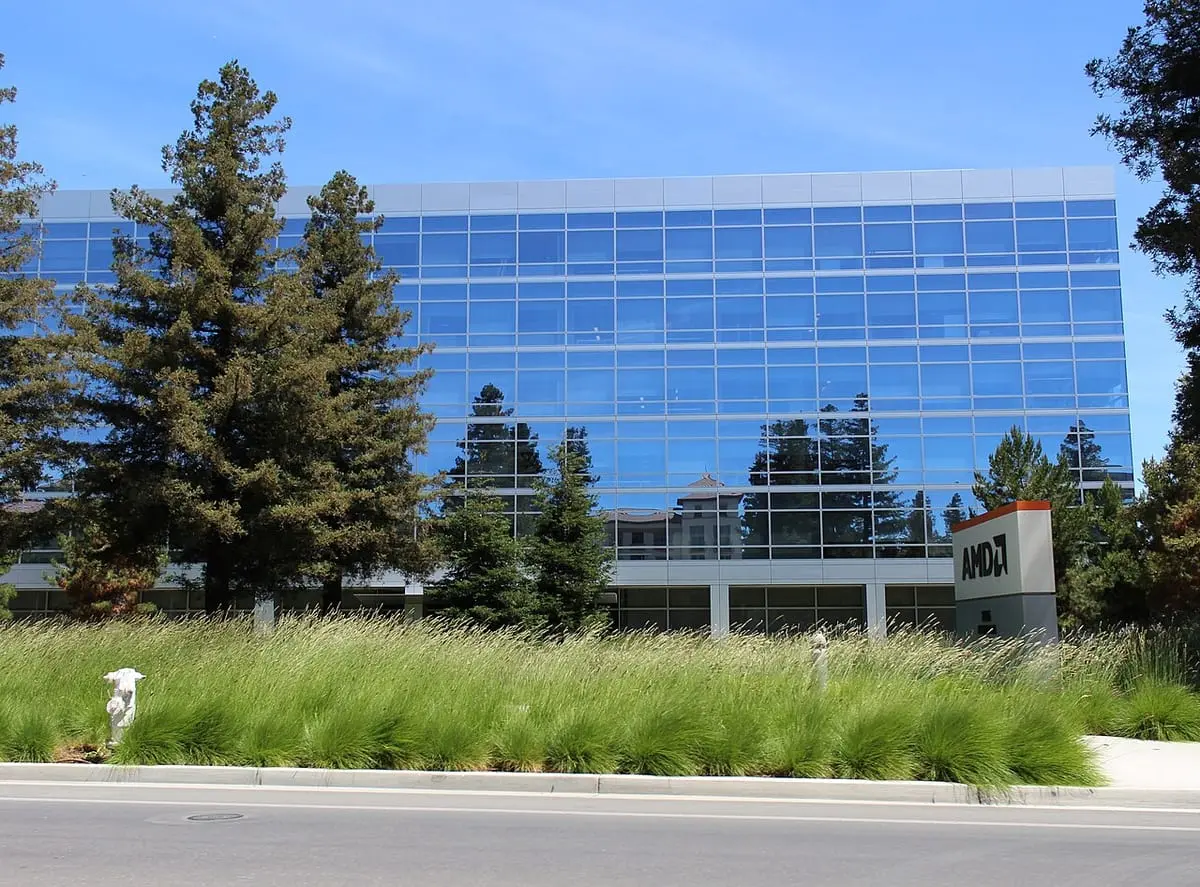
Organization
- Founded
- 1969
- Status
- Active
- Active
- 1969–
- Appearances
- 05
- Name
- ENAMD (Advanced Micro Devices)JAAMD(アドバンスト・マイクロ・デバイセズ)
AMD (Advanced Micro Devices) is a semiconductor company incorporated under Delaware law on 1 May 1969. Its annual report on Form 10-K says it began as a Silicon Valley start-up with dozens of employees; it became a public company in 1972. It is headquartered in Santa Clara, California, and had approximately 31,000 employees at the end of December 2025. Lisa Su is President and Chief Executive Officer, under an employment agreement effective 8 October 2014.
Competing on the same instruction set as Intel
AMD's core product is the processor compatible with Intel's x86. Competing on the same instruction set makes the patent relationship with Intel a precondition of the business. According to the 1995 10-K, the two companies settled all outstanding legal disputes on 11 January 1995 and that December signed a five-year comprehensive patent cross-licence, which excluded microprocessor microcode copyrights. In November 2009 they reached an agreement ending all their disputes, antitrust litigation included: Intel paid AMD US$1.25 billion and the two signed a new five-year cross-licence. AMD dropped its case in the US District Court in Delaware and two cases in Japan, and withdrew its regulatory complaints worldwide.
Within that compatible framework, AMD moved first several times. Its 10-Ks record that it began shipping Athlon, a seventh-generation x86-compatible design, in June 1999, introduced Opteron, a 64-bit server processor, in April 2003, and followed with Athlon 64 that September. AMD claims Athlon 64 as the first Windows-compatible, x86-based 64-bit PC processor. The difference between x86 and ARM is summarised in the glossary.
Three changes of shape
| Year | Event (10-K, 8-K) | What changed |
|---|---|---|
| October 2006 | Acquires the graphics company ATI Technologies; total purchase price US$5.6 billion | A company with GPUs and chipsets as well as CPUs |
| March 2009 | Forms GLOBALFOUNDRIES, a manufacturing joint venture with the investment company ATIC | Fabs separated; wafers for all products now come from outside foundries |
| February 2022 | Acquires the FPGA maker Xilinx in an all-stock deal (1.7234 AMD shares per Xilinx share) | FPGAs and adaptive SoCs added for data centres |
According to the 2025 10-K, TSMC makes all wafers for its CPUs and GPUs at 7 nm and below, and GLOBALFOUNDRIES makes most of those on processes larger than 7 nm. How GLOBALFOUNDRIES put 7 nm on hold indefinitely and AMD moved its 7 nm work to TSMC is in the entry on TSMC 7 nm (2018).
What rebuilt the product line was Zen. The 2017 10-K records that in March of that year AMD released 8-core, 16-thread Ryzen 7 desktop processors based on its new "Zen" core, and in June the EPYC 7000 series for servers, both made on 14 nm FinFET.
AMD inside the game consoles
The 2025 10-K lists AMD semi-custom SoCs in the PlayStation 5, the Xbox Series X/S and the Steam Machine PC that Valve has revealed. Valve's handheld Steam Deck also uses an AMD APU. Console chips sit in the Client and Gaming segment, whose gaming revenue was US$3.9 billion in 2025, up 51%.
Key events
- 1 May 1969: Incorporated under Delaware law.
- 1972: Becomes a public company.
- 11 January 1995: Settles all disputes with Intel; patent cross-licence signed in December.
- June 1999: First shipments of Athlon.
- April 2003: Opteron introduced.
- September 2003: Athlon 64 introduced.
- 25 October 2006: Completes the acquisition of ATI.
- 2 March 2009: GLOBALFOUNDRIES formed.
- November 2009: Comprehensive settlement with Intel, antitrust litigation included; Intel pays US$1.25 billion.
- March 2017: Ryzen 7 on the Zen core introduced.
- June 2017: EPYC 7000 server processors on the Zen core introduced.
- 14 February 2022: Completes the acquisition of Xilinx.
- March 2025: Acquires the server designer ZT Systems (US$3.2 billion in cash and 8.3 million shares); its manufacturing business is sold to Sanmina in October.
- October 2025: Agreement with OpenAI to deploy 6 gigawatts of GPUs.
Key figures
Fiscal year ended December 2025, from the 10-K filed in February 2026.
- Revenue: US$34.6 billion (up 34%) / operating income: US$3.7 billion / net income: US$4.3 billion
- Gross margin: 50%, including about US$440 million of net inventory and related charges tied to US export controls on the MI308 for China
| Segment | Revenue | Change | Operating income |
|---|---|---|---|
| Data Center (AI accelerators, server CPUs and more) | US$16.6bn | +32% | US$3.6bn |
| Client and Gaming (PC CPUs, GPUs, semi-custom SoCs) | US$14.6bn | +51% | US$2.9bn |
| Embedded (embedded CPUs, FPGAs, adaptive SoCs and more) | US$3.5bn | −3% | US$1.2bn |
Revenue for the second quarter of 2026, to 27 June, was US$11.5 billion, up 50% year on year (10-Q).
AI GPUs and export controls
The 10-K names Intel and NVIDIA as its main competitors in the data centre and describes NVIDIA as the discrete-GPU market share leader. According to the 2025 10-K, large hyperscale customers and OEMs deployed the Instinct MI350X, and AMD has set out an annual cadence of new Instinct products.
The OpenAI agreement of October 2025 combines the purchase of 6 gigawatts of GPUs with a warrant allowing OpenAI to buy up to 160 million AMD shares at US$0.01 each. The warrant vests in tranches as GPU purchase milestones, AMD share-price targets and other conditions are met; at the end of 2025 no tranche had vested. The debate over deals of this kind, which tie investment to chip purchases, belongs to the entry on the AI bubble debate.
Export controls hit the results directly. The 10-K says that in the second quarter of 2025 AMD recorded about US$800 million of inventory and related charges on MI308 products because of new US restrictions on exports to China; after obtaining licences to ship to certain China-based customers it began shipping in the fourth quarter and reversed about US$360 million. US officials have said they expect the government to receive 15% of revenue from licensed MI308 sales to China, but, the 10-K notes, no regulation establishing that requirement has been published.
Appearances
Questions this page answers
- When was AMD founded?
- According to its annual report on Form 10-K, AMD was incorporated under Delaware law on 1 May 1969 and became a public company in 1972. It is headquartered in Santa Clara, California.
- Does AMD manufacture its own chips?
- No. In March 2009 it spun its manufacturing off as GLOBALFOUNDRIES, and it now uses outside foundries for the wafers of all its products. According to the 10-K, TSMC makes its CPUs and GPUs at 7 nm and below, and GLOBALFOUNDRIES makes most of those on larger processes.
- What is the AMD–OpenAI agreement?
- Under a product purchase agreement of October 2025, OpenAI is to deploy 6 gigawatts of AMD GPUs, the first gigawatt using Instinct MI450 series products. AMD also issued OpenAI a warrant to buy up to 160 million AMD shares at US$0.01 each, vesting in tranches as GPU purchase milestones, AMD share-price targets and other conditions are met.
Sources
Incorporation on 1 May 1969 and going public in 1972, segment revenue and operating income, net income, headcount, contract manufacturers, semi-custom design wins, the ZT Systems acquisition and the sale of its manufacturing business, the OpenAI agreement and warrant, and charges tied to US export controls on the MI308
Revenue for the second quarter of 2026 (US$11.5 billion, up 50% year on year)
The settlement with Intel of 11 January 1995 and the five-year patent cross-licence signed that December
Initial shipments of Athlon in June 1999
The introduction of Opteron in April 2003 and Athlon 64 in September 2003
Completion of the ATI acquisition on 25 October 2006 and its total purchase price of US$5.6 billion
The formation of GLOBALFOUNDRIES on 2 March 2009 and the November 2009 settlement with Intel (US$1.25 billion) with a new cross-licence
Ryzen 7 (March 2017) and EPYC 7000 (June 2017), based on the Zen architecture
PrimaryAMD Completes Acquisition of Xilinx — AMD, February 14, 2022 (Form 8-K Exhibit 99.1)
Completion of the all-stock Xilinx acquisition and the exchange ratio
Last updated: