T1#research#consumer
IBM Watson Wins Jeopardy! — When Natural-Language Question Answering Beat Humans on TV
Metadata
- Date
- Decade
- 2010s
- Tier
- T1
- Timelines
- A History of Artificial Intelligence
- Sources
- 06
- Connections
- 01
- Tags
- #research#consumer
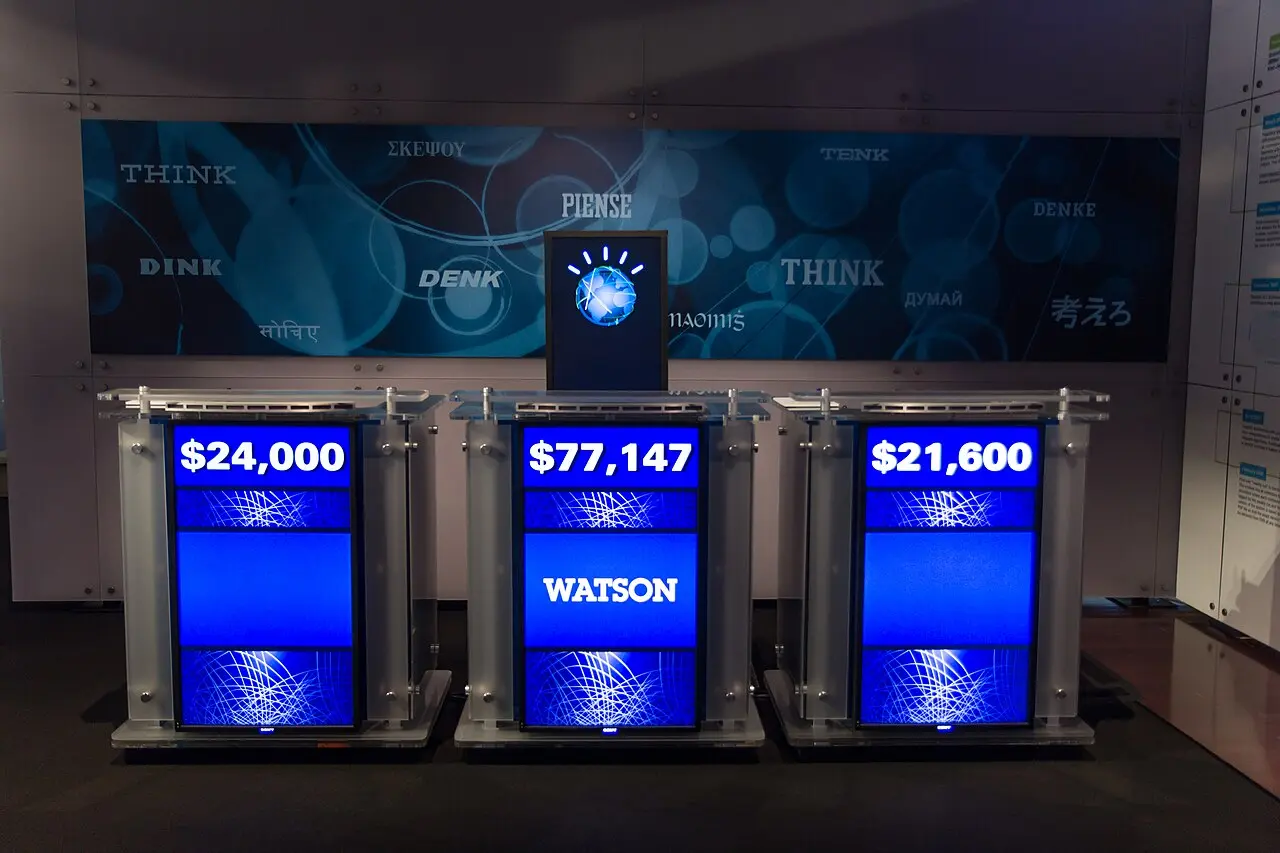
IBM's question-answering system Watson beat Ken Jennings and Brad Rutter, two of the most successful champions of the US quiz show Jeopardy!, in a contest broadcast in the US over three nights: 14, 15 and 16 February 2011. Two matches were spread across the three days, and Watson finished with $77,147 to Jennings's $24,000 and Rutter's $21,600. The games were taped in January 2011 at IBM's research centre in Yorktown Heights, New York.
Watson, a machine that parsed Jeopardy!'s quirky English clues and answered without any connection to the internet, gave IBM its biggest human-versus-machine spectacle since Deep Blue in 1997. The expectations the win raised, and the troubles of the medical business that followed, have also made it a standard example of the gap between AI marketing and AI capability.
Why Jeopardy!
According to IBM, the company had been looking for a new human-versus-machine challenge ever since Deep Blue beat Kasparov in 1997. In 2006 David Ferrucci, an IBM computer scientist with a background in AI, pitched his bosses on building a computer that could beat humans at Jeopardy!. The show reads out clues phrased as answers, contestants reply in the form of a question, and the clues are full of wordplay, irony and riddles.
"The goal is not to model the human brain," Ferrucci said, as IBM records it; the aim was a computer more effective at understanding and interacting in natural language, not necessarily in the way humans do it. He assembled a team of more than two dozen scientists, engineers and programmers at the Thomas J. Watson Research Center in Yorktown Heights, and the system took five years to perfect. It was named after IBM's first CEO, Thomas J. Watson Sr.
How Watson worked
| Item | Detail |
|---|---|
| Software | DeepQA, a question-answering architecture that generates hypotheses, gathers evidence and scores it |
| Hardware | 10 racks holding 90 servers, 2,880 processor cores in all (IBM POWER7 servers) |
| Internet connection | None |
| Knowledge sources | Encyclopedias, dictionaries, Wikipedia, religious texts, novels, plays, books from Project Gutenberg and more |
| Deciding to answer | Hundreds of algorithms score candidate answers in parallel; Watson buzzes only when confidence is high enough |
| Time per clue | About three seconds (IBM) |
As IBM explains it, a search engine returns a list of documents that may or may not be relevant, whereas Watson returned a direct answer. The more of its algorithms independently reached the same answer, the higher its confidence; below the threshold, it stayed silent. The design is set out in "Building Watson: An Overview of the DeepQA Project", published by Ferrucci and colleagues in AI Magazine in autumn 2010.
The contest, from the December 2010 announcement to the February broadcast
| Date | Event |
|---|---|
| 14 Dec 2010 | IBM and Jeopardy! announce the match; prizes of $1 million for first, $300,000 for second, $200,000 for third |
| Jan 2011 | Taping at IBM's research centre in Yorktown Heights |
| 14–16 Feb 2011 | Two matches broadcast over three nights; Watson's win is sealed on the 16th |
At the announcement IBM pledged to give all of its winnings to charity, and Jennings and Rutter half of theirs; according to PCWorld, IBM's share went to World Vision and World Community Grid. The opponents were formidable. Jennings had won 74 games in a row in the 2004–2005 season, earning more than $2.5 million; Rutter had won the highest cumulative amount in the show's history, $3,255,102.
Watson was not perfect. According to IBM, in the first match's Final Jeopardy!, in the category US Cities, it answered "What is Toronto?????" instead of "What is Chicago?", the five question marks signalling very low confidence. It still pulled away in the second match and won by a wide margin. Jennings added a line to his last written response: "I for one welcome our new computer overlords" (PCWorld).
What it meant for society
After the contest Jennings remarked, as IBM quotes him: "'Quiz show contestant' may be the first job made redundant by Watson, but I'm sure it won't be the last." The match put the idea of machines replacing knowledge work in front of a mass television audience.
IBM turned that momentum into a business. According to a 2019 IEEE Spectrum investigation, the day after the match IBM announced that Watson would be applied to medicine, promising its first commercial health-care offerings within 18 to 24 months; the projects announced that day did not yield commercial products. The article cites an oncology advisory tool built with MD Anderson Cancer Center, which MD Anderson cancelled in 2016 after spending $62 million on it. Robert Wachter of UCSF told Spectrum: "They came in with marketing first, product second, and got everybody excited." He also said that IBM, by being first to push AI into the clinic, had shown everyone else how hard the problems were.
On 21 January 2022 IBM announced an agreement to sell Watson Health's data and analytics assets, including MarketScan and Micromedex, to the investment firm Francisco Partners; financial terms were not disclosed. IBM kept the Watson name alive in watsonx, its generative-AI platform launched in 2023, as covered on the IBM page.
The Jeopardy! win showed statistical methods for handling the ambiguity of language reaching a level that could beat human champions on a television stage. Language AI then took a different route, through the Transformer of 2017 to large language models. The wider story is on the AI timeline.
Questions this page answers
- When did IBM Watson play on Jeopardy!?
- It aired in the US over three nights, 14, 15 and 16 February 2011, with two matches spread across the three days. It was taped in January 2011 at IBM's research centre in Yorktown Heights, New York, and announced on 14 December 2010.
- How much did Watson win?
- Watson's on-air total across the two games was $77,147, against $24,000 for Ken Jennings and $21,600 for Brad Rutter. The prizes were $1 million for first, $300,000 for second and $200,000 for third; IBM had pledged all of its winnings to charity and the two players half of theirs.
- Did Watson search the internet for answers?
- No. According to IBM, Watson was not connected to the internet. It used material ingested in advance, from encyclopedias, dictionaries and Wikipedia to literature, ran hundreds of algorithms in parallel to score candidate answers, and buzzed in only when its confidence was high enough.
- What happened to Watson Health?
- On 21 January 2022 IBM announced an agreement to sell Watson Health's data and analytics assets to the investment firm Francisco Partners. Before that, IEEE Spectrum and others had reported that the medical applications fell short of IBM's early promises.
Sources
PrimaryWatson, Jeopardy! champion — IBM Heritage
David Ferrucci's 2006 pitch; 10 racks, 90 servers, 2,880 cores; no internet connection; confidence-based buzzing; the Toronto error; final totals; Jennings's remark
Air dates of 14, 15 and 16 February 2011; two matches over three days; prizes of $1m, $300k and $200k and the charity pledges; the champions' records; POWER7
SecondaryIBM Watson Wins Jeopardy, Humans Rally Back — PCWorld, 17 February 2011
The January taping, the charities, and the line Jennings wrote as his Final Jeopardy! response
The healthcare announcement the day after Jeopardy!; MD Anderson's cancelled project (2016, $62 million); Robert Wachter's assessment
Last updated: