T1#research
The Turing Test — The Paper That Turned "Can Machines Think?" into a Game
Metadata
- Date
- Decade
- 1950s
- Tier
- T1
- Sources
- 05
- Connections
- 02
- Tags
- #research
The Turing test is the test of machine intelligence Alan Turing proposed in "Computing Machinery and Intelligence", published in the British philosophy journal Mind in October 1950 (volume 59, number 236, pages 433–460). Turing declined to answer "Can machines think?" head-on. Instead he replaced it with an imitation game: can an interrogator, communicating only in writing, tell which respondent is which? That game is what is now called the Turing test.
The paper does far more than the one scene usually quoted from it. It designs the test, makes a specific prediction about fifty years ahead, answers nine objections, and ends with a plan for machines that learn. This page separates what the paper actually says from what later readers added. Turing's life is covered on the Alan Turing page.
Replacing the question: how the game is set up
The first section opens with the sentence: "I propose to consider the question, "Can machines think?"" Turing then rejects the idea of settling the meaning of "machine" and "think" from everyday usage, since that would mean looking for the answer in a statistical survey such as a Gallup poll, which he calls absurd.
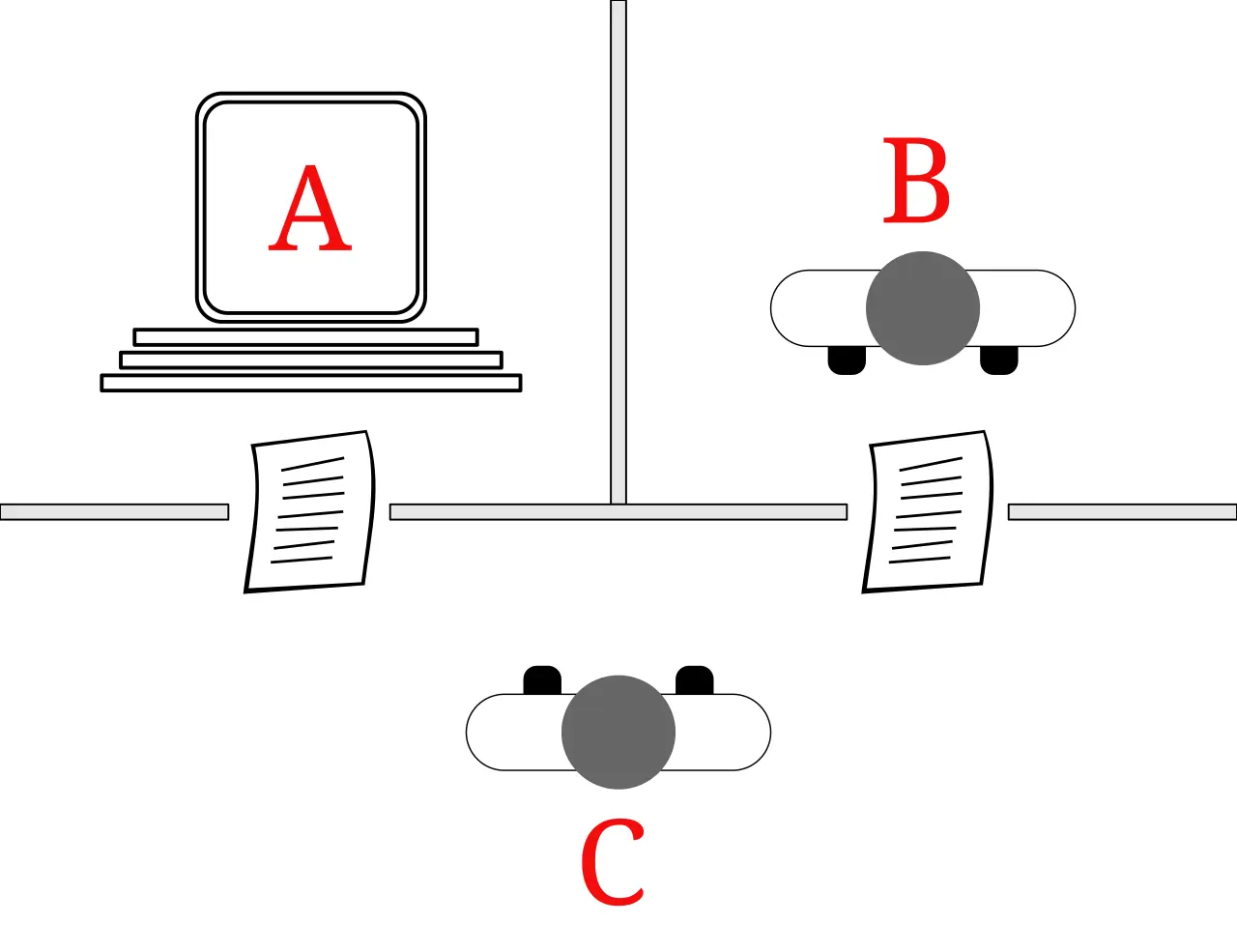
In its place he describes a game for three people: a man (A), a woman (B) and an interrogator (C) of either sex. C, in a separate room, questions the other two and must decide which is the man and which the woman. A's object is to make C choose wrongly; B's is to help C. So that tone of voice gives nothing away, answers are written, ideally sent by teleprinter.
Then Turing asks what happens when a machine takes the part of A. Will the interrogator decide wrongly as often as when the game is played between a man and a woman? These questions, the paper says, replace the original "Can machines think?" In the original text, then, the test is not a plain face-off between a person and a machine; it asks whether a machine can stand in for a human player in the man-and-woman game.
The 1950 prediction
In section 6 Turing sets out his own expectations plainly.
| Item | What the paper says |
|---|---|
| When | In about fifty years' time |
| Size of machine | A storage capacity of about 10⁹ |
| Duration | Five minutes of questioning |
| Standard | An average interrogator has no more than a 70 per cent chance of the right identification |
| On the original question | "Can machines think?" is "too meaningless to deserve discussion" |
| By the end of the century | Usage and educated opinion will have changed so that one can speak of machines thinking without expecting to be contradicted |
Note that Turing did not define a pass mark here. The 70 per cent and the five minutes are a forecast about technology fifty years on. The Stanford Encyclopedia of Philosophy (SEP) entry stresses the same point: the test Turing proposed should be kept distinct from the particular prediction he made about the end of the twentieth century.
Nine objections
The core of the paper lists nine objections to the view that machines can think and answers them one by one. The headings are:
| No. | Objection |
|---|---|
| 1 | The Theological Objection |
| 2 | The "Heads in the Sand" Objection |
| 3 | The Mathematical Objection |
| 4 | The Argument from Consciousness |
| 5 | Arguments from Various Disabilities |
| 6 | Lady Lovelace's Objection |
| 7 | Argument from Continuity in the Nervous System |
| 8 | The Argument from Informality of Behaviour |
| 9 | The Argument from Extrasensory Perception |
The sixth takes up what Ada Lovelace wrote about Babbage's Analytical Engine in her memoir of 1842. Turing quotes her: "The Analytical Engine has no pretensions to originate anything. It can do whatever we know how to order it to perform". He treats it as the classic statement that a machine can only do what it is told, and returns to it in the final section as a question about learning.
The learning machine
In section 7, "Learning Machines", Turing suggests that instead of trying to write a program that simulates an adult mind, one might write one that simulates a child's and then educate it. A child's brain, he proposes, is perhaps something like a notebook bought from a stationer's: rather little mechanism and lots of blank sheets. On where to start, he suggests trying both an abstract activity such as chess and a machine with good sense organs that is taught to understand and speak English.
The paper's last sentence reads: "We can only see a short distance ahead, but we can see plenty there that needs to be done." The idea of acquiring behaviour through learning would be tried out in practice nine years later in Arthur Samuel's checkers work at IBM.
Claims of a pass, and how they were judged
People have tried to run the test many times since 1950. The main claims and assessments:
| Year | Event | Claim and assessment |
|---|---|---|
| Annual | Loebner Prize | SEP says that by the end of the twentieth century its entrants had come nowhere near Turing's standard and were caught by not-very-subtle questions |
| 1991 | PC Therapist | According to SEP it fooled 50% of judges, in a small one-off trial |
| 7 June 2014 | Eugene Goostman (Turing Test 2014, Royal Society, London) | The organiser, the University of Reading, announced a first pass: 33% of 30 judges fooled, against a pass mark of more than 30% |
| March 2025 | Jones and Bergen study | GPT-4.5, prompted to adopt a humanlike persona, judged to be the human 73% of the time |
Eugene Goostman simulated a 13-year-old boy and was built by a team including the Russian-born Vladimir Veselov. In the university's announcement Kevin Warwick said the event involved more simultaneous comparison tests than ever before, was independently verified, and placed no restrictions on topics. SEP, by contrast, notes that PC Therapist, Cleverbot in 2011 and Eugene Goostman all ran very small trials, and that in none of them were there strong grounds for holding that an average interrogator had no more than a 70% chance of a correct call. The 30% figure, moreover, is a number from Turing's prediction, not a definition of passing.
The 2025 study, posted to arXiv by Cameron R. Jones and Benjamin K. Bergen, was a pre-registered randomised test in the three-party format: each participant held five-minute conversations simultaneously with one human and one AI system, then judged which was human. LLaMa-3.1 was judged human 56% of the time, the baseline ELIZA 23% and GPT-4o 21%. The authors claim their results are "the first empirical evidence that any artificial system passes a standard three-party Turing test." That is their own assessment, and what counts as "standard" remains open to argument.
What it meant for society
The Turing test left its mark less as a research target than as a frame for discussing intelligence in terms of observable behaviour. SEP records that Loebner Prize entries were widely conceded to have been designed solely to win the minor annual prize, with no thought of producing something that could really hold a conversation, so the test also shows where a single benchmark failed to steer research.
The social stakes of indistinguishable conversation were already being voiced in 2014, by the organisers themselves. In the university's announcement Warwick said that a computer able to trick a human into thinking someone, or even something, is a person we trust is "a wake-up call to cybercrime". Jones and Bergen write that their results bear on debates about what kind of intelligence large language models exhibit and on the social and economic impacts these systems are likely to have. Since the launch of ChatGPT, not knowing whether the other party is human has become an everyday problem outside any test.
The wider story of AI is on the AI timeline, and the history of computing as a whole on the overview timeline.
Questions this page answers
- What is the Turing test?
- It is a test of machine intelligence that Alan Turing proposed in a 1950 paper. An interrogator questions two respondents in writing only and must say which is which; Turing asked whether, when a machine takes one respondent's place, the interrogator decides wrongly as often as before. He called it the imitation game.
- When and where was the Turing test published?
- In "Computing Machinery and Intelligence", published in the British philosophy journal Mind in October 1950, volume 59, number 236, pages 433–460.
- Has any AI passed the Turing test?
- Claims of a pass recur. In 2014 the University of Reading, which organised the event, announced that Eugene Goostman had passed for the first time by fooling 33% of the judges, and in 2025 a study reported GPT-4.5 being judged human 73% of the time. The 2014 trial had only 30 judges, and the Stanford Encyclopedia of Philosophy notes that such small one-off trials gave no strong grounds for saying Turing's predicted standard had been met.
- What did Turing predict about the test?
- He wrote that in about fifty years it would be possible to programme computers with a storage capacity of about 10⁹ to play the imitation game so well that an average interrogator would have no more than a 70 per cent chance of making the right identification after five minutes of questioning. He also called the original question, "Can machines think?", too meaningless to deserve discussion.
Sources
The paper of record; volume, issue, pages and month (automated fetch returns 403; bibliographic data confirmed on the publisher page)
PrimaryComputing Machinery and Intelligence — full-text transcription (UMBC course copy)
Used to check wording: the opening question, the game's setup, the fifty-year prediction, the nine objections, the Lovelace quotation, learning machines and the closing sentence
On the Loebner Prize; the point that the 1991 PC Therapist, 2011 Cleverbot and 2014 Eugene Goostman trials were too small to show Turing's standard had been met; the distinction between the test and the prediction
PrimaryTuring Test success marks milestone in computing history — University of Reading, 8 June 2014
The Eugene Goostman announcement: 33% of 30 judges, the more-than-30% pass mark, and Kevin Warwick's comments
Pre-registered three-party tests: GPT-4.5 73%, LLaMa-3.1 56%, ELIZA 23%, GPT-4o 21%
Last updated: