T1#regulation#security
The Bletchley AI Safety Summit — 28 Countries and the EU Acknowledge Frontier AI Risk
Metadata
- Date
- Decade
- 2020s
- Tier
- T1
- Sources
- 11
- Connections
- 02
- Tags
- #regulation#security
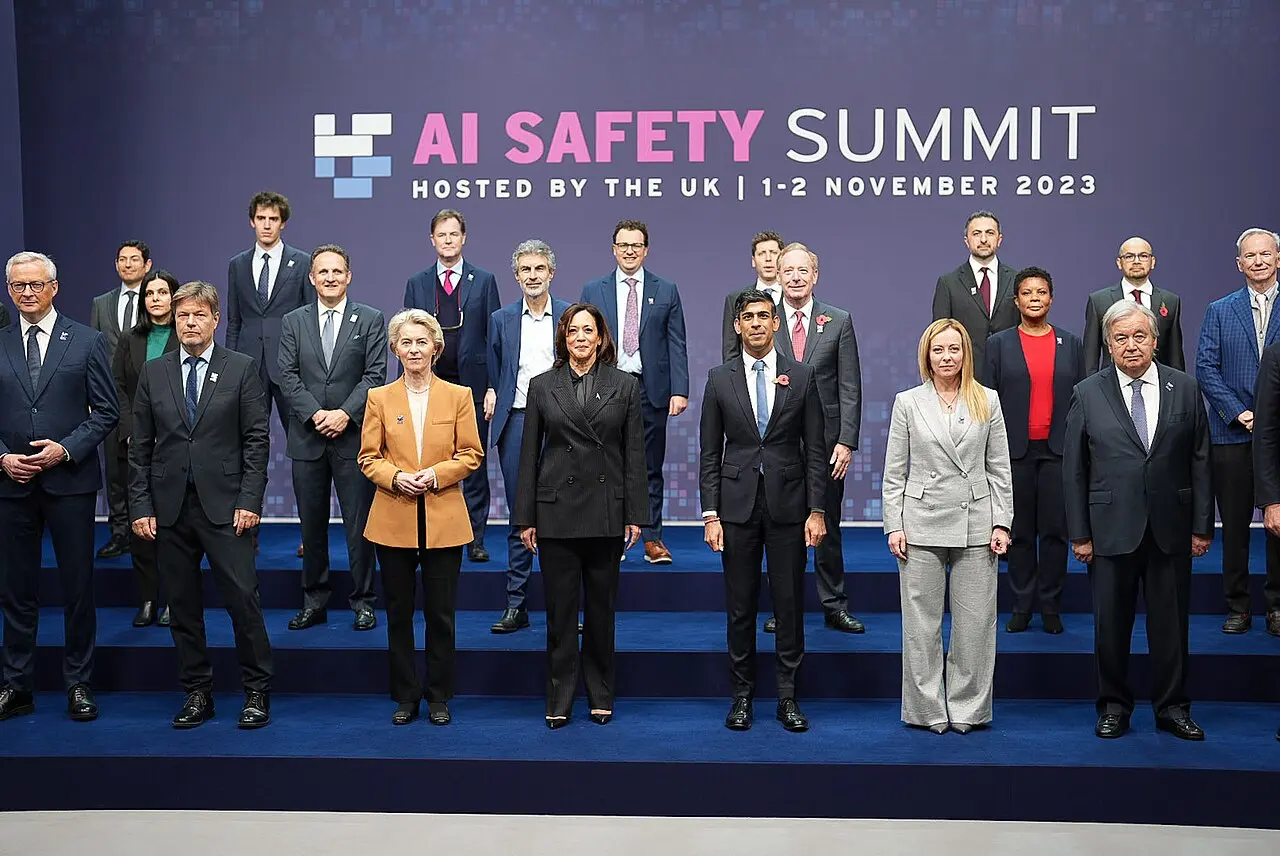
The AI Safety Summit was the first international leaders' meeting devoted to the risks of advanced AI, hosted by the UK government at Bletchley Park, north-west of London, on 1–2 November 2023. On the first day, 28 countries—including the United States, China and Japan—and the European Union agreed the Bletchley Declaration, jointly acknowledging that frontier AI could cause "serious, even catastrophic" harm. On the second day the UK announced its AI Safety Institute, and governments and AI companies agreed to cooperate on safety testing of models before and after release. The venue was the wartime codebreaking centre where Alan Turing had worked.
The summit was hosted by Prime Minister Rishi Sunak's government. It was one of several AI governance moves in 2023, alongside the March pause letter, the US Biden executive order of 30 October and, on the same day, the international guiding principles of the G7's Hiroshima AI Process.
What the Bletchley Declaration says
The declaration begins by noting that AI is already deployed across daily life—housing, employment, transport, education, health, justice—and that issues such as human rights, transparency, fairness, bias mitigation and privacy need to be addressed. It then singles out the "frontier" of AI as the source of particular safety risks, defined as highly capable general-purpose AI models, including foundation models, and narrow AI with potentially harmful capabilities, that match or exceed the capabilities of today's most advanced models.
It names two sources of risk: intentional misuse, and unintended issues of control relating to alignment with human intent. It is especially concerned about cybersecurity, biotechnology and the amplification of disinformation. The key passage reads:
There is potential for serious, even catastrophic, harm, either deliberate or unintentional, stemming from the most significant capabilities of these AI models.
The declaration says these risks are inherently international and best addressed through international cooperation, while recognising that countries should consider pro-innovation and proportionate approaches suited to national circumstances. It contains no binding obligations.
The signatories
The UK government's list comprises the following 28 countries and the EU. New Zealand joined on 23 October 2024.
| Region | Countries and bodies |
|---|---|
| Asia-Pacific | Japan, China, Republic of Korea, India, Indonesia, Singapore, the Philippines, Australia |
| Europe | United Kingdom, France, Germany, Italy, Spain, Netherlands, Ireland, Switzerland, Ukraine, Türkiye, European Union |
| Americas | United States, Canada, Brazil, Chile |
| Middle East and Africa | Israel, Saudi Arabia, United Arab Emirates, Kenya, Nigeria, Rwanda |
The UK government's announcement made a point of the fact that the United States and China had signed the same text.
Day two: an institute and pre-release testing
On 2 November the UK said that the Frontier AI Taskforce, which had spent four months building a team to evaluate frontier models, would become a permanent AI Safety Institute, with Ian Hogarth continuing as chair. The UK government described it as the world's first AI safety institute. Its job was to test new types of frontier AI before and after release, examining risks from social harms such as bias and misinformation up to the extreme risk of humanity losing control of AI completely. The UK agreed partnerships with the US AI Safety Institute—announced the day before by Commerce Secretary Gina Raimondo—and with the government of Singapore.
The same day, governments and leading AI companies agreed a statement on cooperating to test next-generation models before and after deployment. In the UK government's framing, this marked a move away from responsibility for judging frontier AI safety resting solely with the companies. The countries also backed Turing Award winner Yoshua Bengio to lead a "State of the Science" report on the capabilities and risks of frontier AI.
"A missed opportunity"
Criticism came before the summit opened. An open letter to Sunak, coordinated by the Trades Union Congress (TUC), Connected by Data and Open Rights Group, was signed by more than 100 organisations and experts, including the AFL-CIO, the International Trade Union Confederation, Amnesty International, Mozilla and the AI Now Institute. It said the communities and workers most affected by AI had been marginalised by the summit, that civil-society involvement had been selective and limited, and concluded: "This is a missed opportunity." Open Rights Group added that the agenda's focus on future, apocalyptic risks ignored the fact that public bodies were already using automated decision-making in ways that exposed citizens to error and bias.
Seoul, Paris and after
The summit became the first in a series.
| When | What |
|---|---|
| 1–2 Nov 2023 | AI Safety Summit at Bletchley Park; Bletchley Declaration; UK AI Safety Institute launched |
| 14 Feb 2024 | Japan launches its AI Safety Institute (AISI) within IPA |
| 21–22 May 2024 | AI Seoul Summit, co-hosted by Korea and the UK; 16 companies, including from the US, China and the Middle East, sign the Frontier AI Safety Commitments |
| 2025 | First International AI Safety Report, led by Bengio, with over 100 experts and backing from over 30 countries and organisations |
| 10–11 Feb 2025 | AI Action Summit in Paris, co-hosted by France and India; the US and UK do not sign the leaders' declaration |
| 14 Feb 2025 | UK renames its institute the AI Security Institute, refocusing on national security and crime |
| Feb 2026 | Second International AI Safety Report |
In Seoul the companies committed to publish safety frameworks setting out how they measure the risks of their frontier models, and, in the most extreme circumstances, not to develop or deploy a model at all if mitigations could not keep risks below their thresholds. In Paris the agenda shifted from safety toward investment and industry. According to Al Jazeera, the declaration called for AI that is open, inclusive and ethical, while US Vice President JD Vance warned in his speech that excessive regulation could kill a transformative industry. A spokesperson for UK Prime Minister Keir Starmer said the declaration lacked practical clarity on global governance and did not sufficiently address national security. Four days later the UK renamed its institute the AI Security Institute, saying it would not focus on bias or freedom of speech but on serious risks such as chemical and biological weapons, cyber-attacks and fraud.
Social impact
What Bletchley changed was to turn the idea of states evaluating frontier AI into actual institutions. Government-backed institutes followed in the UK, the US, Japan and elsewhere, and companies began to accept showing pre-release models to governments. Japan's AISI cites the founding of the UK and US institutes and the start of international framework-building as its own background.
Whose voices counted was uneven. The invitees were mainly governments and large AI companies; trade unions and human-rights groups were left to criticise from outside. The declaration did mention everyday harms, but what took concrete shape over the two days was a testing arrangement between developers and governments. By 2025 the word "safety" itself had been dropped from the UK institute's name. The structure the summit built remains, but its centre of gravity keeps moving with each government's priorities.
The wider story is on the AI timeline.
Questions this page answers
- What is the Bletchley Declaration?
- A declaration agreed by 28 countries and the EU at the UK's AI Safety Summit on 1 November 2023. It acknowledges potential for serious, even catastrophic, harm, deliberate or unintentional, from the most significant capabilities of frontier AI, and commits to address the risks through international cooperation. It has no binding obligations.
- Did Japan and China sign?
- Yes. The UK government's list includes Japan, China, the US, South Korea, India and others—28 countries plus the EU. New Zealand joined on 23 October 2024.
- What is the AI Safety Institute?
- A UK government institute announced on 2 November 2023 to test frontier AI before and after release, evolved from the Frontier AI Taskforce. Japan set up its own AISI within IPA on 14 February 2024. The UK body was renamed the AI Security Institute in February 2025.
- What criticism did the summit face?
- An open letter coordinated by the TUC and others and signed by more than 100 organisations and experts said the communities and workers most affected by AI had been marginalised and the agenda was skewed toward speculative risks, calling it a missed opportunity.
Sources
PrimaryThe Bletchley Declaration by Countries Attending the AI Safety Summit, 1-2 November 2023 — GOV.UK
Full text, the definition of frontier AI, the 28 countries and the EU, and New Zealand's accession on 23 October 2024
PrimaryPrime Minister launches new AI Safety Institute — GOV.UK, Nov 2, 2023
Taskforce becoming the Institute, Ian Hogarth, the UK's world-first claim, partnerships with the US and Singapore
TertiaryAI Safety Summit — Wikipedia
Last updated: