T1#ethics
ELIZA — The Prototype Conversational Program
Metadata
- Date
- Decade
- 1960s
- Tier
- T1
- Timelines
- A History of Artificial Intelligence
- Sources
- 06
- Connections
- 01
- Tags
- #ethics
The paper that introduced ELIZA opens with an aphorism rather than an abstract claim: "It is said that to explain is to explain away." Joseph Weizenbaum goes on to describe what happens when a program that seems intelligent is "unmasked": its magic "crumbles away", and the observer says to himself, "I could have written that". Then he states his purpose: "The object of this paper is to cause just such a reevaluation of the program about to be 'explained'. Few programs ever needed it more."
So the most famous early conversational program was published, from its first page, as a demonstration of how little was behind the curtain.
What the 1966 ELIZA Paper Describes
"ELIZA—A Computer Program For the Study of Natural Language Communication Between Man and Machine" appeared in Communications of the ACM, volume 9, number 1, January 1966, pages 36–45. The work was supported in part by Project MAC, an MIT research programme sponsored by the Advanced Research Projects Agency under an Office of Naval Research contract.
The implementation details are given plainly. ELIZA ran "on the MAC time-sharing system at MIT" and was "written in MAD-SLIP for the IBM 7094" — the MAD language extended with SLIP, the list-processing system Weizenbaum himself had published in 1963. The name, he wrote, was chosen to emphasise that the program "may be incrementally improved by its users", since its language abilities could be improved by a "teacher": "Like the Eliza of Pygmalion fame, it can be made to appear even more civilized, the relation of appearance to reality, however, remaining in the domain of the playwright."
How ELIZA Works: Keywords, Decomposition, Reassembly
The abstract compresses the mechanism into two sentences. Input sentences "are analyzed on the basis of decomposition rules which are triggered by key words appearing in the input text," and responses "are generated by reassembly rules associated with selected decomposition rules."
The paper lists the technical problems the program has to solve:
- Identify the "most important" keyword in the input.
- Identify some minimal context around it — for example, whether "you" is followed by "are", in which case an assertion is probably being made.
- Choose an appropriate transformation rule, and apply it.
- Respond "intelligently" when the input contains no keyword at all.
- Make the rules easy to edit and extend.
The fourth problem is where much of the illusion lives. A program that always has something plausible to say when it understands nothing is harder to catch out than one that sometimes falls silent.
A Script Is Data
The design decision that matters most for history is in one sentence: "An important property of ELIZA is that a script is data; i.e., it is not part of the program itself." Keywords and their transformation rules make up the script for a particular kind of conversation, and the engine does not care which script it is given. Weizenbaum notes that, at the time of writing, scripts existed in Welsh and German as well as English.
The script that made ELIZA famous imitated a psychotherapist. The paper does not dwell on its name — later sources, including the archive of the original printout, call it DOCTOR — but it explains the choice. The only serious scripts then in existence made ELIZA "respond roughly as would certain psychotherapists (Rogerians)", and a psychiatric interview is one of the few conversations in which one participant "is free to assume the pose of knowing almost nothing of the real world."
His example: if you told a psychiatrist "I went for a long boat ride" and he answered "Tell me about boats", you would not conclude he knew nothing about boats. You would assume he had a purpose. That assumption, Weizenbaum stresses, "is one made by the speaker." The speaker defends the impression of being understood "by attributing to his conversational partner all sorts of background knowledge, insights and reasoning ability. But again, these are the speaker's contribution to the conversation."
Everything Weizenbaum later wrote about the dangers of this effect grew from that paragraph. His book Computer Power and Human Reason (1976), and the phenomenon now called the ELIZA effect, are covered on his own page.
How ELIZA Spread — and Was Misremembered
For half a century most people who knew ELIZA knew a copy. A 2025 paper by Rupert Lane, Anthony Hay, Arthur Schwarz, David M. Berry and Jeff Shrager traces the lineage. Shortly after the CACM paper appeared, Bernie Cosell at the research firm BBN wrote a near-clone in Lisp. BBN soon became the leading technical contractor for the ARPAnet, and Cosell's version spread across the network into the Lisp-centred world of academic AI. Weizenbaum's MAD-SLIP original ran on the Project MAC 7094 under CTSS, which was never on the ARPAnet.
The result, the authors write, was "a 50-year-long community-wide misapprehension that ELIZA had been written in Lisp." The paper itself contributed: it printed the full therapist script but none of the MAD-SLIP code, and the script's list notation looked like Lisp to anyone skimming it. A further strand began in 1977, when Creative Computing published a short BASIC version; as personal computers spread, it begat, in the authors' words, "hundreds of knock-offs".
The 2021 Discovery of the Original ELIZA Code
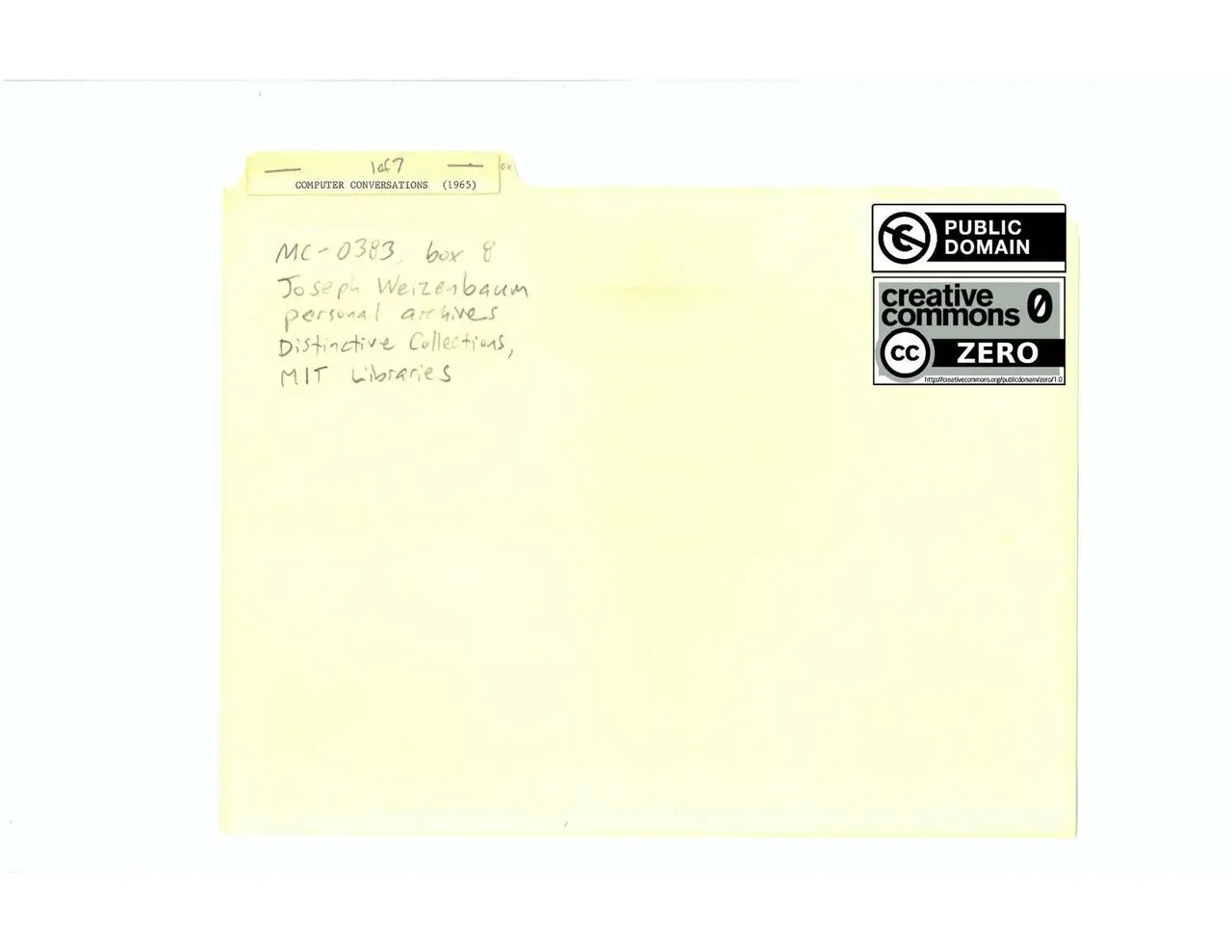
The original was found in 2021, in Weizenbaum's papers at MIT. Shrager, working with MIT archivist Myles Crowley, opened a set of files labelled "Computer Conversations" and found, in the first folder, a complete listing of ELIZA in MAD-SLIP with the therapist script attached. The Weizenbaum estate gave permission for the code to be released, and it is published under a CC0 public-domain dedication — the same source listing shown on this page.
The listing was not quite the published program. Reading it showed several functions described in the 1966 paper were missing, and the attached scripts were simpler, earlier versions. To find out whether it worked at all, the team transcribed roughly 2,600 lines of mostly uncommented MAD and FAP code by hand, ran it on a restored CTSS on an emulated IBM 7094, and tracked down a one-character error in an assembly-language routine. On 21 December 2024 the team had an executable; the original ELIZA, which by their account had not run for over 60 years, could hold complete conversations again.
With a corrected version of the script from the 1966 paper, the revived program reproduced the published conversation except in two places. Running it also exposed a bug no reading had caught: given numeric input such as "you are 999 today", this version crashes. And it confirmed that the "teaching" mode Weizenbaum mentioned only in passing — editing the script from inside a conversation — was fully implemented.
Placing ELIZA
The ELIZA Reanimated paper describes ELIZA as "usually considered the world's first chatbot", which is a fair statement of its reputation rather than a settled priority claim. What is not in doubt is the shape of the argument it started. ELIZA showed that a system with no model of meaning could still be experienced as understanding, and its author spent the following decades warning about exactly that. For the longer history around it, see the AI timeline, which runs from the Dartmouth workshop of 1956 to the large language models whose fluency made Weizenbaum's 1966 paragraph newly relevant.
Questions this page answers
- Who created ELIZA?
- Joseph Weizenbaum at MIT. He wrote it in MAD-SLIP and published it in Communications of the ACM in January 1966.
- What is the difference between ELIZA and DOCTOR?
- ELIZA is the engine. What it says is governed by a swappable script, and DOCTOR is the best-known one, imitating a Rogerian psychotherapist.
- Did ELIZA understand what people typed?
- No. It picked keywords out of the input and rephrased them back using decomposition and reassembly rules. In the paper Weizenbaum argued that the impression of being understood is the speaker's own contribution.
Sources
PrimaryWeizenbaum, J. (1966). ELIZA — text of the CACM 9(1) paper, hosted by UMBC
MAD-SLIP, the IBM 7094 and the MAC time-sharing system; the Pygmalion naming; scripts as data; Welsh and German scripts; the closing discussion of what the speaker contributes
The 2021 discovery of the original source, its revival on emulated CTSS on 21 December 2024, how Cosell's Lisp clone spread, and the numeric-input crash
TertiaryELIZA — Wikipedia
Last updated: