T1#research#military
The Lighthill Report and the First AI Winter
Metadata
- Date
- Decade
- 1970s
- Tier
- T1
- Timelines
- A History of Artificial Intelligence
- Sources
- 07
- Connections
- 00
- Tags
- #research#military
The first AI winter is the name later given to a period of shrinking funding for artificial intelligence research that is usually dated from about 1974 to 1980. It had two main sources. In Britain it followed the Lighthill report, a review written for the Science Research Council, dated July 1972 and published early in 1973. In the United States it followed a tightening of military research funding after the Mansfield Amendment of 1969, which pushed DARPA toward work with direct defence uses. The label itself came later — and some historians now argue that, outside a few elite laboratories, there was no winter at all.
A Mathematician's Survey
The Science Research Council (SRC) was receiving more and more grant applications in a broad field that went, as Lighthill put it, under the general description of artificial intelligence. Its chairman, B. H. Flowers, explained in his preface that the subject was too contentious to assemble a dispassionate panel of experts in the usual way, so he asked Sir James Lighthill — Lucasian Professor of Applied Mathematics at Cambridge, and not an AI researcher — for a personal review.
Lighthill sorted the field into three categories. A stood for Advanced Automation: replacing people with machines for specific industrial, military, mathematical or scientific purposes. C stood for Computer-based Central Nervous System research: using computers to study the brain. Between them sat B, which stood both for "Bridge" and for its central activity, Building Robots. Lighthill found respectable, if disappointing, progress in A and C. Category B, he argued, had been even more disappointing, and its case for existing at all was weak.
His overall verdict was blunt: "In no part of the field have the discoveries made so far produced the major impact that was then promised." He singled out one general cause — failure to recognise the implications of the "combinatorial explosion," the way possible combinations grow explosively as a knowledge base gets larger. He also pointed to machine translation as the most notorious disappointment, citing a 1966 review by the US National Academy of Sciences, better known as the ALPAC report.
The SRC discussed the report in September 1972 and published it the following year, together with rebuttals from Stuart Sutherland, Roger Needham, Christopher Longuet-Higgins and Donald Michie. In June 1973 the BBC broadcast a debate at the Royal Institution between Lighthill and Michie, Richard Gregory and John McCarthy.
The British Cuts
The Chilton Computing archive, which hosts the report, summarises the effect: it provoked a massive loss of confidence in AI by the British academic establishment, including the funding body, and that loss persisted for almost a decade. The next major British effort came only after a 1982 review of intelligent knowledge-based systems, which became part of the Alvey Programme. Wikipedia's summary, citing secondary histories, says AI research carried on in only a few universities, among them Edinburgh, Essex and Sussex.
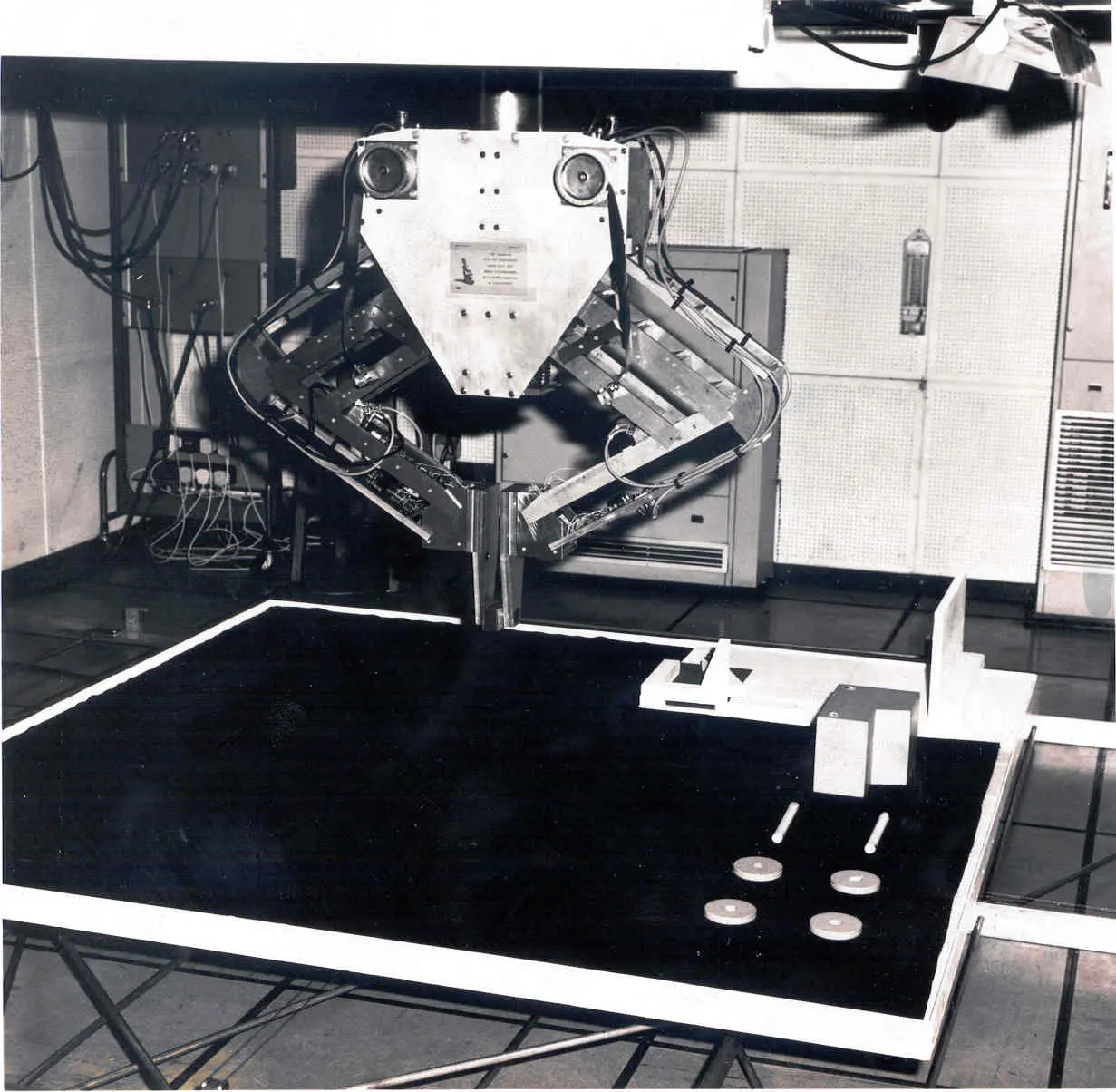
Edinburgh was the obvious target. Thomas Haigh, writing in Communications of the ACM, describes Lighthill as having been commissioned with the specific intent of justifying the withdrawal of funding from Donald Michie's Edinburgh lab — then the most important AI centre in Britain, and home of the Freddy II robot pictured on this page.
The American Side: Mansfield and SUR
The US story was largely separate, though not entirely. The National Research Council's 1999 history Funding a Revolution identifies the Mansfield Amendment, passed in 1969 amid Vietnam-era concern about military domination of academic science, as the most important change. It restricted the Defense Department to supporting basic research with a "direct and apparent" relationship to military functions. DARPA's computing office now had to justify AI programmes by their immediate military usefulness.
The Lighthill report added pressure. According to the same history, it raised questions about AI funding in the United States and led the Defense Department to set up a panel, the American Study Group, to assess DARPA's AI programme. The outcome was a shift of DARPA money away from robotics, which hurt laboratories such as SRI that had committed heavily to it, and toward mission-oriented research.
Speech recognition shows how it played out. DARPA's Speech Understanding Research (SUR) programme began in 1971 with $3 million a year for five years and the intention of a follow-on. When the systems were demonstrated at the end — Carnegie Mellon's HARPY came closest to the goals — the testing was disputed, some at DARPA judged the programme a failure, and DARPA ended it without funding the follow-on. It returned to speech recognition on a large scale only in 1984, under the Strategic Computing Program.
Was There a Winter?
Haigh argues there was not, at least not broadly. Membership of ACM's SIGART, the main AI interest group of the 1970s, stood at 1,241 when the Lighthill report appeared in 1973 — about twice its 1969 level — and had almost tripled to 3,500 by mid-1978, growing faster than the ACM as a whole. In his reading, the pain was real but concentrated in a handful of highly visible, DARPA-funded sites whose leaders later wrote the field's memoirs.
The phrase "AI winter" was not used in the 1970s. It appears in the record at a panel at the 1984 AAAI conference, published in AI Magazine as "The Dark Ages of AI," where Drew McDermott described a worst case — commercial AI collapsing and funding vanishing — and noted that some were calling that condition the "AI Winter." The 1970s retrenchment was named the first one after the fact.
For what came before, see the Dartmouth workshop and the perceptron; for the field as a whole, the AI timeline.
Questions this page answers
- What is an AI winter?
- It is a period when expectations of artificial intelligence collapse and research funding is cut sharply. The phrase was in use at a panel at the 1984 AAAI conference, about a downturn that might be coming; the retrenchment of the 1970s was labelled the first AI winter in hindsight.
- When was the first AI winter?
- Usually about 1974 to 1980, following the Lighthill report in Britain (published 1973) and DARPA's shift after the 1969 Mansfield Amendment in the US. The historian Thomas Haigh argues there was no broad winter: membership of ACM's AI group SIGART grew from 1,241 in 1973 to 3,500 by mid-1978.
- When was the Lighthill report published?
- It was dated July 1972, discussed by the British Science Research Council that September, and published early in 1973. The year 1974 is the usual start date of the first AI winter, not the date of the report.
- Did the Lighthill report cause the American AI winter too?
- Not mainly. In the US, the 1969 Mansfield Amendment restricted Defense Department support to research with direct military relevance, and DARPA ended its Speech Understanding Research programme without a follow-on. But the Lighthill report did raise questions in the US, and led the Pentagon to set up a panel to assess DARPA's AI programme.
Sources
Dated July 1972; prompted by rising applications to the SRC; the 'in no part of the field' sentence; the combinatorial explosion; reference to the 1966 US National Academy review of machine translation
Published early 1973; loss of confidence among UK academics and the funding body lasting almost a decade; June 1973 BBC debate; SRC discussed it in September 1972 and decided to publish (Flowers' preface)
Mansfield Amendment (1969); SUR (begun 1971, $3M a year for five years, ended without a follow-on); Lighthill report prompting the DOD's American Study Group; criticism of robotics
SecondaryHaigh, T. (2023). There Was No 'First AI Winter'. Communications of the ACM 66(12), 35–39
SIGART membership (1,241 in 1973 to 3,500 by mid-1978); the view that the report was commissioned to justify withdrawing funding from Michie's Edinburgh lab
PrimaryMcDermott, D. et al. (1985). The Dark Ages of AI: A Panel Discussion at AAAI-84. AI Magazine 6(3)
Uses the term 'AI Winter' for a possible future collapse in funding
TertiaryAI winter — Wikipedia
Last updated: