T1#research
Generative Adversarial Nets (GAN) — The Generative Model That Pits a Forger Against the Police
Metadata
- Date
- Decade
- 2010s
- Tier
- T1
- Timelines
- A History of Artificial Intelligence
- Sources
- 06
- Connections
- 05
- Tags
- #research
A GAN (generative adversarial network) is a generative-modelling framework that trains a "generator", which produces realistic data, against a "discriminator", which tries to tell real from fake. Ian Goodfellow and seven co-authors at the Université de Montréal posted the paper "Generative Adversarial Nets" to arXiv on 10 June 2014, and it was published the same year at NIPS 2014 (Advances in Neural Information Processing Systems 27).
GANs became widely known as the technique that produces photographs of people who do not exist, and they showed that deep learning could be good at making things, not just recognising them. They also pushed a question out of the lab and into society: what happens when fake images and video become indistinguishable from real ones?
What the paper proposed
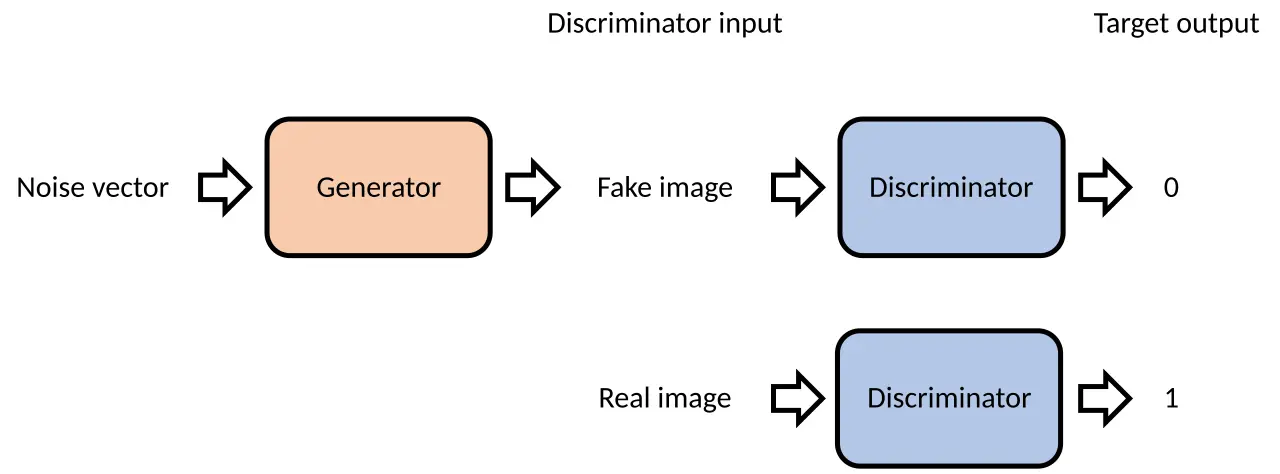
The abstract describes a new framework for estimating generative models via an adversarial process. Two models are trained at once: a generative model G that captures the data distribution, and a discriminative model D that estimates the probability that a sample came from the training data rather than from G. "The training procedure for G is to maximize the probability of D making a mistake." The abstract says this corresponds to a minimax two-player game.
In the space of arbitrary functions the game has a unique solution, in which G recovers the training-data distribution and D outputs one half everywhere. When G and D are multilayer perceptrons, the whole system can be trained with backpropagation alone, with no need for Markov chains or unrolled approximate inference networks during either training or generation. That was how it sidestepped the difficulties that had held back deep generative models.
The introduction explains the idea with an analogy: "The generative model can be thought of as analogous to a team of counterfeiters, trying to produce fake currency and use it without detection, while the discriminative model is analogous to the police, trying to detect the counterfeit currency." Competition drives both sides to improve until the counterfeits cannot be told from the genuine article.
| Item | Detail |
|---|---|
| Title | Generative Adversarial Nets (now titled Generative Adversarial Networks on arXiv) |
| Authors | Ian Goodfellow, Jean Pouget-Abadie, Mehdi Mirza, Bing Xu, David Warde-Farley, Sherjil Ozair, Aaron Courville, Yoshua Bengio |
| Affiliation | Université de Montréal (some authors visiting from other institutions) |
| On arXiv | 10 June 2014 (arXiv:1406.2661) |
| Published at | NIPS 2014 (Advances in Neural Information Processing Systems 27) |
| Data used | MNIST (handwritten digits), the Toronto Face Database, CIFAR-10 |
| Code | Code and hyperparameters released, per a footnote in the paper |
From a Montreal bar
According to a 2018 profile in MIT Technology Review, one night in 2014 Goodfellow was at Les 3 Brasseurs, a Montreal bar, celebrating a fellow doctoral student's graduation. Friends asked for help with a computer that could create photos by itself; he told them their proposed method needed far too much number-crunching. Over his beer he hit on the idea of pitting two neural networks against each other, went home, coded into the early hours, and it worked the first time. The paper's acknowledgements duly thank Les Trois Brasseurs "for stimulating our creativity."
The same article reports that Yann LeCun called GANs "the coolest idea in deep learning in the last 20 years," and that Andrew Ng described them as "a significant and fundamental advance." Both are assessments the article relays.
StyleGAN and people who do not exist
After the paper, GANs became a field of rapid variation. MIT Technology Review noted that hundreds of GAN papers had been written since 2014, and that a fan had built a "GAN zoo" page to track the versions. In 2017 researchers at NVIDIA drew wide attention with a GAN that generated pictures of imaginary celebrities after training on photos of real ones.
On 12 December 2018 NVIDIA's Tero Karras and colleagues posted "A Style-Based Generator Architecture for Generative Adversarial Networks", the StyleGAN paper. Trained on human faces, its generator automatically separates high-level attributes such as pose and identity from stochastic variation such as freckles and hair, allowing scale-specific control; the paper also introduced a new, high-quality dataset of faces. In its profile of 2018 Turing Award laureate Yoshua Bengio, the ACM says GANs have been widely used to generate images, for example highly realistic photographs of non-existent people or objects for use in video games.
The link to deepfakes
GANs are often called "the deepfake technology", but the relationship is more tangled. According to a 2020 survey by Yisroel Mirsky and Wenke Lee, at the end of 2017 a Reddit user named "deepfakes" was found to be using deep learning to swap celebrities' faces into pornographic videos, causing a media frenzy. In 2018 BuzzFeed released a deepfake of former president Barack Obama made with that user's software (FakeApp), raising concerns about impersonation and misinformation. The survey states that the original deepfake network published by the Reddit user was an encoder-decoder with one encoder and two decoders. GAN-based variants, such as faceswap-GAN in 2018, came afterwards.
Even so, the GAN idea of making fakes indistinguishable from the real thing was seen early on as an accelerant. MIT Technology Review's 2018 article wrote that a machine designed to create realistic fakes is a perfect weapon for purveyors of fake news who want to influence everything from stock prices to elections, and concluded: "GANs didn't create this problem, but they'll make it worse." Hany Farid of Dartmouth College, who works on detecting fake videos, warned that GANs would adapt in turn: "We're fundamentally in a weak position." According to the article, Goodfellow himself, by then at Google Brain, was spending much of his time working against those who wished to misuse his invention.
In the 2020s those fears turned into real harm. Impersonation with generative AI showed up in cases such as the 2024 Arup video-call fraud in Hong Kong and the fake Biden robocall before a 2024 primary, though the techniques used in such cases were not necessarily GANs. In image generation, a different family, diffusion models such as Stable Diffusion, also rose to prominence.
What it meant for society
The impact cut both ways. MIT Technology Review described Casey Greene of the University of Pennsylvania proposing synthetic medical records almost as good as real ones, which could be shared widely for research while the real records stayed protected. Goodfellow himself said GANs could drive the next big wave in science and engineering problems that involve optimising something, from more effective medicines to more efficient batteries.
On the other side, once generated images and video cannot be told from real ones, the assumption that a photograph or a recording counts as evidence, in journalism, in court and in everyday life, starts to give way. The contest between forger and detective that sits inside a GAN has, in effect, been reproduced in society at large. The wider story of AI is on the AI timeline.
Questions this page answers
- What is a GAN (generative adversarial network)?
- It is a framework that trains two models against each other: a generative model G that produces realistic data and a discriminative model D that judges whether data is real or made by G. G learns to fool D while D learns to catch it; in the ideal case G recovers the training-data distribution and D outputs one half everywhere.
- When and by whom was the GAN paper published?
- Ian Goodfellow, Jean Pouget-Abadie, Mehdi Mirza, Bing Xu, David Warde-Farley, Sherjil Ozair, Aaron Courville and Yoshua Bengio posted it to arXiv on 10 June 2014; it was published at NIPS 2014 the same year.
- Are deepfakes made with GANs?
- Not necessarily. According to a 2020 survey by Mirsky and Lee, the original deepfake network published by a Reddit user at the end of 2017 was an encoder-decoder with one encoder and two decoders, not a GAN. GAN-based methods, such as variants that add an adversarial loss, spread afterwards.
- What have GANs been used for?
- The ACM says they have been widely used to generate images, for example highly realistic photographs of non-existent people or objects for video games. MIT Technology Review also described scientific uses, such as generating near-real synthetic medical records that can be shared for research.
Sources
PrimaryGenerative Adversarial Networks — Goodfellow et al., arXiv:1406.2661 (v1 submitted 10 June 2014)
Submission date, authors, abstract, the counterfeiters-and-police analogy, experiments on MNIST, TFD and CIFAR-10, acknowledgements
PrimaryYoshua Bengio — A.M. Turing Award laureate profile, ACM
That Bengio developed the GAN concept with Goodfellow, and that GANs are widely used to generate realistic photographs of non-existent people or objects
The idea in a Montreal bar, LeCun's and Ng's assessments, synthetic medical records, concerns about fakes and Hany Farid's comment
The Reddit user 'deepfakes' at the end of 2017, BuzzFeed's 2018 Obama video, and the original network being an encoder-decoder
Last updated: