ORGANIZATION
Bell Labs
Founded on 1 January 1925 as a jointly and evenly owned venture of AT&T and Western Electric, Bell Labs was among the twentieth century's largest industrial research institutions. The point-contact transistor (1947, Bardeen and Brattain); information theory (1948, Shannon); UNIX and C (1969 and 1972, Thompson and Ritchie); the CCD (1969, Boyle and Smith); the practical silicon solar cell; the theory of the laser—many of the inventions that reshaped the world emerged here. Ten Nobel Prizes and five Turing Awards have been awarded for work completed at the lab. After the 1984 AT&T breakup it continued under Lucent, then Alcatel-Lucent, and now Nokia.
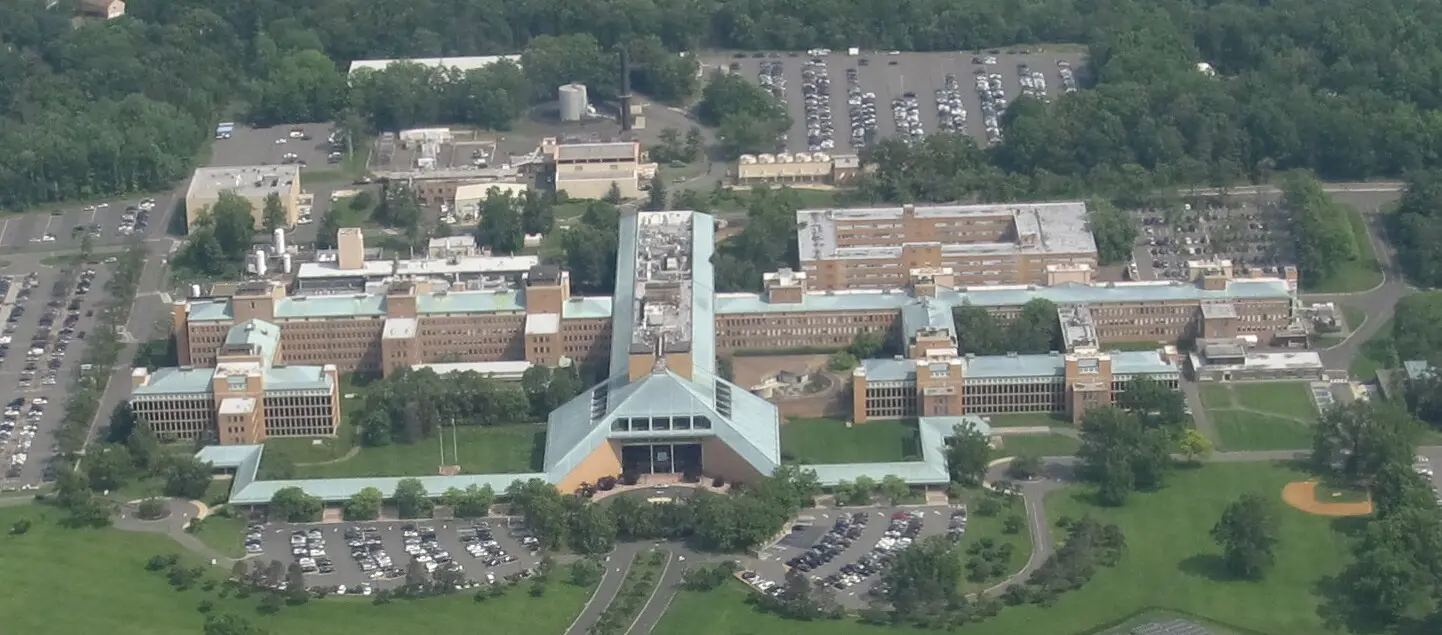
Organization
- Founded
- 1925
- Status
- Active
- Active
- 1925–
- Appearances
- 07
- Name
- ENBell LabsJAベル研究所
Bell Telephone Laboratories — later Bell Laboratories, and today Nokia Bell Labs — was incorporated on 1 January 1925, its ownership shared evenly between AT&T and Western Electric. Centred on Murray Hill, New Jersey, it became one of the most important industrial research institutions of the twentieth century: the transistor, information theory, UNIX, C, the CCD, and the practical silicon solar cell were all invented or substantially developed there. Ten Nobel Prizes and five Turing Awards have been awarded for work completed at the lab. After the 1984 break-up of AT&T it continued under Lucent, then Alcatel-Lucent, and since 2016 under Nokia; its headquarters are moving from Murray Hill to the HELIX innovation district in New Brunswick, New Jersey.
1925 to Nokia, by way of the Bell System break-up
By Nokia Bell Labs' own account, the lab grew out of the consolidation of several engineering departments inside AT&T and Western Electric, the Bell System's manufacturing arm. In 1925 some 4,000 scientists and engineers were assigned to the newly created Bell Telephone Laboratories and dedicated full-time to research; AT&T's Development and Research Department was folded in during 1934, and other development groups followed. Headquarters were at 463 West Street in Manhattan; research began moving to Murray Hill in 1941, and the headquarters designation followed officially in 1967.
During the Second World War the lab's resources went to military electronics — radar, magnetics, acoustics, cryptography. In peacetime management underwrote basic research: the point-contact transistor in December 1947 (John Bardeen and Walter Brattain; William Shockley devised the junction transistor, and the three shared the 1956 Nobel Prize in Physics), and in 1948 both Claude Shannon's information theory and Richard Hamming's error-correcting codes.
The 1950s and 1960s produced the practical silicon solar cell (1954, Chapin, Fuller and Pearson), the theory of the optical maser (1958, in a joint paper by Bell Labs' Arthur Schawlow and Columbia's Charles Townes), Telstar 1 with NASA (1962), and the discovery of the cosmic microwave background (1964, Penzias and Wilson). The semiconductor laser itself was first demonstrated in 1962 at General Electric, IBM and MIT Lincoln Laboratory; Bell Labs' contribution came in 1970, when Morton Panish and Izuo Hayashi achieved continuous-wave operation at room temperature. Then, within a single year, 1969 gave both UNIX, by Ken Thompson and Dennis Ritchie, and the CCD, by Willard Boyle and George Smith (Nobel Prize in Physics 2009). Ritchie's C followed in 1972, Bjarne Stroustrup's C++ in the 1980s, and the S statistical language (ancestor of R) also came from the lab.
The 1984 AT&T break-up (the Modification of Final Judgment) split several thousand staff off into Bellcore, the research organisation for the newly independent local exchange carriers. In 1996 AT&T spun off most of Bell Labs and its equipment-manufacturing business into Lucent Technologies, retaining a smaller group of researchers as AT&T Laboratories. The 2006 merger with Alcatel created Alcatel-Lucent Bell Labs; Nokia's 2016 acquisition of Alcatel-Lucent produced today's Nokia Bell Labs. In March 2025 the New Jersey Economic Development Authority approved up to US$103.9 million in Aspire tax credits for HELIX Phase 2 — the ten-storey, roughly 370,000-square-foot H-2 building in New Brunswick, with Nokia Bell Labs as its main tenant.
What came out of Murray Hill
| Year | Result | People |
|---|---|---|
| 1928 | Sampling theorem; theory of thermal noise | Harry Nyquist, John B. Johnson |
| 1937 | Electron diffraction (Nobel Prize in Physics) | Clinton Davisson |
| 1947 | Point-contact transistor | Bardeen, Brattain |
| 1948 | Information theory | Claude Shannon |
| 1948 | Hamming error-correcting codes | Richard Hamming |
| 1954 | Practical silicon solar cell | Chapin, Fuller, Pearson |
| 1958 | Theory of the optical maser (laser) | Schawlow (Bell Labs) with Townes (Columbia) |
| 1962 | Telstar 1 communications satellite, with NASA | Team |
| 1964 | Cosmic microwave background | Penzias, Wilson (Nobel 1978) |
| 1969 | UNIX | Ken Thompson, Dennis Ritchie |
| 1969 | CCD | Boyle, Smith (Nobel 2009) |
| 1970 | Room-temperature continuous-wave semiconductor laser | Panish, Hayashi |
| 1972 | C language | Dennis Ritchie |
| 1980s | C++ (2018 Draper Prize) | Bjarne Stroustrup |
| 1980s-90s | Quantum dots; applied convolutional neural networks | Louis Brus, Yann LeCun |
| 2001 / 2014 | MIMO, then massive MIMO | Team |
| 2020s | 6G, quantum networking, industrial AI | Team |
Key events
- 1 January 1925: Incorporated, ownership shared evenly by AT&T and Western Electric; about 4,000 staff.
- 1937: Clinton Davisson awarded the Nobel Prize in Physics for electron diffraction.
- December 1947: Amplification achieved in a point-contact device on 16 December; demonstrated to management on 23 December.
- 1956: Bardeen, Brattain, and Shockley share the Nobel Prize in Physics. The consent decree of the same year obliges AT&T to license its existing patents royalty-free.
- 1964: Penzias and Wilson discover the cosmic microwave background, the experimental evidence for the Big Bang.
- 1967: Headquarters formally relocated to Murray Hill.
- 1969: UNIX and the CCD in the same year.
- January 1984: AT&T break-up; several thousand staff leave to form Bellcore.
- 1996: AT&T spins most of Bell Labs and its manufacturing business into Lucent Technologies.
- 2006: Alcatel and Lucent merge.
- 2016: Nokia acquires Alcatel-Lucent; rebranded Nokia Bell Labs.
- March 2025: NJEDA approves up to US$103.9 m in Aspire tax credits for HELIX Phase 2, with Nokia Bell Labs as the anchor tenant of the H-2 building.
Ten Nobel Prizes and five Turing Awards
- Nobel Prizes for work completed at the lab: ten (1937 Davisson; 1956 Bardeen, Brattain, Shockley; 1977 Anderson; 1978 Penzias and Wilson; 1997 Chu; 1998 Störmer, Tsui, Laughlin; 2009 Boyle and Smith; 2014 Betzig; 2018 Ashkin; 2023 Brus)
- Turing Awards: five (1968 Hamming; 1983 Ritchie and Thompson; 1986 Tarjan; 2018 LeCun; 2020 Aho and Ullman)
- Peak headcount (~1980): reported at roughly 25,000
- HELIX H-2: ten storeys, about 370,000 sq ft; Aspire award up to US$103.9 m
Basic research paid for by a regulated monopoly
Bell Labs is the canonical example of a model the world has largely lost: deep basic research underwritten by a regulated monopoly. AT&T enjoyed monopoly rents from long-distance telephony and tacitly diverted a share of them to research whose immediate commercial application was unclear; the transistor and UNIX were the externalities of that arrangement. The 1956 consent decree required AT&T to license its existing patents royalty-free, which set the stage for Texas Instruments, Fairchild, Intel, and the whole of Silicon Valley. UNIX likewise spread because AT&T could not commercially exploit it outside telecommunications; the lab distributed it to universities cheaply, seeding BSD, Linux, and ultimately macOS.
After the 1984 break-up the resources and headcount shrank progressively. In 2002 the J. Hendrik Schön scandal — fabricated results in semiconductor and superconductivity physics during the Lucent era — led to a long series of retractions across Nature, Science and Physical Review; it became a touchstone case for the limits of peer review and internal verification. During Alcatel-Lucent's financial difficulties in the 2010s research budgets were squeezed further, and under Nokia the lab publishes four research areas: network fundamentals, automation, semiconductors and devices, and AI and software systems. The move to HELIX places it beside Rutgers and the New Brunswick biopharma cluster. Whether Bell Labs can again change the world is unclear, but the historical rarity of the regulated-monopoly research-lab model is now widely appreciated.
Appearances
- The Point-Contact Transistor — Bell Labs
- A Mathematical Theory of Communication — Information Gets a Unit
- The Birth of UNIX — Bell Labs
- The C Language — Dennis Ritchie
- 1BSD Released — The Berkeley Fork of UNIX Begins
- C++ Ships Commercially — Bjarne Stroustrup
- LeNet — The Convolutional Network That Read Zip Codes and Checks
Questions this page answers
- What is Bell Labs?
- An industrial research laboratory set up on 1 January 1925 and owned equally by AT&T and Western Electric, based at Murray Hill, New Jersey. The transistor, information theory, UNIX, C and the CCD all came out of it.
- What happened to Bell Labs?
- The 1984 AT&T break-up split several thousand staff off into Bellcore, and in 1996 most of the lab went to Lucent Technologies. It became Alcatel-Lucent Bell Labs after the 2006 merger and has been Nokia Bell Labs since Nokia's 2016 acquisition. Its headquarters are moving to the HELIX district in New Brunswick, New Jersey.
- Who invented the transistor at Bell Labs?
- The point-contact transistor of December 1947 was the work of John Bardeen and Walter Brattain; William Shockley devised the junction transistor. The three shared the 1956 Nobel Prize in Physics.
- How many Nobel Prizes came out of Bell Labs?
- Ten Nobel Prizes and five Turing Awards have been awarded for work done at the lab, from Davisson's 1937 prize for electron diffraction to Brus in 2023.
Sources
TertiaryBell Labs — Wikipedia
Last updated: