PERSON
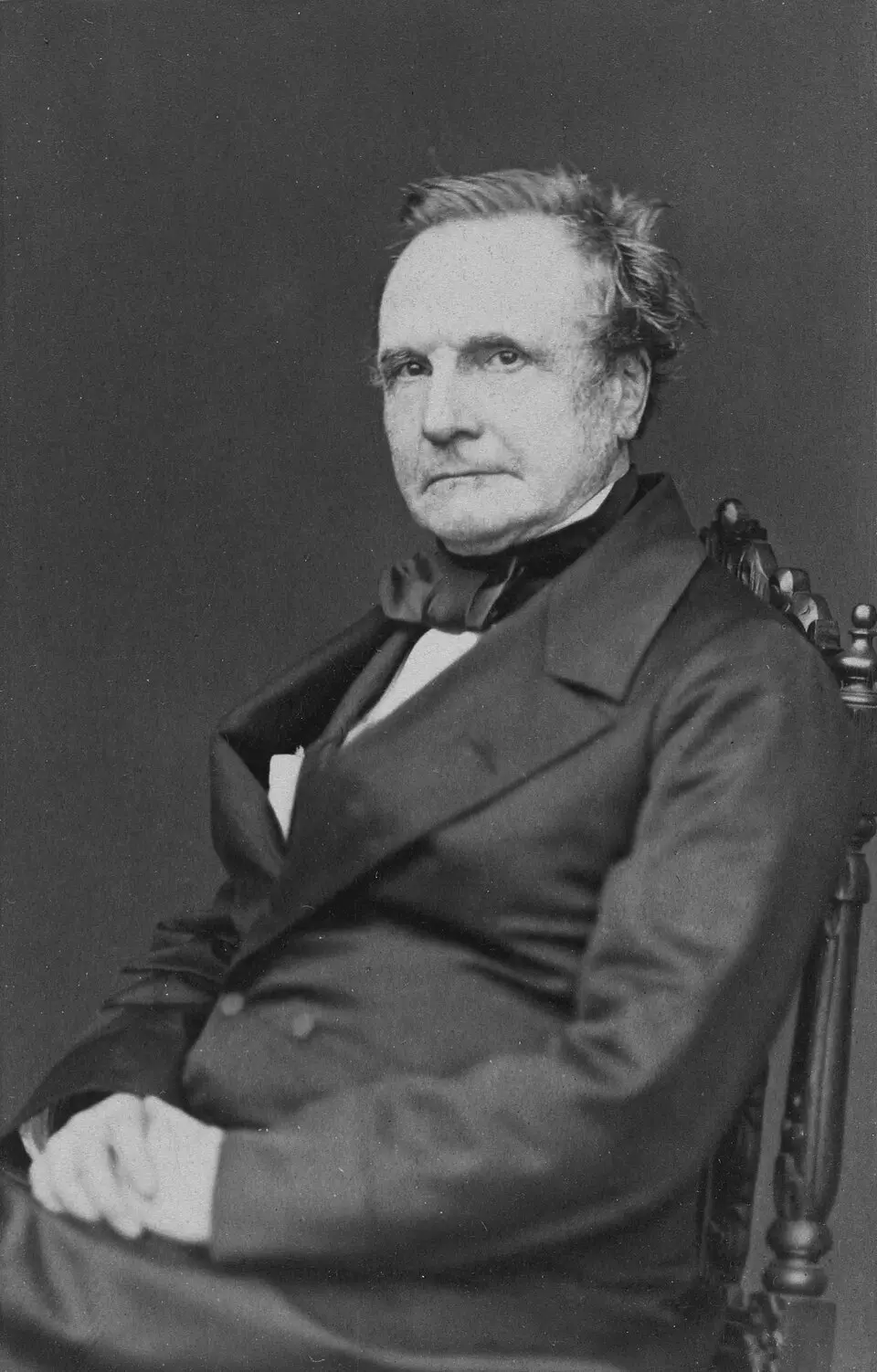
Charles Babbage
The English mathematician who first turned the idea of automatic computation into detailed engineering designs. He announced the Difference Engine in 1822 and built it with government money, but work stopped in 1833 after a dispute with his engineer Joseph Clement, with about one-seventh of the machine finished. In 1834 he conceived the Analytical Engine, programmed by punched cards and with a separate store for numbers and mill for arithmetic; he refined it for the rest of his life but never found the funds. His Difference Engine No. 2, designed in 1847-49, was built by the Science Museum, which completed the calculating section in 1991 for his bicentenary and the printer in 2002, showing that the design works.
Profile
- Born
- 1791
- Died
- 1871
- Span
- 80 years
- Appearances
- 00
- Name
- ENCharles BabbageJAチャールズ・バベッジ
Charles Babbage (26 December 1791 – 18 October 1871) was the English mathematician who turned the idea of handing calculation to a machine into engineering drawings detailed down to individual parts. He designed the Difference Engine, for producing mathematical tables, and the general-purpose Analytical Engine, instructed by punched cards. Neither was completed in his lifetime. Confirmation that his designs worked came 120 years after his death, when the Science Museum in London assembled the calculating section of his Difference Engine No. 2 in 1991.
Background
His birth year was long given as 1792. A nephew wrote to The Times a week after the obituary to say it was 26 December 1791, and in 1975 Anthony Hyman found that his birth had been registered at St Mary's, Newington, London, on 6 January 1792, which settled the matter in favour of 1791 (MacTutor). His father was a banker.
He went up to Trinity College, Cambridge, in October 1810. Cambridge then taught calculus in Newton's notation; Babbage preferred Leibniz's continental notation, and in 1812 he founded a student society, the Analytical Society, with John Herschel, George Peacock and others, which translated Lacroix's calculus textbook into English (published 1816). He graduated from Peterhouse in 1814, was elected a Fellow of the Royal Society in 1816 at twenty-four, and in 1820 was a major influence in founding the Royal Astronomical Society. He also held the Lucasian chair of mathematics at Cambridge (MacTutor has him appointed in 1827 for twelve years; Turing's 1950 paper gives 1828 to 1839) but never taught. His time went into the engines.
The Difference Engine (1822-1833)
In the early nineteenth century navigators, engineers and bankers relied on printed mathematical tables. Human computers compiled them, and errors crept in at every stage: calculation, transcription, typesetting and printing. According to the Science Museum, Babbage, frustrated by the mistakes, declared in 1821 at a meeting with his friend Herschel: "I wish to God these calculations had been executed by steam".
His chosen method was the method of finite differences. A table of polynomial values can be produced by repeating nothing but addition and subtraction, which is far easier to mechanise than multiplication. On 14 June 1822 he announced the Difference Engine in a paper read to the Royal Astronomical Society. According to MacTutor he had by then completed a small trial engine, which produced values of n² + n + 41 at about sixty every five minutes.
The government paid for a full-scale engine. It was built of brass gear wheels, rods and ratchets, with numbers held in decimal by the positions of ten-toothed wheels. Making hundreds of near-identical precision parts sat somewhere between craft and mass production, and the work fell to the engineer Joseph Clement. In 1832 a section of about 2,000 parts was completed — about one-seventh of the design — and Babbage demonstrated it to visitors. In 1833 a dispute with Clement stopped the work. The Science Museum puts the Treasury's outlay at £17,500, the cost of twenty-two new steam locomotives from Robert Stephenson's works in 1831. The government's decision not to proceed came nine years later, in 1842 (MacTutor).
The Analytical Engine (1834-)
In 1834, with the Difference Engine stalled, Babbage began a far more ambitious machine. The Analytical Engine was meant to carry out not one fixed kind of calculation but any calculation set before it.
Its organisation will look familiar:
| Part | Function | Today's term |
|---|---|---|
| Store | Holds numbers and intermediate results; 1,000 numbers of 50 digits (MacTutor) | Memory |
| Mill | Performs the arithmetic | Arithmetic unit |
| Punched cards | Specify the sequence of operations, borrowing the method the Jacquard loom used for woven patterns | Program |
| Printing and card output | Delivers results; punching data to cards and reading it back later extends capacity | Output and external storage |
The Science Museum calls the separation of store and mill a fundamental feature of the internal organisation of modern computers. Built, the engine would have been the size of a small locomotive and powered by steam. Babbage designed several versions and kept refining it for the rest of his life, but after the Difference Engine he did not seek government support, and the money never came. When he died in 1871 a trial piece of the mill was still under construction.
In his 1950 paper Computing Machinery and Intelligence, Alan Turing introduced the Analytical Engine as an early digital computer, wrote "Although Babbage had all the essential ideas", and used the fact that it was entirely mechanical to argue that whether a computer is electrical is of no theoretical importance.
Menabrea and Lovelace
In 1840 Babbage visited Turin and discussed the Analytical Engine with mathematicians there. One of them, the military engineer L. F. Menabrea, collected the material and published an account in French in a Geneva journal in October 1842. Ada Lovelace translated it into English and added notes about three times the length of the original, published in 1843. In his autobiography, Passages from the Life of a Philosopher (1864), Babbage wrote that adding the notes had been his suggestion. The argument over how much of the notes was Lovelace's own work is set out on her page.
Difference Engine No. 2: a design that ran in 1991
Between 1847 and 1849 Babbage redesigned the Difference Engine using techniques developed for the Analytical Engine. Difference Engine No. 2 did the same job with about one-third the parts of the first. He made no attempt to build it.
The Science Museum began construction in 1985, drawing on its collection of Babbage's models and components and on its Babbage archive, which holds almost all the surviving technical material on his calculating machines; the work was led by Doron Swade, then curator of computing. The calculating section was completed in 1991 for an exhibition marking the bicentenary of his birth, and the printing mechanism was added in 2002. According to the Computer History Museum the finished engine has 8,000 parts, weighs five tons and is 11 feet long, and was completed 153 years after it was designed. It is driven by a hand crank, not steam. The museum built one other copy, which was displayed for many years at the Computer History Museum in California.
By 2011 Swade and others had formed Plan 28 to build a working Analytical Engine, and the Science Museum digitised the Babbage archive; in 2016 the catalogue went online with more than 7,700 images.
Assessment
None of Babbage's engines ran in his lifetime, and to the government of the day the first Difference Engine was an expensive failure. Yet his drawings, notebooks and trial pieces show that a general-purpose machine, controlled by a program and with memory separated from arithmetic, existed on paper in the first half of the nineteenth century. The 1991 engine then demonstrated, in metal, that his design could be built to the precision of its time.
Beyond the engines, his Reflections on the Decline of Science in England (1830) attacked the state of British science and led to the founding of the British Association for the Advancement of Science the following year (MacTutor).
Questions this page answers
- What is Charles Babbage known for?
- He was the English mathematician who designed the Difference Engine, announced in 1822 to produce mathematical tables by machine, and the general-purpose Analytical Engine, conceived in 1834 and instructed by punched cards. The Science Museum notes that the Analytical Engine's separation of a store for numbers from a mill for arithmetic is a fundamental feature of modern computers.
- Were Babbage's engines ever built?
- Not in his lifetime. Work on the first Difference Engine stopped in 1833 with about one-seventh assembled, and a trial piece of the Analytical Engine's mill was still under construction when he died. The Science Museum built Difference Engine No. 2 from his drawings, completing the calculating section in 1991 and the printer in 2002.
- How big is Difference Engine No. 2?
- According to the Computer History Museum it has 8,000 parts, weighs five tons and is 11 feet long. It is driven by a hand crank, not by steam.
- How was Babbage connected to Ada Lovelace?
- They met in June 1833, and Lovelace became a lifelong friend after seeing the working section of the Difference Engine demonstrated. In 1843 she published an English translation of Menabrea's paper on the Analytical Engine with notes about three times its length; Babbage wrote in his autobiography that he had suggested she add them.
Sources
PrimaryCharles Babbage's Difference Engines and the Science Museum — Science Museum, published 18 July 2023
The 14 June 1822 announcement; Clement's ~2,000-part section (completed 1832, one-seventh of the design); the 1833 halt and £17,500; the 1834 Analytical Engine with store and mill; Difference Engine No. 2 (designed 1847-49, begun 1985, first phase 1991, printer 2002, led by Doron Swade)
PrimaryThe Babbage Engine — Computer History Museum
Difference Engine No. 2: 8,000 parts, five tons, 11 feet long; completed in London in 2002, 153 years after it was designed
How he suggested that Lovelace add notes to her translation, and his account of the Bernoulli-number section
PrimaryTuring, A. M. Computing Machinery and Intelligence. Mind, October 1950, pp. 433-460
Section 5 on the Analytical Engine (gives the Lucasian chair as 1828-1839)
Settling the birth date (Hyman 1975), the Analytical Society, the Lucasian chair, government funding and the 1842 decision, the store's capacity
TertiaryCharles Babbage — Wikipedia
Last updated: