PERSON
Ada Lovelace
Lord Byron's daughter and the mathematician who put Charles Babbage's Analytical Engine into words. In 1843 she published an English translation of Menabrea's paper on the engine with Notes A to G, about three times the original's length. The last, Note G, contains a table setting out how the engine would compute Bernoulli numbers, often called the first computer program. She foresaw the engine handling symbols and music as well as numbers, and also wrote that it could originate nothing, a view Turing took up as an objection in 1950. Scholars disagree on how much of the notes was her own work. The Ada programming language, born of US military requirements, is named after her.
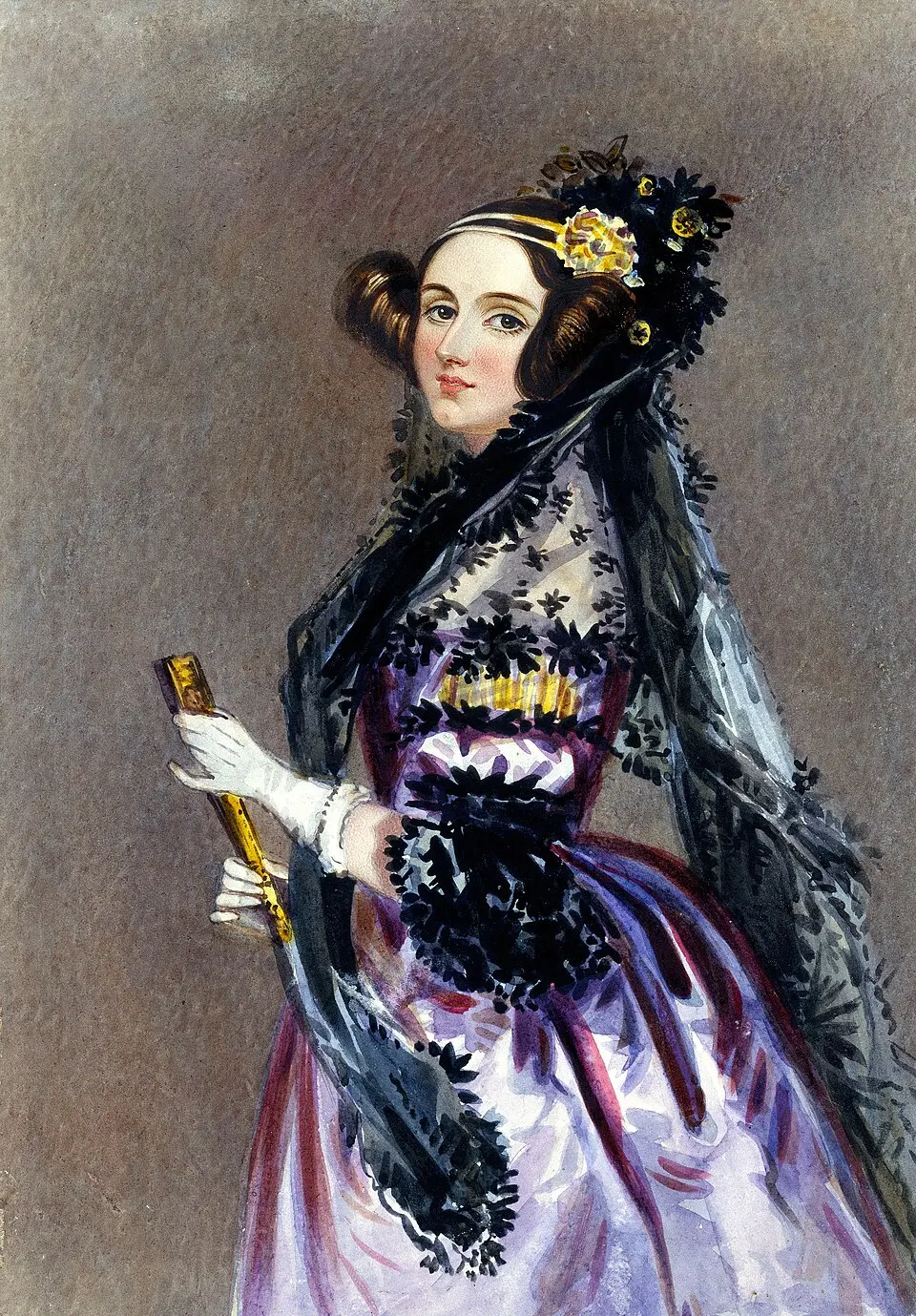
Profile
- Born
- 1815
- Died
- 1852
- Span
- 37 years
- Appearances
- 00
- Name
- ENAda LovelaceJAエイダ・ラブレス
Ada Lovelace (born Augusta Ada Byron; Augusta Ada King, Countess of Lovelace; 10 December 1815 – 27 November 1852) was the mathematician who in 1843 wrote a long set of notes on the Analytical Engine designed by Charles Babbage. The table of Bernoulli-number calculations at the end of those notes is often called the "first computer program". How much of the notes was her own work, and how good a mathematician she was, are questions on which historians have sharply disagreed. This page sets out both sides, source by named source.
Early life
Her father was the poet Lord Byron and her mother Anne Isabelle Milbanke. They married in January 1815 and separated in January 1816, a month after she was born. Byron left England that year and she never saw him again (MacTutor). Her mother had her educated by tutors with a strong emphasis on mathematics, partly so that she would not become a poet like her father. In her teens the mathematician and science writer Mary Somerville sent her books, set her problems and talked to her about Babbage and his engines.
On 5 June 1833, at seventeen, she met Babbage at a party; two weeks later she and her mother visited his studio and saw the small working section of the Difference Engine. According to the Science Museum this began a lifelong friendship, and Babbage called her the "Enchantress of numbers". She married William King on 8 July 1835 and became Countess of Lovelace when he was made an earl in 1838. After the births of their three children she took a university-level correspondence course in mathematics with Augustus De Morgan of University College London in 1840-41.
The notes of 1843
In 1840 Babbage discussed the Analytical Engine with mathematicians in Turin, among them L. F. Menabrea, who published an account in French in October 1842. Lovelace translated it. In Babbage's autobiography (1864), he asked why she had not written an original paper of her own; she replied that the thought had not occurred to her, and he suggested she add notes to the translation. Notes A to G came to about three times the length of the original and appeared in 1843 in volume 3 of Taylor's Scientific Memoirs, with the translator identified as A.A.L.
The notes are still read because they discuss not the engine's gears but what such a machine could do.
- Note A locates the difference between the Analytical and Difference Engines in the Jacquard loom's punched cards: "the Analytical Engine weaves algebraical patterns just as the Jacquard-loom weaves flowers and leaves". The same note argues that if the relations of pitched sounds could be expressed in the engine's notation, it "might compose elaborate and scientific pieces of music of any degree of complexity or extent". The Science Museum describes this view — that the engine could manipulate symbols and musical notes, not just numbers — as a conceptual leap not fully appreciated until electronic computing a century later
- Note G opens by warning against exaggeration: "The Analytical Engine has no pretensions whatever to originate anything. It can do whatever we know how to order it to perform." It then follows step by step how the engine would compute the Bernoulli numbers, with a diagram and table for B₇. As Hollings and colleagues explain, the table shows how each part of the machine changes at each stage of the computation — in modern terms an execution trace — and the program itself would have been the corresponding stack of punched cards
The opening of Note G is what Alan Turing took up in 1950 as "Lady Lovelace's Objection", the classic statement that a machine can only do what it is told (Turing cited the notes as a memoir of 1842). In the same passage he wrote that the Analytical Engine was a universal digital computer which, with enough storage and speed, could by suitable programming mimic other machines, an argument that, he thought, probably had not occurred to the Countess or to Babbage.
The debate over her contribution
Opinions of Lovelace, Hollings, Martin and Rice write in their 2017 paper, have ranged from "genius" to "charlatan". The main positions:
| Position | Who | Claim |
|---|---|---|
| Contemporary testimony | Charles Babbage (1864) | The choice of illustrations and the algebraic working-out were hers, except the Bernoulli numbers, which he offered to do to save her the trouble; she sent his working back, having found a grave mistake in it |
| Contemporary testimony | Augustus De Morgan (1844, private letter to her mother) | Her power of mathematical thinking was utterly out of the ordinary for a beginner; in a young man about to go to Cambridge he would have predicted an original investigator, perhaps of first-rate eminence |
| Low estimate of her ability | Dorothy Stein (biography, 1985) | Her elementary errors and frequent questions on points of detail show a tenuous grasp of mathematics |
| Small contribution | Allan Bromley (1990) | There is no evidence she ever prepared a program for the Analytical Engine, and her correspondence with Babbage shows she lacked the knowledge to do so |
| Doubtful understanding | Doron Swade (2000) | In the late 1830s she lacked the background to have understood accounts of the Difference Engine |
| Synthesiser | Betty Toole (1992) | A synthesiser and visionary who saw the need for a more expressive mathematical and scientific language that incorporated imagination |
| Collaboration | Thomas Misa (2016) | The 1843 paper, mathematics included, was the product of an intense intellectual collaboration with Babbage |
| Reassessment | Hollings, Martin and Rice (2017) | The first analysis of her correspondence with De Morgan by historians of mathematics, with the letters re-dated, concludes that by early 1842 she had a solid grounding in university-level mathematics and a critical attitude to first principles; the letter central to Stein's case dates from 1840, not 1842 |
The last study was led by Ursula Martin at Oxford, working from the mathematical papers in the Lovelace-Byron archive at the Bodleian Library; the correspondence is online, with transcriptions, at the Clay Mathematics Institute. Babbage's account, for its part, is the recollection of an interested party, and is compatible with Misa's description of a collaboration. This page does not pick a winner. What is not in dispute is that the notes were published under her initials, that Babbage himself credited her with everything except the Bernoulli working, and that their content — the prospect of a machine handling more than numbers, and the caveat that it originates nothing — carried straight into the arguments about computers a century later.
Later life
After the notes were published her health was often poor, and the further mathematical work she planned did not materialise. She died of cancer in 1852, aged thirty-six (MacTutor).
The Ada language
In the 1970s the US military, troubled that its software was written in hundreds of languages and dialects, drew up requirements for a new high-level language and put them out to competition. The winner was a French team led by Jean Ichbiah, and the government team named the language Ada in Lovelace's honour (Ada Resource Association). It is not an acronym. The first version, Ada 83, dates from the early 1980s; the language targets large, long-lived applications such as embedded systems, where reliability is essential.
Questions this page answers
- What did Ada Lovelace do?
- In 1843 she published an English translation of Menabrea's paper on Babbage's Analytical Engine, with notes about three times the original's length. The notes argue the engine could handle symbols and music as well as numbers, and the last, Note G, tabulates the steps for computing Bernoulli numbers.
- Was Ada Lovelace the first computer programmer?
- The Note G table is often called the first computer program, but historians disagree. Allan Bromley argued she lacked the knowledge to program the Analytical Engine; Thomas Misa calls the paper the product of an intense collaboration with Babbage; Hollings, Martin and Rice, from her correspondence with De Morgan, challenge the low estimate of her mathematical ability.
- Who worked out the Bernoulli numbers in Note G?
- In his 1864 autobiography Babbage wrote that the choice of illustrations and the algebraic working-out were hers, except the Bernoulli-number problem, which he had offered to do to save her the trouble; she sent it back for an amendment, having found a grave mistake in his working.
- Why is the Ada programming language called Ada?
- It was named in her honour by members of the US government team after a competition run against military requirements; it is not an acronym. The first version, Ada 83, was developed in the early 1980s by a French team led by Jean Ichbiah.
Sources
Note A on the Jacquard loom and music; the opening of Note G on originating nothing, and the table for the Bernoulli number B7
How the notes came about, the Bernoulli-number section and the mistake she caught, the notes' length of about three times the memoir
Survey of the assessments by Stein (1985), Bromley (1990), Swade (2000), Toole (1992) and Misa (2016); De Morgan's letter of 21 January 1844; the corrected dating of the correspondence
PrimaryTuring, A. M. Computing Machinery and Intelligence. Mind, October 1950, pp. 433-460
Section 6, "Lady Lovelace's Objection"
SecondaryCharles Babbage's Difference Engines and the Science Museum — Science Museum, published 18 July 2023
Their meeting in June 1833, and the museum's assessment of her point about symbols and musical notes
PrimaryAda Overview — Ada Resource Association
Ada is not an acronym and honours Lovelace; Ada 83 and Jean Ichbiah
PrimaryIntro to Ada, Part 1 — Ada Resource Association
The military requirements, the competition, and the naming by the government team
Her parents' separation, Mary Somerville, the meeting of 5 June 1833, marriage in 1835 and the earldom of 1838, the notes signed AAL
TertiaryAda Lovelace — Wikipedia
Last updated: