T1#research
Wikipedia Launched
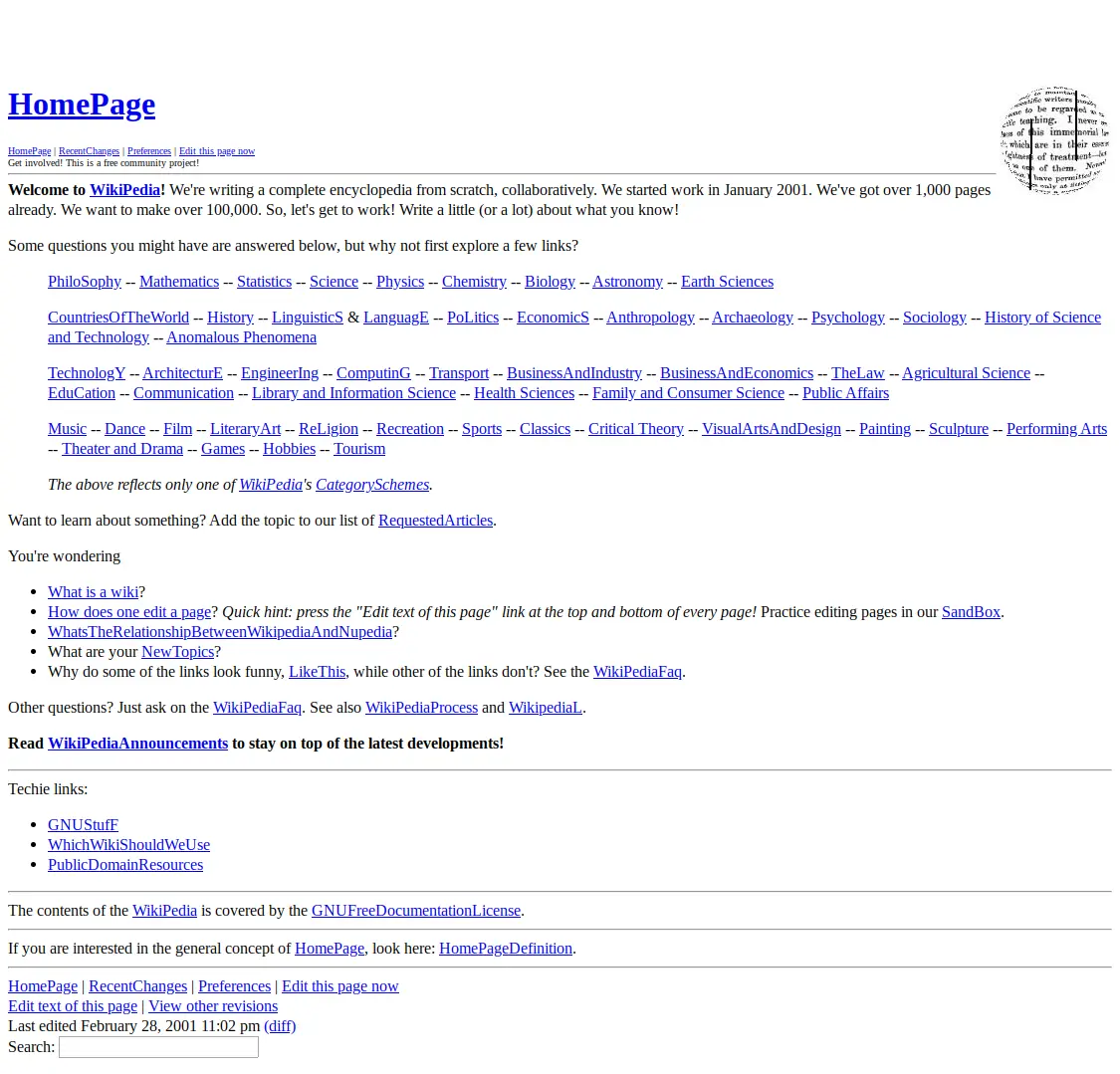
Metadata
- Date
- Decade
- 2000s
- Tier
- T1
- Sources
- 08
- Connections
- 00
- Tags
- #research
On 15 January 2001, Larry Sanger posted a message to the Nupedia mailing list with the subject line "Wikipedia is up!" Its request to the list's members was modest: "Humor me. Go there and add a little article."
Nupedia was the project Wikipedia was supposed to help. By Sanger's later count, it had fewer than 24 finished articles at that point, after almost a year of work.
Nupedia: An Encyclopedia With Seven Steps
Nupedia started in March 2000. It was funded by Bomis, a web company owned by Jimmy Wales and two partners, and Sanger, a philosophy PhD, was hired as its editor-in-chief. Its model was conventional for a reference work: articles were written by experts and passed through a multi-stage process of editing, fact-checking and peer review—seven stages, as it was eventually set up with Nupedia's volunteer Advisory Board.
The process produced quality and very little else. Sanger's 2005 memoir, written for Slashdot, is frank that around the turn of 2001 he was already thinking hard about "a more open system, that would require minimal programming to set up".
Ten Days in January 2001
What happened next can be dated almost day by day from contemporaneous records:
| Date | Event | Source |
|---|---|---|
| 2 Jan 2001 | Over dinner, Ben Kovitz explains the wiki concept to Sanger | Sanger's memoir |
| 10 Jan 2001 | Sanger posts "Let's make a wiki" to Nupedia-L; a wiki is set up | Sanger's own archive of the post |
| 11 Jan 2001 | Sanger proposes the name "Wikipedia" | History of Wikipedia |
| 13 Jan 2001 | wikipedia.com and wikipedia.org registered | .com and .org registry records |
| 15 Jan 2001 | Wikipedia launched at wikipedia.com; "Wikipedia is up!" | Sanger's archive; History of Wikipedia |
Sanger's 10 January post made the case in the terms that would define the project. A wiki, he wrote, is "the ULTIMATE 'open' and simple format for developing content", and wikis "can be implemented practically instantly, need very little maintenance, and in general are very low-risk." The same post placed it among ideas for simpler, more open projects that would either replace or supplement Nupedia.
The name was Sanger's—he wrote in 2005 that he "came up with the name"—a blend of wiki and encyclopedia. The domain was .com because, as he explained, they were considering selling advertisements to pay for staff and servers. The project moved to .org in 2002 after Wales assured users it would not carry ads.
Why It Grew
A wiki let anyone edit any page and kept every previous version, so mistakes could be reverted as easily as they were made. That removed both the gatekeeping that had slowed Nupedia and much of the fear of vandalism. Sanger recalled that one of the first policies he and Wales agreed on was a "nonbias" or neutrality policy: on contested subjects an article should fairly represent all sides rather than take one. It survives today as "neutral point of view".
The growth was rapid by any standard of the time:
- March–May 2001 — the first non-English editions, including German, Catalan, French, Swedish and Italian
- End of 2001 — roughly 20,000 articles across the language editions
- March 2002 — Sanger leaves, after Bomis withdrew funding for his position in the dot-com bust
- 20 June 2003 — the Wikimedia Foundation is established as a non-profit to run the project; Nupedia effectively ends the same year
- 1 March 2006 — the English edition's one-millionth article
As of October 2026, Meta-Wiki's List of Wikipedias counts 364 language editions created under the Wikimedia Foundation, of which 16 have been closed, leaving 348 active. Between them they hold about 68.4 million articles.
Who Founded Wikipedia?
The answer depends on whom you ask, and the two people involved have never agreed.
Sanger's position is that he co-founded it. He points out that the New York Times described him that way in September 2001, and that Wikipedia's own first press release in January 2002 credited both men. According to the Wikipedia article on Wales, Wales himself used the description "co-founder" in August 2002.
Wales's position, maintained publicly since the mid-2000s, is that he is the sole founder: Bomis paid for the project, and Sanger was his employee. Sanger, in his own account, dates Wales's denial to 2005 or 2006, "just when Wikipedia began to enter the public eye".
Sanger also offers a distinction that clarifies the argument without settling it. In the business sense, he writes, the founder was Bomis, which paid the bills. In the sense of who conceived the encyclopedia and built its early community and rules, the claim is his. What is not in dispute is the sequence of events in January 2001, and that both men were present for it.
Legacy
Wikipedia is the clearest working answer to a question the early web kept asking: whether strangers, coordinating only through software and a set of written norms, could build something reliable together. The answer has never been simple—disputes over accuracy, bias and governance are as old as the project itself—but the project has kept running for a quarter of a century.
Sanger, who went on to criticise the project he helped start, has argued that its experience did not refute his original view that expert oversight is necessary for a highly credible encyclopedia. That argument, between openness and expertise, was present in the ten days of January 2001 and has never quite been settled.
For other internet services of the same era see Google and Yahoo!.
Questions this page answers
- Who founded Wikipedia?
- Jimmy Wales and Larry Sanger launched it on 15 January 2001, but the question is unsettled between them: Sanger claims co-founder status and Wales disputes it.
Sources
Primarywikipedia.com — registration record (Verisign RDAP)
Both wikipedia.com and wikipedia.org were registered on 13 January 2001
TertiaryJimmy Wales — Wikipedia
TertiaryHistory of Wikipedia — Wikipedia
Last updated: