T1#consumer
Neo Geo — Taking the Arcade Board Home
Metadata
- Date
- Decade
- 1990s
- Tier
- T1
- Sources
- 06
- Connections
- 00
- Tags
- #consumer
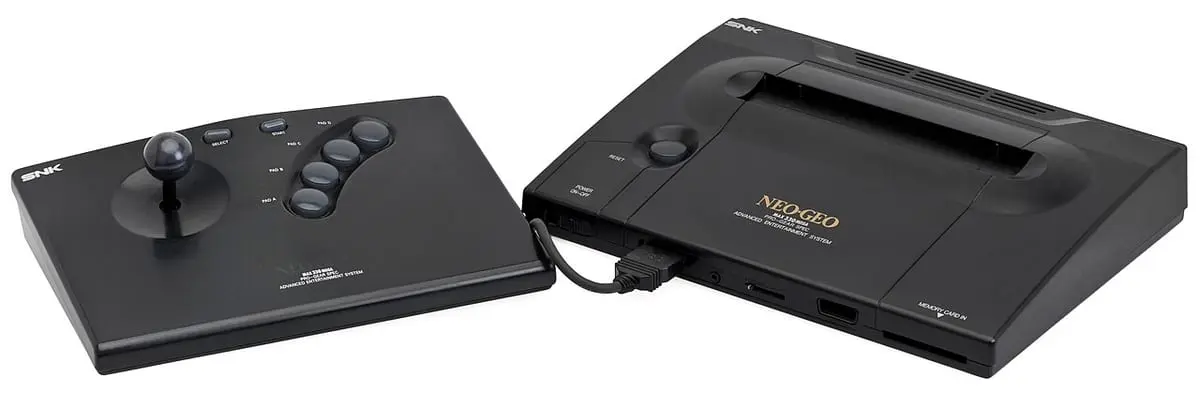
The Neo Geo is a game system SNK launched in April 1990. Two things arrived together: MVS, an arcade board for game centres, and the NEO-GEO home console, which played the same games. The home unit was not sold in shops at first. It was offered for rental, and general retail sale in Japan officially began on 1 July 1991, with the console at ¥48,800.
| Item | Date and price | Source |
|---|---|---|
| MVS arcade board and NEO-GEO home console arrive | April 1990 | SNK |
| MVS in arcades | 16 April 1990 | Japanese Wikipedia |
| Home unit offered for rental | 26 April 1990 | Japanese Wikipedia |
| Original console price | ¥58,000 | Japanese Wikipedia; GAME Watch |
| General sale begins, prices revised | 1 July 1991; console ¥48,800 | Famitsu; Japanese Wikipedia |
| Games (after revision) | ¥13,800 to ¥21,000, by capacity | Famitsu |
| North America (Gold System) | $649.99 | English Wikipedia |
The sources disagree on price. GAME Watch's 2026 article gives ¥58,000 for the 1 July 1991 release, while Famitsu and Japanese Wikipedia say ¥58,000 was the original 1990 price, cut to ¥48,800 when general sale began on 1 July 1991. This page follows the latter.
MVS and AES
SNK's official "SNK HISTORY" site describes MVS (Multi Video System) as an innovative system that let several games share a single cabinet, and says about 12,000 were installed across Japan.
The home unit is also called the AES (Advanced Entertainment System). According to GAME Watch, it had the same performance as the arcade MVS, and the game data was identical. Early MVS cabinets had a memory card slot, so a game played in the arcade could be continued at home. SNK presents the home unit as designed to bring arcade games home unchanged, under a slogan that invited players to take the amazing games home with them.
According to Japanese Wikipedia, the main specifications were:
| Item | Detail |
|---|---|
| Main CPU | 68000 (16-bit, 12 MHz) |
| Sound CPU | Z80 (8-bit, 4 MHz) |
| Resolution | 320×224 |
GAME Watch notes that Nintendo's Super Famicom, from the same year, cost ¥25,000 with games around ¥10,000, while Neo Geo games initially cost roughly ¥20,000 to ¥30,000. The same article also remarks on how large the home cartridges were.
From rental to retail
According to Famitsu, the Neo Geo was rolled out from 1990 as arcade games and rental games, with some test sales. GAME Watch says the home unit was first rented out, together with games, through video rental shops. General sale officially began on 1 July 1991, and according to Famitsu the console was then repriced at ¥48,800, with games at ¥13,800 to ¥21,000 depending on capacity.
Famitsu describes the Neo Geo as a luxury home console that played the same games as the arcade. Games over 100 megabits carried a "100 Mega Shock" badge, the first being Art of Fighting.
A fighting-game machine
According to SNK, Fatal Fury was released in November 1991. GAME Watch says the fighting-game boom from 1991 led SNK to concentrate on the genre, and the Neo Geo came to be seen in that light. Famitsu lists Fatal Fury 2, Samurai Shodown, Art of Fighting 2 and The King of Fighters '94 among the representative titles.
In September 1994 came the NEOGEO CD, which replaced ROM cartridges with CD-ROM. SNK says it was developed as a Neo Geo for casual players. According to Famitsu, CD games were cheaper, at ¥4,800 to ¥8,800, at the cost of long loading times.
Fourteen years of games
According to SNK, new Neo Geo games kept coming for 14 years, until 2004. Japanese Wikipedia names the last as Samurai Shodown V Special (2004) and says repairs for the hardware ended on 31 August 2007.
SNK's own sales figures could not be found. Japanese Wikipedia gives 350,000 home units in Japan and 410,000 worldwide; English Wikipedia gives 1 million MVS units. On those figures, the arcade MVS outnumbered the home console.
A reissue, the NEOGEO AES+, is also planned. According to VGC, SNK and Plaion announced in September 2026 that a component shortage had pushed its release to 16 September 2027.
For the wider story, see the game consoles timeline.
Questions this page answers
- When was the Neo Geo released?
- According to SNK, the MVS arcade board and the NEO-GEO home console arrived in April 1990. Japanese Wikipedia gives 16 April for MVS and 26 April for the home unit, first for rental. General retail sale officially began on 1 July 1991.
- How much did the Neo Geo cost?
- According to Famitsu, prices were revised when general sale began on 1 July 1991: ¥48,800 for the console and ¥13,800 to ¥21,000 per game, depending on capacity. Japanese Wikipedia and GAME Watch put the earlier console price at ¥58,000. English Wikipedia gives $649.99 for the North American Gold System.
- What is the difference between the MVS and the AES?
- MVS (Multi Video System) was the arcade board, letting one cabinet swap between several games. AES (Advanced Entertainment System) was the home console with the same performance; according to GAME Watch, the game data was identical between home and arcade.
Sources
PrimarySNK HISTORY — SNK(公式)
MVS and NEO-GEO in April 1990, about 12,000 MVS installations, the memory card, NEOGEO CD in September 1994, 14 years of software to 2004
Secondaryネオジオの一般販売が公式に開始された日 — ファミ通.com、2023年7月1日
Rental from 1990, general sale and revised prices on 1 July 1991, the 100 Mega Shock line, NEOGEO CD game prices
Secondaryアーケードゲームファンの憧れだったハード『NEOGEO』35周年! — GAME Watch、2026年7月11日
AES and MVS, rental through video shops, ¥58,000, releases until 2004
The NEOGEO AES+ reissue delayed to 16 September 2027
TertiaryNEOGEO — Wikipedia
MVS and home dates, ¥58,000 and ¥48,800, specifications, unit sales
TertiaryNeo Geo (system) — Wikipedia
North American Gold and Silver System prices; 1 million MVS and 410,000 AES units
Last updated: