T1
The Perceptron Unveiled — Frank Rosenblatt
Metadata
- Date
- Decade
- 1950s
- Tier
- T1
- Timelines
- A History of Artificial Intelligence
- Sources
- 05
- Connections
- 04
The demonstration that introduced the perceptron did not involve the perceptron machine. As the Cornell Chronicle later reconstructed it, the US Office of Naval Research showed reporters an IBM 704 — "a 5-ton computer the size of a room" — being fed a series of punch cards. After 50 trials, it had taught itself to tell cards marked on the left from cards marked on the right.
The learning was real; the hardware was a general-purpose mainframe running a simulation. The purpose-built Mark I Perceptron, the machine that became the icon of the idea, was still to come. Keeping those two things apart is the first step to reading July 1958 correctly.
The Perceptron Announcement of July 1958
The work came from Frank Rosenblatt, a psychologist at the Cornell Aeronautical Laboratory in Buffalo, and it was the Navy, not Cornell, that presented it. The press reaction was out of proportion to a card-sorting demonstration. The New York Times ran it under the headline "NEW NAVY DEVICE LEARNS BY DOING: Psychologist Shows Embryo of Computer Designed to Read and Grow Wiser". Rosenblatt himself, by Cornell's account, called the perceptron "the first machine which is capable of having an original idea."
The same year, Rosenblatt published the theory in Psychological Review, volume 65, number 6, pages 386–408, under a title that makes clear what he thought he was doing: "The perceptron: A probabilistic model for information storage and organization in the brain." The perceptron was offered first as a model of the brain, and only second as an engineering device.
His biography, the details of the learning rule and the convergence theorem, and the later dispute with Marvin Minsky are on Rosenblatt's own page. This page concentrates on the event and on the machine that followed it.
The Learning Idea in One Paragraph
A perceptron takes a set of inputs, multiplies each by a weight, adds them up, and switches on if the sum exceeds a threshold. When it gives the wrong answer, the weights are adjusted in the direction that would have produced the right one. Repeat over many examples and, for problems where the categories can be separated by a straight line or plane, the weights settle on a solution. Nothing about a "left" or "right" mark is programmed in; the distinction is accumulated in the weights. That is the sense in which the IBM 704 "taught itself".
Inside the Mark I Perceptron
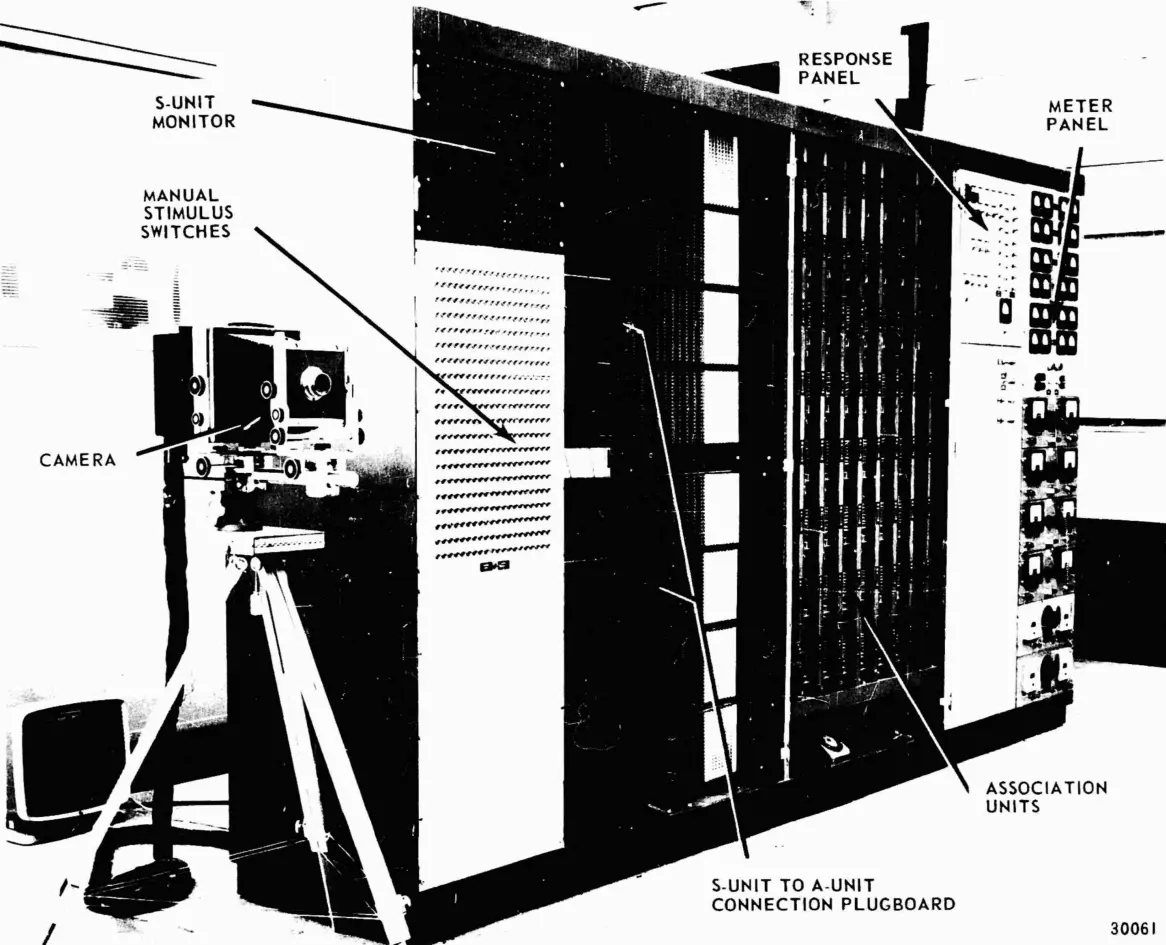
The best description of the hardware is the Mark I Perceptron Operators' Manual, issued by the Cornell Aeronautical Laboratory on 15 February 1960 as report VG-1196-G-5 under Office of Naval Research contract Nonr-2381(00), and signed off by Rosenblatt as head of the Cognitive Systems Section. It describes the Mark I as "a pattern learning and recognition device" meant as "an experimental tool for the direct study of a limited class of perceptrons" — specifically those with a single layer of association units that are not cross-coupled.
The machine has three kinds of unit.
| Layer | What the manual describes |
|---|---|
| Sensory (S) units | 400 photoresistors in a 20 × 20 array, mounted in the film plane of a modified view camera; a matching 20 × 20 bank of neon lamps shows which are on, and a 20 × 20 bank of switches can stand in for the camera |
| Association (A) units | 512 units, wired to the S-units through a plugboard with effectively random connections |
| Response (R) units | Switch on when the summed signal from their A-units passes a threshold |
The memory is mechanical. Each A-unit's output passes through a potentiometer connected to a small DC motor, and "the positions taken by the wipers of the potentiometers of all the 512 A-units constitute the memory of the perceptron." Learning means motors turning knobs. It is slow — the manual gives roughly one-sixteenth of a revolution per minute at full feedback voltage — and audible: the procedure for erasing the memory tells the operator to wait, about ten minutes per stage, until the A-unit motors "become inaudible". For experiments, the camera's photocell bank could be removed and placed at one end of a light-tight box, with a slide projector at the other.
Three Ways to Teach the Machine
The manual sets out three training procedures, and they map neatly onto categories still used today.
- Forced learning. For each stimulus, the operator switches the response units to the desired values and the machine reinforces whichever A-units are active.
- Error correction. The machine responds on its own; corrective reinforcement is applied only to the response units that got it wrong. The manual says this "in general, leads to better learning."
- Spontaneous learning. Left to its own resources, the perceptron divides the patterns it sees into classes "on a classification basis of its own forming".
The first two are what is now called supervised learning; the third is an early form of unsupervised learning. Both ideas were present, in hardware, by 1960.
What the Perceptron Showed, and What It Did Not
The Mark I had one layer of adjustable weights, between the A-units and the R-units; the S-to-A wiring was fixed at random. That made it trainable, and it also bounded what it could learn. The best-known statement of those bounds came in 1969, in Minsky and Papert's Perceptrons; the argument over what that book proved, and whether it really cut off funding, is set out on Rosenblatt's page and around the first AI winter on the AI timeline.
What the 1958 announcement established was narrower and more durable: that a machine could acquire a discrimination from examples and corrections rather than from explicit rules. The arithmetic of a single unit in a modern neural network — weighted sum, nonlinearity, error-driven update — is recognisably this one. The step that made many layers trainable came later, with backpropagation and the work of Geoffrey Hinton and others, and the step that made it dominant came with the ImageNet result of 2012.
Where the Mark I Is Now
The Cornell Chronicle notes that the Mark I Perceptron now resides at the Smithsonian Institution, and Smithsonian magazine, writing about the object in its collections in 2026, describes it as "a room-size grid of 400 light-registering sensors designed to perceive and sort images." The original schematic reproduced on this page is Figure 2 of the 1960 operators' manual.
For the perceptron's place among the other founding events of the field — two years after the Dartmouth workshop gave AI its name — see the AI timeline.
Questions this page answers
- What actually ran at the 1958 perceptron demonstration?
- The demonstration was a simulation on an IBM 704 that learned, in about fifty trials, to tell cards marked on the left from cards marked on the right. The Mark I Perceptron, the purpose-built machine with 400 light sensors, was separate electromechanical hardware assembled at the same laboratory.
- Where did Frank Rosenblatt work?
- He was a researcher at the Cornell Aeronautical Laboratory. The press conference was held by the US Office of Naval Research, and his theoretical paper appeared the same year in Psychological Review 65(6), 386-408.
Sources
The 20×20 array of 400 photoresistors, the 512 A-units, the motor-driven potentiometers that hold the weights, and the Office of Naval Research contract
The Mark I Perceptron as an object in the Smithsonian collections
TertiaryPerceptron — Wikipedia
Last updated: