PERSON
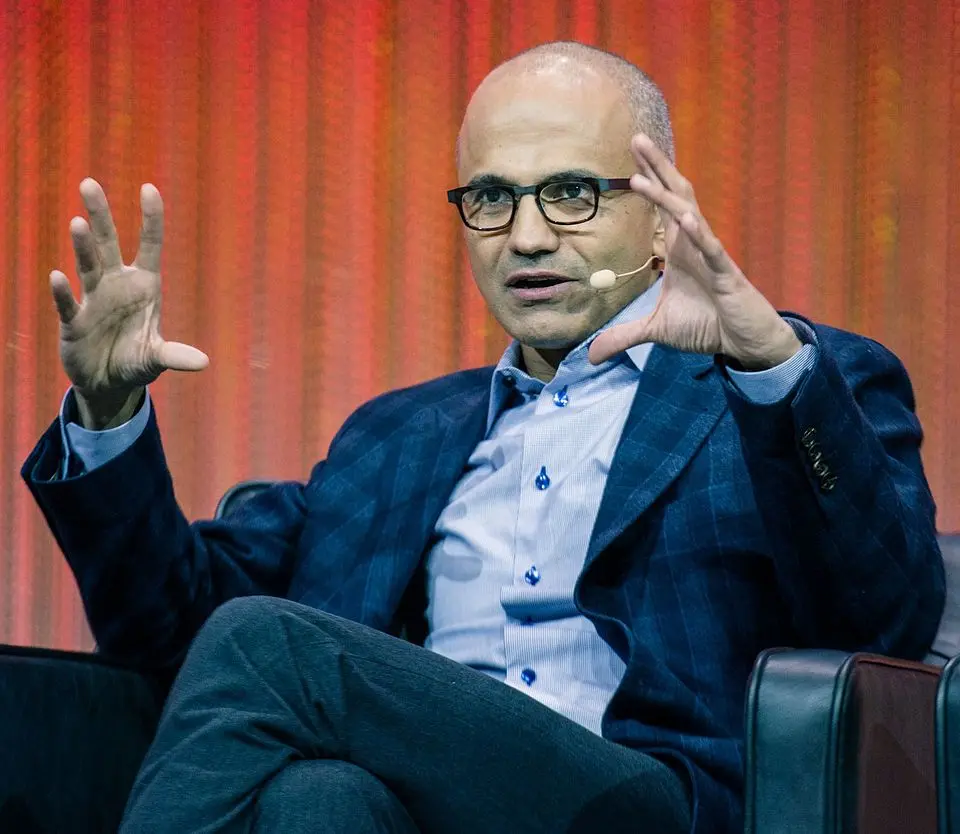
Satya Nadella
Microsoft's third chief executive, from 4 February 2014, and chairman of its board since June 2021. He joined the company in 1992 and ran first Server and Tools and then Cloud and Enterprise; as CEO he rebuilt a Windows-and-Office strategy around Azure. Accepting Linux and open source, acquiring GitHub, LinkedIn and Activision Blizzard, and investing in OpenAI in stages were the defining decisions. Annual revenue grew from US$77.8 billion in fiscal 2013 to US$331.8 billion in fiscal 2026.
Profile
- Born
- 1967
- Status
- Living
- Span
- 1967–
- Appearances
- 07
- Name
- ENSatya NadellaJAサティア・ナデラ
Satya Narayana Nadella (born 19 August 1967) is Microsoft's third chief executive, after Bill Gates and Steve Ballmer. He has held the job since 4 February 2014 and has also chaired the board since 16 June 2021. Over that tenure the company's revenue has more than quadrupled: US$77.8 billion in fiscal 2013, the last full year before he took over, against US$331.8 billion in fiscal 2026.
Background
Nadella was born in Hyderabad, India; his father was an Indian Administrative Service officer and his mother a lecturer in Sanskrit. He took a bachelor's degree in electrical engineering at the Manipal Institute of Technology (1988), a master's in computer science at the University of Wisconsin–Milwaukee (1990), and an MBA at the University of Chicago Booth School of Business. He was a member of the technical staff at Sun Microsystems before joining Microsoft in 1992.
Microsoft's own executive biography compresses the internal career into a line: R&D for the Online Services Division, vice president of the Microsoft Business Division, the Server and Tools Business, and then executive vice president of Cloud and Enterprise. The job he held immediately before becoming CEO was running the cloud infrastructure and services business — which turns out to be the whole of the later strategy in miniature.
Taking the job, and consolidating the board
Ballmer had said on 23 August 2013 that he would retire once a successor was named, and the search ran for close to six months. In the announcement of 4 February 2014, Bill Gates stepped down as chairman to become Founder and Technology Advisor, undertaking to spend more time at the company helping Nadella shape technology and product direction, and the lead independent director John Thompson took the chair. The only track record the press release cited for Nadella was the Server and Tools Business, which it said had outperformed the market and taken share from competitors. His own comment was equally short: "The opportunity ahead for Microsoft is vast, but to seize it, we must focus clearly, move faster and continue to transform." The appointment itself is covered in Satya Nadella Becomes CEO of Microsoft.
On 16 June 2021 the board's independent directors unanimously elected Nadella board chair, with Thompson returning to lead independent director. He is the third chairman in Microsoft's history, after Gates and Thompson — a title Ballmer never held while he was CEO.
Getting out from behind Windows
The substance of the Nadella era is a migration of the company's centre of gravity. Azure became the platform everything else sat on; Linux was accepted as a customer environment rather than a threat; and the places developers and professionals congregate were bought outright — LinkedIn (announced 13 June 2016, US$26.2 billion in cash), GitHub (2018), and Activision Blizzard (2023). The GitHub deal in particular was read as the reversal of a company that had treated Linux as an enemy under the previous CEO. The corporate mission was rewritten to "empower every person and every organization on the planet to achieve more", and now appears in the boilerplate of every press release.
The shape of the reporting changed with it: a company that once sold Windows and Office licences now reports a line called Microsoft Cloud, worth US$59.3 billion in the fourth quarter of fiscal 2026, with commercial remaining performance obligation up 84 percent to US$678 billion. The fiscal 2026 fourth-quarter breakdown shows where that ended up. Intelligent Cloud revenue was US$39.3 billion, up 32 percent, with Azure alone up 43 percent. More Personal Computing was US$12.9 billion, down 4 percent, with Windows OEM and Devices down 7 percent. Windows has not gone away; it is simply no longer what grows.
The OpenAI bet, and its dilution
The US$1 billion investment of 2019 went into a research organisation that had just published GPT-2. For the extension announced on 23 January 2023, Microsoft's own words were "a multiyear, multibillion dollar investment" — the US$10 billion figure attached to it in coverage is press reporting, not a company disclosure. During the OpenAI board crisis of November 2023 Nadella publicly backed Sam Altman and said Microsoft would take him and his colleagues on.
The definitive agreement of 28 October 2025 left Microsoft holding roughly 27 percent of OpenAI Group PBC, worth about US$135 billion, and extended its IP rights to models and products through 2032. It also subjected any AGI declaration to verification by an independent expert panel and gave up Microsoft's right of first refusal to be OpenAI's compute provider. Three weeks later, on 18 November 2025, Microsoft and NVIDIA announced investments in Anthropic, which committed to purchase US$30 billion of Azure compute; by the fourth quarter of fiscal 2026 Microsoft was booking a US$3.2 billion gain on that Anthropic stake. Having concentrated the company's AI position on a single lab, Nadella then spent two years spreading it back out.
Assessment
Nadella's achievement is not an invention. It is having persuaded an incumbent to accept a future in which its largest revenue source is no longer the centre of the company. A firm that fought for twenty years to defend Windows now sells Linux, owns GitHub, depends on an outside laboratory for frontier models, and has deliberately diluted that dependence. Every one of those moves ran against the short-term interest in protecting existing revenue. The partnership with Altman is the emblem — but the 2025 agreement, which redesigned the partnership so that it could be loosened, says more about him as an executive.
Appearances
- Satya Nadella Becomes CEO of Microsoft
- Microsoft Acquires GitHub for US$7.5 Billion
- Microsoft Invests US$1 Billion in OpenAI
- The 2023 Tech Layoffs — The Month a Decade of Hiring Ended
- Microsoft Invests Another US$10 Billion in OpenAI
- Microsoft Closes US$68.7 Billion Acquisition of Activision Blizzard
- OpenAI's Recapitalisation — The For-Profit Becomes a PBC, the Nonprofit Keeps Control
Sources
TertiarySatya Nadella — Wikipedia
Last updated: