PERSON
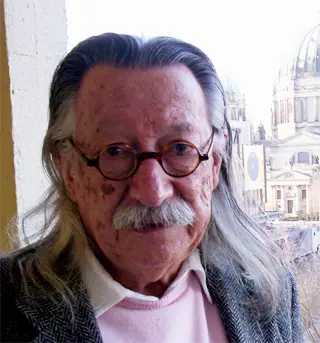
Joseph Weizenbaum
MIT computer scientist. He wrote the conversational program ELIZA in MAD-SLIP—MAD extended with SLIP, his own list-processing language—and published it in Communications of the ACM in January 1966. ELIZA was the engine; the Rogerian psychotherapist was DOCTOR, one swappable script. He identified in the paper itself the way users attribute knowledge and reasoning to the program, and in Computer Power and Human Reason (1976) built that observation into an argument separating calculation from judgement. The book is still read as a founding text of AI ethics.
Profile
- Born
- 1923
- Died
- 2008
- Span
- 85 years
- Appearances
- 02
- Name
- ENJoseph WeizenbaumJAジョセフ・ワイゼンバウム
Joseph Weizenbaum (8 January 1923 — 5 March 2008) was the MIT computer scientist who published the ELIZA conversational program in 1966. It documented for the first time a phenomenon — later named the "ELIZA effect" — in which users project rich human meaning and feeling onto a program that has neither. Weizenbaum himself was disturbed by what he had found, and spent the rest of his life building the field that is now called AI ethics.
Background
Weizenbaum was born in Berlin into a Jewish family; his father Jechiel ("Harry") was a court furrier and fur dealer. He grew up near the Gendarmenmarkt and attended the Luisenstädtisches Realgymnasium until 1935, when he was forced into the Jewish community's boys' school; in January 1936, aged 13, he emigrated with his family to Detroit. He repeatedly identified that exile as the root of his later scepticism about uncritical faith in computation.
He began studying mathematics at Wayne University in 1941, served 1942-45 as a meteorologist in the US Army Air Corps — he had been turned down for cryptology work on account of his "enemy alien" status — and took his master's in 1950. He then built computing equipment at Wayne, and from 1955 to 1963 worked at General Electric on ERMA, the automated banking system built for the Bank of America that put magnetic-ink character recognition on the bottom of cheques.
He came to MIT in 1963 as a visiting professor, became associate professor in 1964, full professor in 1970, and emeritus in 1988. What got him there was SLIP (Symmetric List Processor), the list-processing language of his own design published in CACM in 1963. He moved to Berlin in 1996 and died on 5 March 2008 at Ludwigsfelde-Gröben in Brandenburg, aged 85; he is buried in the Weißensee Jewish cemetery in Berlin.
ELIZA (1966)
Developed at MIT between 1964 and 1966, ELIZA ran on the MAC time-sharing system and was, in the paper's own words, "written in MAD-SLIP for the IBM 7094" — MAD extended with Weizenbaum's SLIP. It was not written in LISP. The name was chosen, he explained, because the program "may be incrementally improved by its users" through a teacher — "like the Eliza of Pygmalion fame".
The distinction that matters: ELIZA is the engine, and what it says is governed by a swappable script. The famous script, DOCTOR, imitated a Rogerian psychotherapist — the non-directive style in which the counsellor reflects the patient's statements back. The paper opens with this exchange (user in lower case, ELIZA in capitals):
Men are all alike.
IN WHAT WAY?
They're always bugging us about something or other.
CAN YOU THINK OF A SPECIFIC EXAMPLE?
Well, my boyfriend made me come here.
YOUR BOYFRIEND MADE YOU COME HERE
He says I'm depressed much of the time.
I AM SORRY TO HEAR YOU ARE DEPRESSED
The mechanism is nothing more than picking keywords out of the input and rephrasing them back through decomposition and reassembly rules. The reaction was not nothing. In Computer Power and Human Reason Weizenbaum recounted that his own secretary — who had watched him build the program for months and so certainly knew it was a program — asked him to leave the room after only a few exchanges with it. From the clinical side, Kenneth Colby, James Watt and John Gilbert proposed in the Journal of Nervous and Mental Disease in 1966 that the method be developed into automated psychotherapy.
For Weizenbaum this was the alarming finding. That users would project felt, empathic presence onto trivial string rewriting was the observation that pushed him into a critique of his own field.
Computer Power and Human Reason (1976)
Published in 1976, Computer Power and Human Reason: From Judgment to Calculation is the founding document of AI ethics.
The central arguments:
- Deciding and choosing are different things. Deciding is a computational activity and can ultimately be programmed. Choice is the product of judgement, and judgement is not calculation.
- There are domains in which computers should not be used at all — military decision-making, judicial sentencing, psychotherapy, the core of education, care of the elderly. That something can be done by machine does not make it right to do.
- Researchers are responsible for the social consequences of what they build. There is no such thing as a neutral technology.
The AI mainstream pushed back hard. The sharpest reply was John McCarthy's "An Unreasonable Book", printed with a review by Benjamin Kuipers and Weizenbaum's own response in ACM SIGART Bulletin 58 (June 1976), 4–13. Bruce Buchanan and Joshua Lederberg wrote reviews too; the Computer History Museum holds the set as "Three Reviews of J. Weizenbaum's Computer Power and Human Reason".
The ELIZA effect
The phenomenon Weizenbaum first described — the human tendency to project understanding and feeling onto a mechanical interlocutor — was later generalised as the "ELIZA effect", and is now one of the most useful concepts for reading the 2020s generative-AI moment.
- June 2022: Google engineer Blake Lemoine claimed LaMDA was a sentient being, was suspended on 13 June and fired the following month.
- The use of ChatGPT (2022) as counsellor, friend, or romantic partner.
- The psychological-dependence problems surfacing around AI companion products such as Replika and character.ai.
All sit on the 1966 observation.
Awards and honours
Weizenbaum never received the major computer-science prizes — no Turing Award, no Kyoto Prize.
- 1988 Norbert Wiener Award (Computer Professionals for Social Responsibility)
- 1994 Humboldt-Preis (Alexander von Humboldt Foundation)
- 1998 honorary doctorate, University of Bremen (Hamburg followed in 2003)
- 2001 Grand Cross of the Order of Merit of the Federal Republic of Germany
- 2002 VIZE 97 Prize (Dagmar and Václav Havel Foundation)
- 2003 honorary member, Gesellschaft für Informatik
The Weizenbaum Institute for the Networked Society in Berlin and the Weizenbaum Award both carry his name.
Legacy
The list of domains Weizenbaum argued in 1976 should stay free of machine decision-making is, in 2026, almost entirely under machine decision-making instead. AI targeting in military operations (the Lavender and Gospel systems in the 2024 Gaza operation), recidivism-prediction algorithms in courts, automated psychotherapy, education automation, and care robotics each occupy what was once his exclusion list.
Nevertheless, Computer Power and Human Reason reads now as one of the intellectual sources of the risk-based regulatory architecture of the EU AI Act (2024). The framing that there exist domains in which final judgement must remain human is Weizenbaum's.
The man who built ELIZA became its most cautious reader. The structural rhyme with Geoffrey Hinton's departure from Google in 2023 — building a technology and then sounding the alarm about it — is exact. Half a century apart, the same pattern was replayed.
Appearances
Sources
TertiaryJoseph Weizenbaum — Wikipedia
Last updated: