PERSON
Geoffrey Hinton
A central figure of deep learning. Known for the 1986 Nature paper that made backpropagation usable (with Rumelhart and Williams), the Boltzmann machine (1983-85, with Ackley and Sejnowski), Deep Belief Networks (2006), and for supervising the team that produced AlexNet in 2012. IEEE Frank Rosenblatt Award in 2014; ACM Turing Award in 2018 with Yann LeCun and Yoshua Bengio; Nobel Prize in Physics in 2024 with John Hopfield. Since leaving Google in May 2023 he has spoken publicly and continuously about the risks of AI.
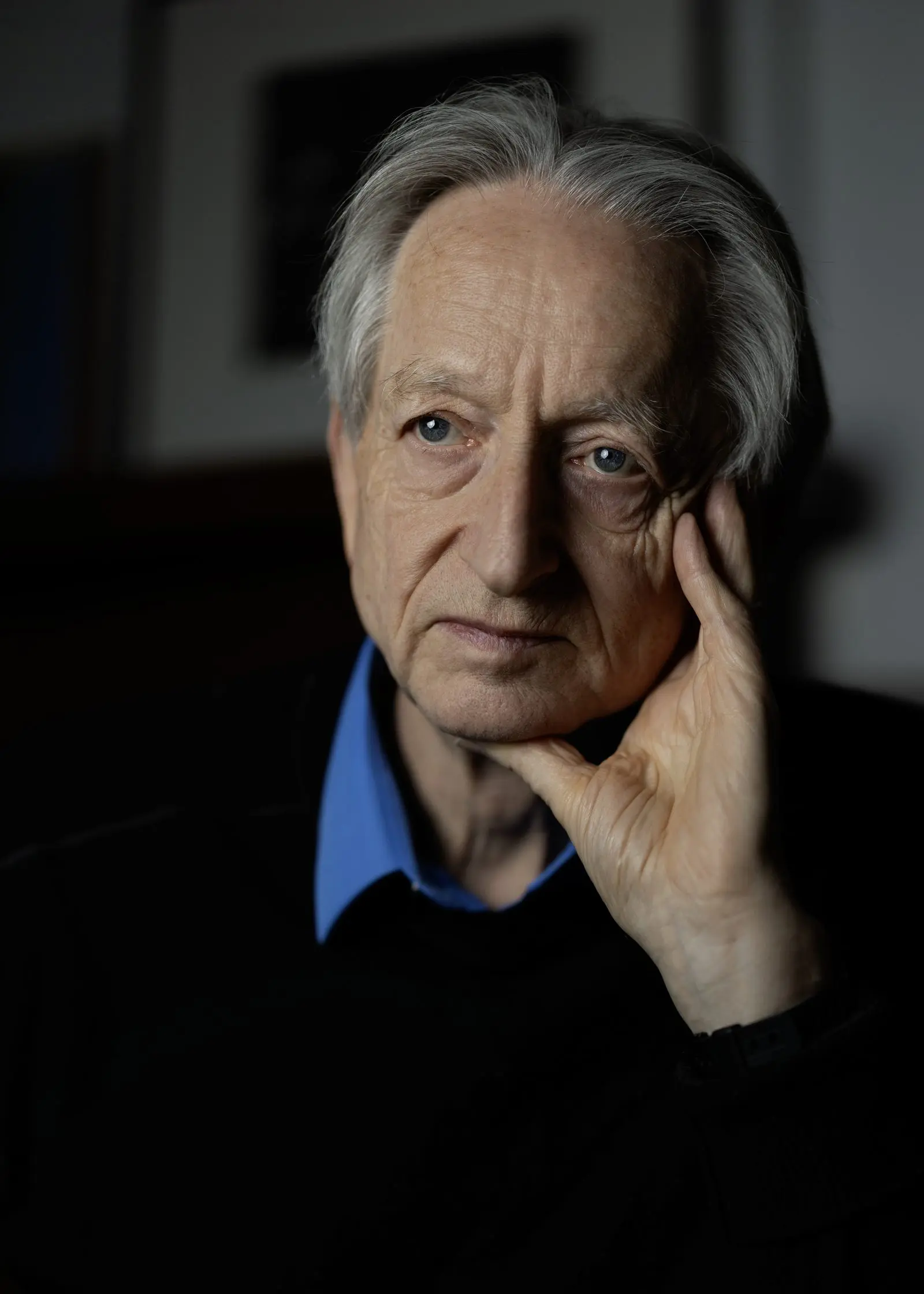
Profile
- Born
- 1947
- Status
- Living
- Span
- 1947–
- Appearances
- 07
- Name
- ENGeoffrey HintonJAジェフリー・ヒントン
Geoffrey Everest Hinton (born 6 December 1947) is the central figure in pulling neural-network research out of the long lull that followed Minsky and Papert's Perceptrons (1969), through AlexNet (2012), and into the deep learning that followed. He shared the 2018 ACM Turing Award with Yann LeCun and Yoshua Bengio, and in 2024 shared the Nobel Prize in Physics with John Hopfield. A computer scientist winning a Nobel is not itself unprecedented — Herbert Simon took the 1978 prize in economic sciences — but 2024 was the first time the physics prize went to work in machine learning.
Background
Hinton was born in Wimbledon, London. His father, Howard Hinton, was an entomologist; his great-great-grandparents were the mathematics educator Mary Everest Boole and the logician George Boole. His middle name comes from George Everest, the Surveyor General of India after whom the mountain is named. The physicist Joan Hinton, one of two women on the Manhattan Project, was his first cousin once removed.
He matriculated at King's College, Cambridge in 1967, moved between natural sciences, history of art and philosophy, and graduated in experimental psychology in 1970. After a year apprenticing as a carpenter he returned to research, studying at Edinburgh from 1972 under Christopher Longuet-Higgins — who favoured symbolic AI over neural networks — and taking his PhD in artificial intelligence in 1978. Funding for the field was thin and the intellectual fashion was against it; Hinton stayed on the connectionist line anyway.
After Sussex and the MRC Applied Psychology Unit, unable to get funding in Britain, he moved to the United States: the University of California, San Diego (where the backpropagation work was done, with David Rumelhart) and Carnegie Mellon, before joining the University of Toronto in 1987. He became a CIFAR fellow the same year, and from 2004 led for a decade the CIFAR programme he had proposed, "Neural Computation and Adaptive Perception". Between 1998 and 2001 he was back in London as founding director of the Gatsby Computational Neuroscience Unit at UCL. In 2017 he co-founded the Vector Institute in Toronto and became its chief scientific adviser.
Major contributions
1986: backpropagation
"Learning representations by back-propagating errors", with David Rumelhart and Ronald Williams (Nature 323, 533–536, October 1986), put a method for training multilayer networks by propagating output error backwards into a form the cognitive-science community could use. Priority over the algorithm is contested — reverse-mode automatic differentiation is Seppo Linnainmaa's (1970), and the proposal to use it for training neural networks is usually credited to Paul Werbos — to his 1974 thesis in most accounts, to a 1982 paper in Schmidhuber's, which argues the thesis did not yet make it (see backpropagation). The authors have not claimed invention; what was decisive was making it work and making it spread.
1983-85: Boltzmann machines
With David Ackley and Terry Sejnowski, Hinton built the Boltzmann machine, a stochastic neural network that imported the Boltzmann distribution from statistical mechanics. It was among the first generative frameworks with hidden units, and the line runs directly into the Restricted Boltzmann Machine and the Deep Belief Network. It is the work the 2024 Nobel citation names explicitly.
2006: Deep Belief Networks
"A Fast Learning Algorithm for Deep Belief Nets", with Simon Osindero and Yee-Whye Teh (Neural Computation 18, 1527–1554), showed that stacking RBMs to pre-train each layer made deep networks trainable. LeCun, Bengio and Hinton's 2015 review in Nature dates the revival of interest in deep networks to this work of around 2006, at a moment when the field was being pushed aside by support vector machines and boosting (others, Schmidhuber among them, dispute that framing); see deep belief nets, and RBM pre-training stayed the standard recipe until around 2010.
2012: AlexNet
His students Alex Krizhevsky and Ilya Sutskever, under his supervision, built the convolutional network that won ILSVRC 2012 outright. The three incorporated DNNresearch; Google acquired it in March 2013 for about $44 million.
2013-2023: Google
As a Google Brain fellow, splitting his time with Toronto, Hinton kept working on method: knowledge distillation (2015), capsule networks (concept 2011, papers 2017-19), a contrastive-learning framework (2021), and the Forward-Forward algorithm presented at NeurIPS 2022.
Leaving Google and the AI-risk turn (2023-)
In May 2023 Hinton left Google in order to speak freely about the risks of AI. The circumstances, and what he told the New York Times, are covered on that event's page. His argument since sorts into three claims: mass unemployment; misuse by malicious actors (disinformation, autonomous weapons, AI-assisted pathogen design); and the possibility that AIs smarter than humans escape human control. He has called for an international ban on lethal autonomous weapons since 2017.
2024: Nobel Prize in Physics
On 8 October 2024 Hinton shared the Nobel Prize in Physics with John Hopfield. At the press conference on the day the prize was announced, after saying he had been fortunate in students cleverer than himself, he added: "I'm particularly proud of the fact that one of my students fired Sam Altman." He meant Ilya Sutskever — his AlexNet co-author, OpenAI co-founder, and a central figure in the November 2023 firing of Sam Altman. His Nobel lecture that December was a separate and largely technical affair, titled "Boltzmann Machines" and delivered on 8 December, distinct again from the banquet speech of 10 December.
2025-2026
On CNN's State of the Union, broadcast 28 December 2025, Hinton said AI would replace many more jobs during 2026. Asked whether he was more or less worried than two years earlier, he answered: "I'm probably more worried." His reason: "It's progressed even faster than I thought." He added that alongside the wonderful things come frightening ones, "and I don't think people are putting enough work into how we can mitigate those scary things". Since 2024 he has repeatedly argued that some form of universal basic income is the only credible response to AI-driven unemployment, and that frontier models are starting to deceive their supervisors.
Awards and honours
- 1996 Fellow of the Royal Society of Canada; 1998 Fellow of the Royal Society
- 2001 Rumelhart Prize (its first recipient)
- 2005 IJCAI Award for Research Excellence
- 2014 IEEE Frank Rosenblatt Award
- 2016 International Member, US National Academy of Engineering; BBVA Frontiers of Knowledge Award
- 2018 ACM Turing Award (with LeCun and Bengio); Companion of the Order of Canada
- 2022 Princess of Asturias Award (with LeCun, Bengio and Demis Hassabis)
- 2024 Nobel Prize in Physics (with Hopfield); VinFuture Prize
- 2025 Queen Elizabeth Prize for Engineering
Legacy
The connectionist line Hinton tended for thirty years produced, more or less, the entire AI industry of the 2010s and 2020s. The Transformer (2017), GPT-3 (2020), GPT-4 (2023), Anthropic's Claude (2023), and DeepSeek-R1 (2025) all sit downstream. So does the roster of his lab: Peter Dayan, Radford Neal, Zoubin Ghahramani, Yee Whye Teh, Ruslan Salakhutdinov, Ilya Sutskever, Alex Graves — a list that doubles as a map of the field.
Keeping an unfashionable programme alive through the 1970s, popularising multilayer training in the 1980s, settling the empirical case with AlexNet in the 2010s, and then warning loudly about the technology he had been instrumental in building: the arc is the result of one person's choices, and it has the same shape, half a century apart, as Joseph Weizenbaum's turn against ELIZA.
Appearances
- The Backpropagation Paper — Rumelhart, Hinton and Williams Show Hidden Units Can Learn
- Deep Belief Nets — In 2006, Deep Neural Networks Learned Again
- AlexNet — The Deep-Learning Era Begins
- The AI Pause Letter — Halt Training Beyond GPT-4 for Six Months
- Geoffrey Hinton Leaves Google to Warn About AI's Dangers
- California's SB 1047 — The Frontier AI Safety Bill a Governor Vetoed
- Nobel Prizes for AI — Physics and Chemistry in the Same Week
Sources
Objection to the 2006-revival account; unsupervised pre-training of deep recurrent networks with the 1990s history compressor
PrimaryDeep learning — LeCun, Bengio & Hinton, Nature 521, 436–444 (May 28, 2015)
Neglect in the late 1990s, the revival around 2006 by researchers brought together by CIFAR, speech recognition in 2009 and Android phones by 2012, ReLUs and the end of mandatory pre-training
TertiaryGeoffrey Hinton — Wikipedia
Last updated: