PERSON
Dario Amodei
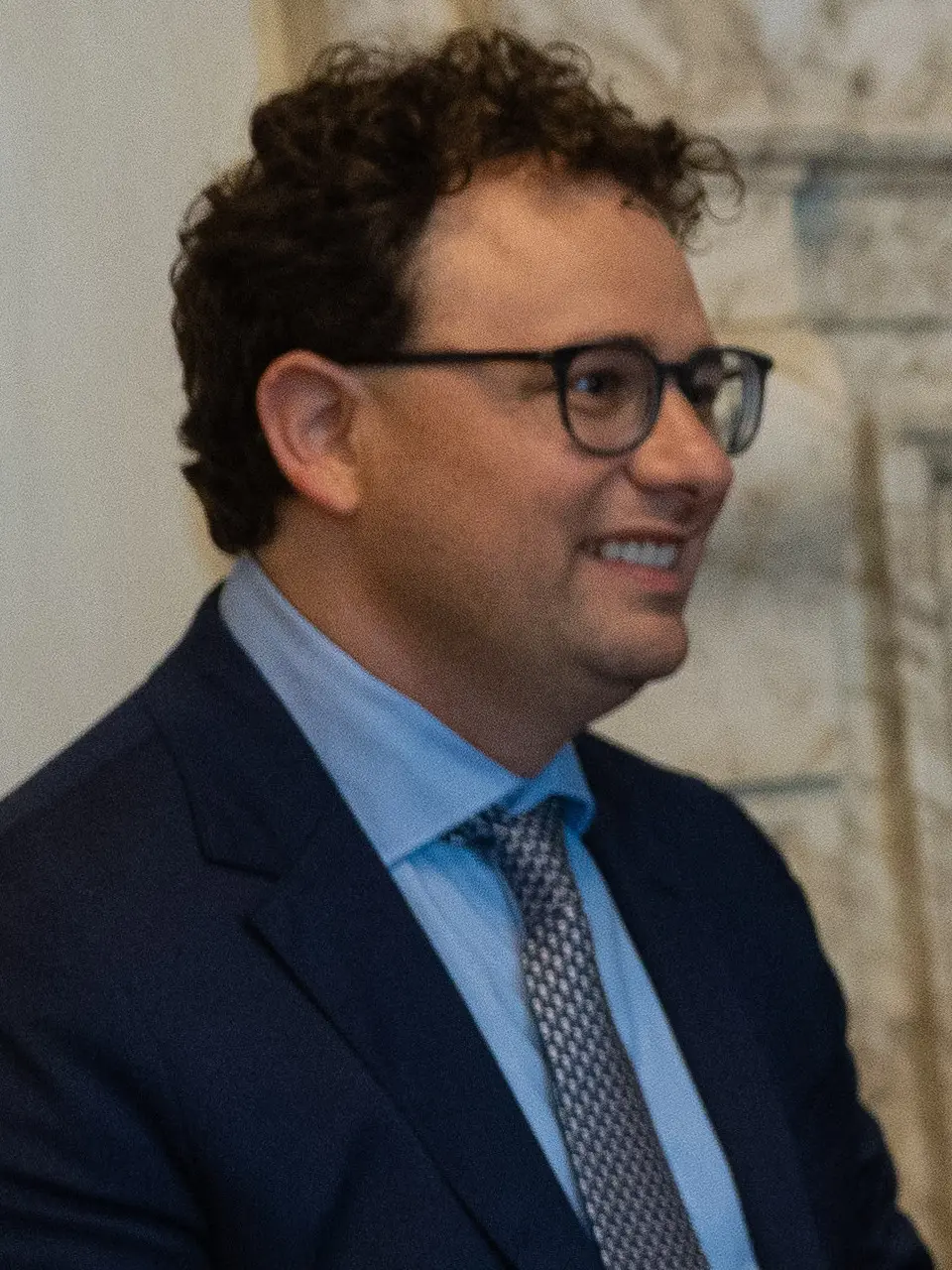
Co-founder and chief executive of Anthropic. After Stanford and a Princeton PhD on the electrophysiology of neural circuits, a postdoc at Stanford's School of Medicine, Baidu and Google Brain, he was OpenAI's VP of Research and led the work on GPT-2 and GPT-3. He left OpenAI at the end of 2020 and co-founded Anthropic in 2021.
Profile
- Born
- 1983
- Status
- Living
- Span
- 1983–
- Appearances
- 01
- Name
- ENDario AmodeiJAダリオ・アモデイ
Dario Amodei (born 1983) is a co-founder and the chief executive officer of Anthropic. A researcher who led the development of large language models went on to run a company whose public identity is built on safety. The first half of his career was in physics and neuroscience.
From physics to neural circuits
According to his own site and the Hertz Foundation, he did his undergraduate studies at Stanford and his doctorate at Princeton as a Hertz Fellow. The Hertz Foundation describes the degree as a PhD in physics; his own site calls it biophysics. The thesis is titled "Network-Scale Electrophysiology: Measuring and Understanding the Collective Behavior of Neural Circuits." The foundation says he worked on statistical-mechanics models of neural circuits and on new devices for intracellular and extracellular recording, and the thesis won him the Hertz Thesis Prize.
After the PhD he was a postdoctoral scholar at the Stanford University School of Medicine, applying mass spectrometry to network models of the cellular proteome and to the search for cancer biomarkers.
Baidu, Google Brain and a paper on safety
The first published sign of his move into machine learning is "Deep Speech 2," posted to arXiv in December 2015 by Baidu Research's Silicon Valley AI Lab. The paper recognised both English and Mandarin speech with a single end-to-end neural network. Its 34 authors are listed alphabetically, which puts Amodei first.
He then joined Google Brain; his site gives the title Senior Research Scientist. In June 2016, with a Google Brain affiliation, he published "Concrete Problems in AI Safety," as joint first author with Chris Olah (the two are marked as equal contributors). The paper sorted "accidents" in machine-learning systems — unintended and harmful behaviour arising from poor design — into five research problems, among them avoiding side effects and avoiding reward hacking.
VP of Research at OpenAI
He moved to OpenAI in 2016 (OpenAI's announcement at the end of 2020 put his tenure at "nearly five years"). "Deep reinforcement learning from human preferences," a June 2017 collaboration between OpenAI and DeepMind, showed how to learn a reward from a person's choices between pairs of short behaviour clips. His site describes him as a co-inventor of reinforcement learning from human feedback (RLHF).
As VP of Research he led the work on GPT-2 and GPT-3. On the GPT-3 paper of May 2020, "Language Models are Few-Shot Learners," his is the last of 31 names. On 29 December 2020 OpenAI announced his departure, crediting him with building GPT-2 and GPT-3 with the team and with co-leading the direction of its research alongside Ilya Sutskever. The same announcement said that he and a handful of colleagues were planning a new project that would focus less on product development and more on research.
Chief executive of Anthropic
That project became Anthropic, founded in 2021. Its founding, funding and successive generations of Claude are set out on the organization page and in the launch of Claude (2023); only what belongs to him as chief executive is noted here.
Anthropic is a public benefit corporation whose directors are elected by its stockholders and by its Long-Term Benefit Trust. Amodei has been CEO since the founding and sits on the board. In 2023 he signed the Center for AI Safety's statement that mitigating the risk of extinction from AI should be a global priority alongside pandemics and nuclear war, together with Sam Altman of OpenAI and Demis Hassabis of Google DeepMind (see the open letters of 2023).
Positions set out in essays
His views can be followed through the long essays on his own site. All were written as the head of Anthropic, and should be read as forecasts and arguments rather than findings.
| When | Title | Gist |
|---|---|---|
| October 2024 | Machines of Loving Grace | The benefits side of powerful AI: a "compressed 21st century" in which the progress in biology and medicine expected over the whole twenty-first century arrives within a few years, and the image of a "country of geniuses in a datacenter" |
| January 2025 | On DeepSeek and Export Controls | Argued that DeepSeek's releases did not undermine the case for US export controls on chips to China, and in fact strengthened it |
| April 2025 | The Urgency of Interpretability | The progress of the technology cannot be stopped, but the order and manner in which it unfolds can be changed: "We can’t stop the bus, but we can steer it." |
| January 2026 | The Adolescence of Technology | How to confront the risks of powerful AI |
At the start of the first essay he notes that people often take him for a pessimist, and explains that he focuses on risks because they are the only thing standing between us and a fundamentally positive future. Anthropic's policy of building frontier models while putting safety at the centre of the business follows from that position.
His remarks on AI and employment are discussed under entry-level jobs (2025), and the 2026 dispute with the US government over export controls under AI model export controls (2026).
Assessment
What sets Amodei's career apart is that the safety researcher and the capability builder are the same person: a joint first author of "Concrete Problems in AI Safety" who also led the development of GPT-3. That double role passed directly into the character of Anthropic. Criticism of a safety-branded company joining the frontier capability race, and the debate over supplying models to defence customers, are covered on the organization page.
Appearances
Questions this page answers
- Who is the CEO of Anthropic?
- Dario Amodei, one of its co-founders. He has been chief executive since the company was founded in 2021 and sits on its board.
- What did Dario Amodei do at OpenAI?
- As VP of Research he worked on GPT-2 and GPT-3 and co-led the direction of OpenAI's research with Ilya Sutskever. OpenAI announced on 29 December 2020 that he was leaving after nearly five years.
- What is Dario Amodei's academic background?
- He did his undergraduate studies at Stanford and his PhD at Princeton, with a thesis on measuring the collective behaviour of neural circuits through electrophysiology, followed by a postdoc at the Stanford University School of Medicine.
- What is Machines of Loving Grace?
- A long essay he published on his own site in October 2024, arguing that powerful AI could compress the progress in biology and medicine expected over the whole twenty-first century into a few years.
Sources
PrimaryDario Amodei
His own site: biography and list of essays
SecondaryDario Amodei — Hertz Foundation
Education, thesis title, postdoc, Hertz Fellowship
PrimaryDeep Speech 2: End-to-End Speech Recognition in English and Mandarin (arXiv:1512.02595)
Paper from his time at Baidu Research
PrimaryCompany — Anthropic
Public-benefit-corporation governance and board
TertiaryDario Amodei — Wikipedia
Year of birth
Last updated: