PERSON
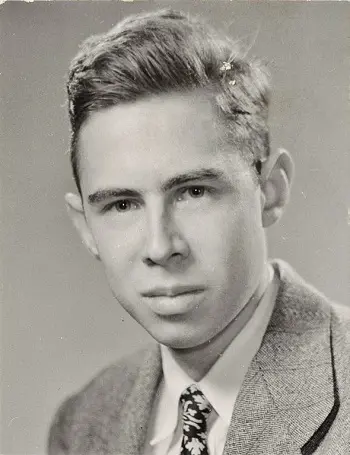
Frank Rosenblatt
Psychologist and computer researcher at the Cornell Aeronautical Laboratory. He simulated the perceptron on an IBM 704 in 1957; the US Office of Naval Research announced it at a press conference in July 1958, and the theory appeared the same year in Psychological Review. The Mark I Perceptron—a separate, purpose-built electromechanical machine with 400 photocells in its sensory layer—was assembled at the same laboratory. After Minsky and Papert's Perceptrons (1969) set out the limits of the single-layer model the line went out of fashion, but its skeleton—a weighted sum, and weights updated from error—survives in every multilayer network since. He drowned in a boating accident on Chesapeake Bay on his 43rd birthday in 1971.
Profile
- Born
- 1928
- Died
- 1971
- Span
- 43 years
- Appearances
- 01
- Name
- ENFrank RosenblattJAフランク・ローゼンブラット
Frank Rosenblatt (11 July 1928 — 11 July 1971, drowned on his forty-third birthday) put the perceptron into the world in 1957-58 and, with it, the field of trainable learning machines. Where Minsky and McCarthy chose to formalise "artificial intelligence" as symbolic processing, Rosenblatt took the parallel route of brain simulation — and started the lineage that runs into modern deep learning (AlexNet 2012).
Background
Rosenblatt was born in New Rochelle, New York. He graduated from the Bronx High School of Science in 1946 — one year apart from Marvin Minsky, whom he therefore knew from adolescence — and took his A.B. (1950) and Ph.D. (1956) at Cornell.
His doctoral work was not on perception theory but on the multivariate analysis of psychometric data, and to do it he built his own machine: EPAC, the Electronic Profile Analyzing Computer, which he used between 1951 and 1953 to process a 600-item survey of more than 200 Cornell undergraduates. The instinct — if the machine you need does not exist, build it — carried straight through to the Mark I Perceptron.
After the PhD he moved to the Cornell Aeronautical Laboratory, the Cornell-affiliated aerospace research centre in Buffalo (later Calspan), rising from research psychologist to senior psychologist to head of the cognitive systems section. In 1959 he moved to Cornell's Ithaca campus as director of the Cognitive Systems Research Program and lecturer in psychology, and in 1966 he joined the newly formed Division of Biological Sciences, in the Section of Neurobiology and Behavior, as an associate professor. He was never promoted to full professor.
The perceptron
The perceptron first ran in 1957 as a simulation on an IBM 704 at the Cornell Aeronautical Lab; in July 1958 the US Office of Naval Research presented the work at a press conference. The New York Times of 8 July 1958 ran it under the headline "NEW NAVY DEVICE LEARNS BY DOING; Psychologist Shows Embryo of Computer Designed to Read and Grow Wiser", reporting that the demonstration used the Weather Bureau's $2,000,000 "704" and that the purpose-built machine, expected in about a year, would cost some $100,000. Most of the extravagant claims in that coverage came from the Navy — but Rosenblatt was not himself understated. Cornell's own record of his 1958 remarks has him calling it "the first machine which is capable of having an original idea".
The paper that appeared the same year — "The perceptron: A probabilistic model for information storage and organization in the brain", Psychological Review 65(6), 386–408 — is a careful mathematical formulation. The model has three layers:
- A sensory layer S (the "retina" of photocells)
- An association layer A, wired to S by fixed connections
- A response layer R, whose weights are learned
The learning rule updates weights in proportion to output error — a special case of stochastic gradient descent in modern terms — and the perceptron convergence theorem proves that, for any linearly separable problem, the procedure converges in a finite number of steps. His 1962 book Principles of Neurodynamics: Perceptrons and the Theory of Brain Mechanisms (Spartan Books) went well past the single layer, treating multilayer, cross-coupled and back-coupled perceptrons.
Mark I Perceptron
The Mark I Perceptron was dedicated hardware: 400 photocells in the sensory layer, weights held in potentiometers, weight updates driven by motors. The machine running at the July press conference was not this one but the IBM 704 simulation; the Mark I was assembled separately at the same laboratory. Sources put its completion at 1958, 1959 or 1960, so this page does not pick one. The machine itself is now held by the Smithsonian Institution.
Its successor, Tobermory, was built between 1961 and 1967 for speech recognition: four layers, 12,000 weights implemented in toroidal magnetic cores, filling a room. By the time it was finished, simulation on digital computers had become faster than purpose-built perceptron hardware, and that line of machines stopped there.
Collision with Perceptrons (1969)
In 1969 Marvin Minsky and Seymour Papert published Perceptrons: An Introduction to Computational Geometry (MIT Press). What they analysed was the perceptron under a locality restriction — each association unit sees only a small part of the input — and under that restriction they proved rigorously that predicates such as parity and connectedness cannot be computed. The book is dedicated to Rosenblatt; the two argued loudly at conferences and stayed on friendly terms.
Rosenblatt had been discussing multilayer models since 1962 and never accepted the gloss that "the limits of the restricted single layer = the limits of neural networks". That unrestricted networks of such units can compute any Boolean function had been known since McCulloch and Pitts.
The claim that the book dried up funding for neural networks is often repeated and has never been demonstrated. The first AI winter around 1974 was triggered by the Lighthill report in Britain and, in the United States, by the ALPAC report, the Mansfield Amendment and DARPA's cancellation of Speech Understanding Research — a separate chain of events. What is certain is that through the 1970s the mainstream moved to symbolic methods and connectionism became a minority position.
Death
On 11 July 1971, his forty-third birthday, Rosenblatt drowned while sailing a sloop named Shearwater on Chesapeake Bay. He had been teaching at Cornell up to that point and, since 1963, working on theories of memory and on experiments injecting brain extracts from trained rats into untrained ones to test whether learned behaviour transferred. On that question he concluded against his own hopes: the large effects reported by earlier work were wrong, and any transfer was at most very small.
He was eulogised on the floor of the House of Representatives, among others by the former senator Eugene McCarthy — Rosenblatt had worked on McCarthy's 1968 presidential campaign and joined the Washington protests against the Vietnam War.
Rehabilitation
The 1986 Nature paper on backpropagation by Geoffrey Hinton, David Rumelhart and Ronald Williams gave a workable way to train multilayer perceptrons, and so demonstrated after the fact that Rosenblatt's programme had been perhaps twenty years ahead of its hardware. From the 1990s onwards the neural-network literature treats him as a direct ancestor again.
The IEEE established the Frank Rosenblatt Award in 2004 and has presented it since 2006. The first recipient was Lawrence J. Fogel; later ones include Teuvo Kohonen (2008), John J. Hopfield (2009), Vladimir Vapnik (2012), Terrence Sejnowski (2013), Geoffrey Hinton (2014), Paul Werbos (2022), and Andrew Barto with Richard Sutton (2026). The field that once wrote the perceptron off now confirms its own descent through an award carrying his name.
Legacy
The components Rosenblatt left behind — (1) a weighted linear sum followed by a non-linear activation, (2) weight updates driven by output error, (3) a simple structure realisable in hardware — survive essentially unchanged in AlexNet (2012), the Transformer (2017), and GPT-4 (2023). The arithmetic of a single artificial neuron is the same as that of a 1958 perceptron; only the count of weights — now hundreds of billions — has changed.
Appearances
Sources
TertiaryFrank Rosenblatt — Wikipedia
Last updated: