T1#labor#ethics
Hollywood's Double Strike — Writers and Actors Write AI into the Contract
Metadata
- Date
- Decade
- 2020s
- Tier
- T1
- Sources
- 14
- Connections
- 01
- Tags
- #labor#ethics
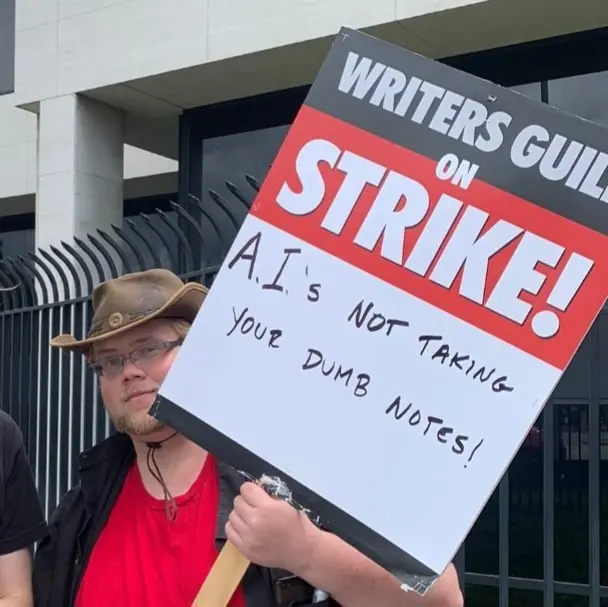
In 2023 Hollywood's writers and then its actors went on strike, and how generative AI may be used became a formal item of collective bargaining. The Writers Guild of America (WGA) struck from 2 May to 27 September; SAG-AFTRA, the actors' union, from 14 July to 9 November. On 24 September 2023 the WGA reached a tentative agreement with the studios' bargaining group, the Alliance of Motion Picture and Television Producers (AMPTP), putting into a union contract the rule that "AI can't write or rewrite literary material." This page is dated to that tentative agreement: it was the day the AI terms were first agreed between the two sides, and the ratification on 9 October confirmed them.
Why AI was on the table
On 1 May 2023, less than six months after ChatGPT appeared, the WGA set out for members where bargaining stood. Its AI proposal had three parts: "AI can't write or rewrite literary material; can't be used as source material; and MBA-covered material can't be used to train AI." The AMPTP "Rejected our proposal. Countered by offering annual meetings to discuss advancements in technology."
The same day, announcing the strike, the guild listed the companies' refusal to guarantee weekly employment in episodic television alongside "their stonewalling on free work for screenwriters and on AI for all writers". The core of the dispute was pay, streaming residuals and conditions of employment; AI was one strand. The source-material demand was aimed at a specific risk: AI output being dressed up as "source material" to weaken a writer's credit and rights.
The writers' deal — four provisions
After what the guild counted as 148 days on strike, the WGA announced the tentative agreement on 24 September and published the deal points on 26 September. The strike ended at 12:01 a.m. Pacific time on 27 September, and members voted from 2 to 9 October. Of 8,525 valid votes, 8,435 were yes and 90 no — 99 per cent in favour. The contract runs from 25 September 2023 to 1 May 2026.
According to the WGA's summary, the AI terms are these.
| Provision | What it means |
|---|---|
| "AI can't write or rewrite literary material, and AI-generated material will not be considered source material under the MBA" | AI output can't be used to undermine a writer's credit or separated rights |
| A writer may use AI with the company's consent, but "the company can't require the writer to use AI software (e.g., ChatGPT)" | Use of AI is the writer's choice |
| The company must disclose if materials given to the writer were generated by AI or incorporate AI-generated material | Writers can't unknowingly be handed an AI draft to polish |
| "The WGA reserves the right to assert that exploitation of writers' material to train AI is prohibited by MBA or other law." | No agreement on training; the fight was left open |
Measured against May, the first two demands were essentially met; the training ban was not. What the writers won was not "AI may not be used" but "using AI cannot lower the writer's standing".
The actors' deal — digital replicas and consent
For actors the issue was more direct: a digital replica built from scans of a face or a voice can be used without the performer present. According to the reporting summarised by English Wikipedia, SAG-AFTRA's chief negotiator Duncan Crabtree-Ireland alleged that the studios had proposed scanning background actors for one day's pay and holding rights to their likenesses indefinitely; the AMPTP denied this, saying replicas would be used only in the production they were made for, with consent and further pay required for anything else.
SAG-AFTRA struck on 14 July, reached a tentative agreement on 8 November and ended the strike on 9 November. In the ratification vote announced on 5 December, 78.33 per cent voted yes on a turnout of 38.15 per cent. According to analyses by the law firm DLA Piper and the Authors Guild, the main AI terms are:
- A distinction between an "employment-based" digital replica, made during a performer's employment with their participation, and an "independently created" one, made from existing material
- For both, consent that is "clear and conspicuous" and a "reasonably specific description" of the intended use
- Consent survives the performer's death unless otherwise stated; where consent is needed after death, an authorised representative may give it
- Producers must notify the union when they use synthetic performers not based on a specific actor, and bargain over compensation
- Using performances to train AI is not prohibited; the union secured only a promise to meet regularly about pay for such use
The deal was contested from inside. Negotiating committee member Shaan Sharma, who urged a no vote, told NPR: "There are so many loopholes, that it really isn't protection." Crabtree-Ireland answered that "We pushed the companies to agree to things they said they would never agree to when the negotiations started," and said further AI protections could be negotiated in the next contract.
Who gained what
The writers and actors did not stop AI from coming into production. What they won was choice over whether to use it, the right to be told when it has been used, and consent before their likeness or voice is copied. The Authors Guild, which represents book authors, published its own analysis presenting the actors' deal as an important set of AI safeguards.
Training remained the open question. Neither writers' scripts nor actors' performances were contractually protected from it. Who should license training data, and who should be paid, went to the courts instead — see The New York Times v. OpenAI and Bartz v. Anthropic.
The 2026 renewals
Three years on, both unions extended the AI terms. Item 15 of the memorandum of agreement the WGA and the AMPTP signed on 4 April 2026 requires each company to meet the guild at least semi-annually, on request, to discuss its use of generative AI, and to give written notice when it grants a paid licence to an unaffiliated third party to use covered literary material to train a public-facing generative AI system — a "GAI License" — and to meet about it, including remuneration, if the guild asks. Members ratified the contract on 24 April 2026 with 90.38 per cent in favour; it runs from 2 May 2026 to 1 May 2030.
SAG-AFTRA's new TV/theatrical contract was ratified in a vote that closed on 4 June 2026, with 91.42 per cent in favour; it builds on the earlier digital-replica protections and adds terms that further restrict the use of synthetic performers. In video games, SAG-AFTRA struck from July 2024 over consent and pay for AI replicas, reached a deal in June 2025 and ratified it with more than 95 per cent support.
Questions this page answers
- How long did the 2023 writers' strike last?
- The WGA strike began on 2 May 2023; after the tentative agreement of 24 September it ended at 12:01 a.m. PT on 27 September. The WGA puts it at 148 days. The contract was ratified on 9 October.
- What did the writers' contract say about AI?
- AI can't write or rewrite literary material, and AI-generated material is not source material, so it can't be used to undermine a writer's credit or rights. Writers may use AI with the company's consent, but the company can't require it, and must disclose AI-generated material it hands over. On training, the guild reserved its rights.
- What did SAG-AFTRA win?
- Rules distinguishing digital replicas made during employment from those made independently, both requiring clear and conspicuous consent and a reasonably specific description of the intended use, plus notice to the union when producers use synthetic performers not based on a specific actor. The contract was ratified on 5 December 2023 with 78.33 per cent in favour.
- Have the AI terms changed since?
- They were extended in 2026. The WGA's new contract, ratified on 24 April 2026, requires notice to the guild, and talks on request, when a company licenses covered scripts to train an outside generative AI system; SAG-AFTRA's new contract, ratified in June 2026, further restricts the use of synthetic performers.
Sources
PrimarySummary of the 2023 WGA MBA — Writers Guild of America
Section 5, Artificial Intelligence: the four provisions
PrimaryWGA Negotiations—Status as of May 1, 2023 — Writers Guild of America (PDF)
The WGA's AI proposal and the AMPTP's counter-offer of annual meetings on technology
Strike ends at 12:01 a.m. PT on 27 September; ratification vote 2–9 October; 148 days
Primary2023 MBA Ratified — Writers Guild of America, Oct 9, 2023
8,435 yes and 90 no of 8,525 valid votes; term 25 September 2023 to 1 May 2026
SecondaryInside the SAG-AFTRA collective bargaining agreement — DLA Piper, Dec 20, 2023
Employment-based and independently created digital replicas, notice for synthetic performers, and the absence of a ban on training
Clear and conspicuous consent, a reasonably specific description, consent surviving death
78.33 per cent in favour on 38.15 per cent turnout; 118 days; Crabtree-Ireland and Shaan Sharma
Item 15, Generative Artificial Intelligence: semi-annual meetings and notice of GAI Licenses
Last updated: