T1#research#standard
The First Website — info.cern.ch
Metadata
- Date
- Decade
- 1990s
- Tier
- T1
- Sources
- 11
- Connections
- 02
- Tags
- #research#standard
The first website was info.cern.ch, set up by Tim Berners-Lee at CERN, the European Organization for Nuclear Research. Its first page lived at http://info.cern.ch/hypertext/WWW/TheProject.html, and it was about the World Wide Web project itself. When it "went live" depends on what you count. According to CERN, the first server and browser were running inside CERN by the end of 1990; the site was announced to the outside world on 6 August 1991, when Berners-Lee posted to the alt.hypertext newsgroup.
The 1989 proposal and the NeXT machine that became the server are covered on the page for the World Wide Web proposal. This page is about the site that ran on it.
From late 1990 to August 1991
Putting the timeline the W3C keeps alongside CERN's account shows the site opening from the inside out.
| When | What happened |
|---|---|
| November 1990 | The first server is nxoc01.cern.ch, later called info.cern.ch; the first page is http://nxoc01.cern.ch/hypertext/WWW/TheProject.html |
| 13 November 1990 | Last-modified date of the oldest web page known (its address later changed) |
| Christmas 1990 | The line-mode browser and the WorldWideWeb browser/editor can be demonstrated, with access to hypertext files, the CERNVM "FIND" index and Internet news |
| March 1991 | The line-mode browser is released to a limited audience |
| 17 May 1991 | General release of WWW on CERN's central machines |
| 6 August 1991 | Posted to alt.hypertext; files available on the net by FTP |
| October 1991 | An anonymous telnet service starts, and so does the www-talk mailing list |
| 12 December 1991 | Paul Kunz installs the first web server outside Europe, at SLAC |
That is why searches turn up two answers, December 1990 and August 1991. The first is when the site was working inside CERN; the second is when anyone on the internet could be told how to reach it.
The 6 August post
The post was a reply, not an announcement. Nari Kannan, writing from a DEC address, had asked whether anyone knew of work on hypertext links that could retrieve information from multiple heterogeneous sources. Berners-Lee answered: "The WorldWideWeb (WWW) project aims to allow links to be made to any information anywhere."
He described what existed: a prototype hypertext editor for the NeXT, and a browser for line-mode terminals that ran on almost anything. Both could read local files, NFS-mounted files and anonymous FTP, and could also use a simple protocol, HTTP, to talk to a server. A server on CERN's mainframe already made all of the computer centre's documentation available as hypertext.
The code, he wrote, was very much a prototype but could be fetched by anonymous FTP from info.cern.ch; it was copyright CERN, but free distribution and use was not normally a problem. Anyone reading the post in the NeXTStep editor could simply click on http://info.cern.ch/hypertext/WWW/TheProject.html to find out more. That is how the address of the first website was put in front of the outside world: inside a Usenet thread.
According to the W3C timeline the post went out twice on 6 August and again on 19 August, followed by comp.sys.next.announce on the 20th and comp.text.sgml and comp.mail.multi-media on the 22nd.
What was on the first site
The first site was not about the web's contents but about the web project. CERN's 2013 announcement says it described the basic features of the web, how to access other people's documents and how to set up your own server.
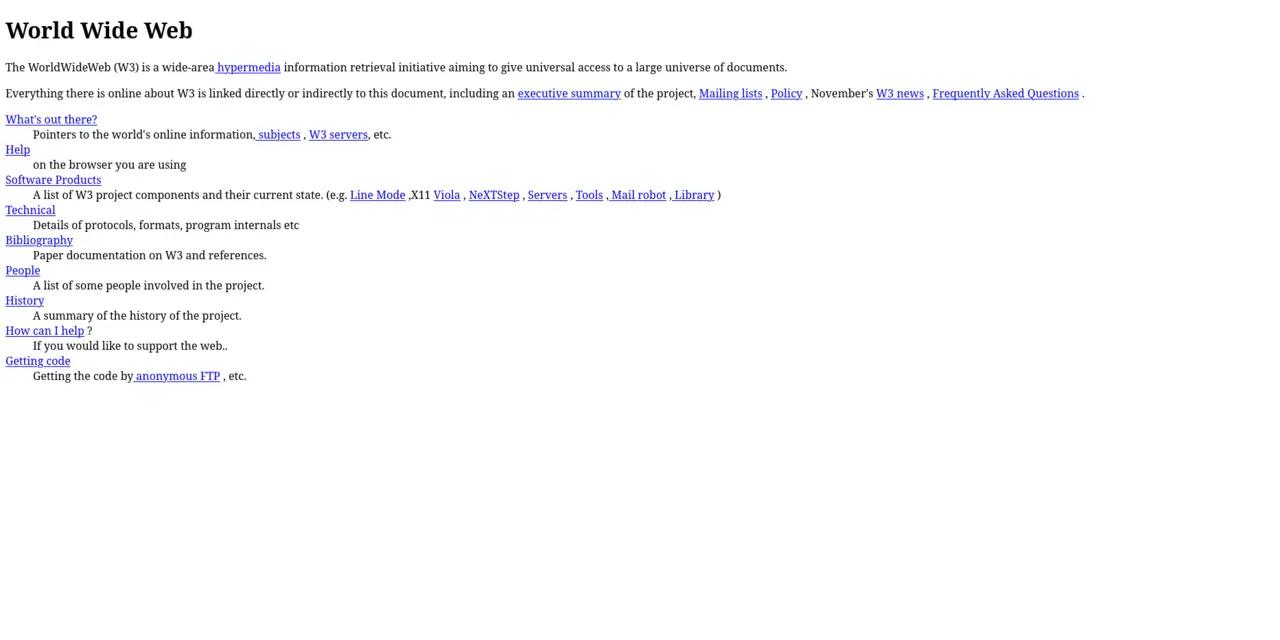
The version readable at info.cern.ch today has these headings:
| Heading | What it offered |
|---|---|
| What's out there? | Pointers to the world's online information, subjects and W3 servers |
| Help | Help on the browser you are using |
| Software Products | Line Mode, X11 Viola, NeXTStep, servers, tools, a mail robot, the library |
| Technical | Details of protocols, formats and program internals |
| Bibliography / People / History | Papers, the people involved, the history of the project |
| How can I help? / Getting code | Supporting the web; getting the code by anonymous FTP |
This is not exactly the August 1991 site. In April 2013 Dan Noyes of CERN wrote on the restoration project's blog that the files had been put back at the original address from a 1992 copy archived on the W3C site; it might be the earliest copy that could be found, and the team would keep looking for older ones. That is why it mentions things from 1992 such as the Viola browser. The site as it stood in 1990 or 1991 does not survive in its original form.
"Don't be disappointed"
For a while, one way to try it from outside was telnet; CERN started an anonymous telnet service in October 1991. The restoration project turned up a September 1993 article written for a conference of DFN, the German research network, which told readers that to find out about WWW they should type telnet info.cern.ch. That would give them the very basic line-mode interface. "Don't be disappointed," it went on: use it to find out how to install a better browser locally. The article gave info.cern.ch's IP address at the time as 128.141.201.74.
The 2013 restoration
On 30 April 2013, marking twenty years since the 1993 document that made web technology free for everyone to use, CERN announced a project to restore the first website and preserve the digital assets associated with the birth of the web. The announcement noted that the NeXT machine that had been the original web server was still at CERN, but that the first website was no longer online at its original address. The story of the 1993 decision itself is on the World Wide Web proposal page.
The project's objectives included restoring the files at the first URL to their earliest possible versions, restoring the machine names and IP addresses mentioned in the documentation, preserving the data and hardware of the NeXT machines, and recreating the experience of the line-mode browser and the NeXT browser/editor. CERN hosted line-mode browser hack days in September 2013, and today info.cern.ch lets you browse the first site through a line-mode browser simulator. In February 2019 another project at CERN rebuilt the WorldWideWeb browser inside a modern browser.
The first website can still be read at its original address — as a restored copy.
The web's later history is on the internet and web timeline, and the man who built the first server and browser is profiled under Tim Berners-Lee. For the protocol the site spoke, see HTTP in the glossary. Two years later the graphical Mosaic browser opened the web to ordinary users.
Questions this page answers
- What was the first website?
- info.cern.ch, set up by Tim Berners-Lee at CERN. Its first page was http://info.cern.ch/hypertext/WWW/TheProject.html, and it described the web project itself: how the web worked, how to access other people's documents and how to set up your own server.
- When did the first website go live?
- It depends what you count. CERN says the first server and browser were running inside CERN by the end of 1990. WWW was generally released on CERN's central machines on 17 May 1991, and Berners-Lee announced it to the outside world in the alt.hypertext newsgroup on 6 August 1991.
- Can you still see the first website?
- Yes. The restoration project CERN began in 2013 put files back at the original address using a 1992 copy archived by the W3C; the 1990 or 1991 state itself does not survive. info.cern.ch also lets you browse it through a line-mode browser simulator.
Sources
PrimaryA short history of the Web — CERN
First server and browser running by the end of 1990, info.cern.ch as the address of the first website and server, the March and August 1991 releases, and SLAC
PrimaryBerners-Lee, T. Re: Qualifiers on Hypertext links... — alt.hypertext, 6 Aug 1991 (W3C archive)
The text of the 6 August post: the NeXT editor and line-mode browser, HTTP, anonymous FTP distribution and the pointer to TheProject.html
PrimaryA Little History of the World Wide Web — W3C
nxoc01.cern.ch, the oldest page dated 13 November 1990, the Christmas 1990 demonstration, and the March, 17 May, August, October and 12 December 1991 milestones
PrimaryCERN celebrates 20 years of a free, open web — CERN press release, 30 April 2013
What the first website contained, the NeXT still at CERN, and the launch of the restoration project
PrimaryFirst URL active once more — Restoring the first website (CERN, archived), 29 Apr 2013
Restoring the first URL from a 1992 copy on the W3C site, and the 'Don't be disappointed' line from the 1993 DFN article
Last updated: