PERSON
Mark Zuckerberg
Co-founder of Facebook. He launched the product from a Harvard dorm in February 2004; the company, incorporated in July 2004, went public in May 2012 and renamed itself Meta Platforms on 28 October 2021. He drove the acquisitions of Instagram (2012) and WhatsApp (2014), testified before Congress in 2018, funded Reality Labs through years of losses, and then pivoted the company to AI. A dual-class structure leaves him chairman, CEO and holder of a majority of the voting power.
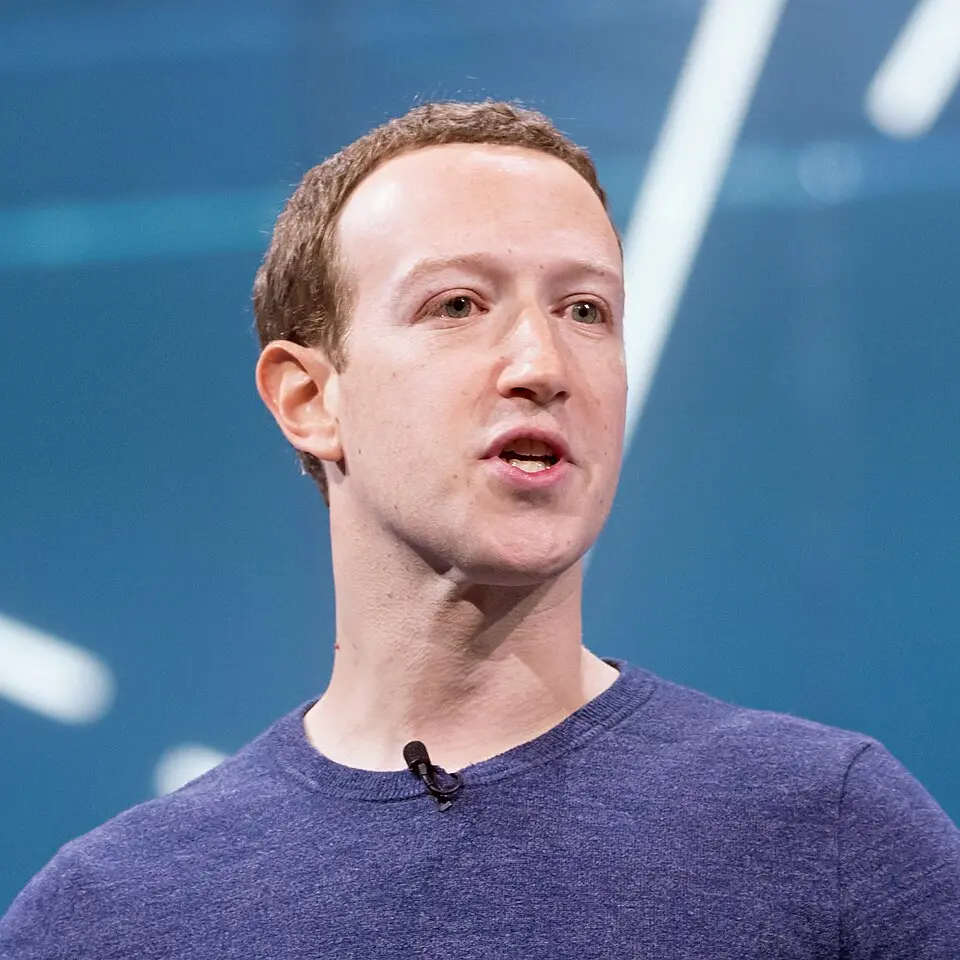
Profile
- Born
- 1984
- Status
- Living
- Span
- 1984–
- Appearances
- 06
- Name
- ENMark ZuckerbergJAマーク・ザッカーバーグ
Mark Elliot Zuckerberg (born 14 May 1984) co-founded Facebook in February 2004 and is chairman and chief executive of Meta Platforms, the company that now runs it alongside Instagram, WhatsApp and Threads. For June 2026 Meta reported an average of 3.60 billion Family daily active people (DAP) — a metric of its own definition, counting people who used at least one app in the family on a given day. Drop the metric name and "three billion users" means nothing in particular.
What makes him unusual in this archive is not the product. It is that twenty-two years after the launch, one individual still holds a majority of the voting power.
Product, company and name are three different events
- The product launched from a Harvard dorm room in February 2004, with co-founders Eduardo Saverin, Dustin Moskovitz, Andrew McCollum and Chris Hughes.
- The company came afterwards. Facebook's 2012 registration statement says of itself: "We were incorporated in July 2004." The IPO followed in May 2012.
- The name changed on 28 October 2021, when the parent became Meta Platforms. The apps kept their names. The announcement said Meta intended "to start trading under the new stock ticker we have reserved, MVRS, on December 1", and SEC registrant records still show the former name Facebook Inc running to 27 October 2021.
"Meta was founded in 2004" and "Facebook became Meta" both collapse those three things into one.
The acquisitions: announced and closed are different numbers
Because the consideration was stock, the figure announced and the figure booked never match.
| As announced | As closed (Form 10-K) | |
|---|---|---|
| April 2012: approximately 23 million shares of common stock plus $300 million in cash | Total purchase price US$521 million — roughly 12 million vested Class B shares issued to non-employee stockholders, plus $300 million in cash | |
| 19 February 2014: 183,865,778 shares (valued at $12 billion) plus $4 billion in cash, and 45,966,444 RSUs to employees (valued at $3 billion) | Purchase consideration US$17,193 million — about 178 million shares plus $4.59 billion in cash |
"A billion dollars for Instagram" and "nineteen billion for WhatsApp" are announcement-day valuations, not the numbers that reached the accounts.
Testimony, and regulation as a permanent condition
After the Cambridge Analytica reporting of March 2018, Zuckerberg testified before both chambers of Congress on 10 and 11 April. The official Senate transcript (S. Hrg. 115-683) records this in his opening statement: "We did not take a broad enough view of our responsibility, and that was a big mistake. And it was my mistake, and I am sorry. I started Facebook, I run it, and I am responsible for what happens here." The penalties and the aftermath belong to that event's own article.
On the antitrust side the finder is easy to get wrong. The FTC sued in December 2020 alleging unlawful monopolisation; on 18 November 2025 Chief Judge James Boasberg of the US District Court for the District of Columbia decided for Meta. It was a court, not a regulator, that made the finding, and the FTC said in January 2026 that it would appeal.
From the metaverse to "personal superintelligence"
The bet the rename was built on has a running tally in the 10-K. Reality Labs' loss from operations was US$16.1 billion in 2023, US$17.7 billion in 2024 and US$19.2 billion in 2025. In that same 2025, Family of Apps earned US$102.5 billion from operations. Advertising has paid for everything else throughout.
In 2025 Meta closed a US$13.80 billion minority investment in Scale AI. On 30 July that year Zuckerberg published a letter titled Personal Superintelligence, which opens: "Over the last few months we have begun to see glimpses of our AI systems improving themselves." Guidance for 2026 capital expenditures stands at US$130–145 billion. The company that bet on the metaverse is now betting on compute.
The control structure
Meta's 2025 Form 10-K discloses it as a risk factor: "Mark Zuckerberg, our founder, Chairman, and CEO, is able to exercise voting rights with respect to a majority of the voting power of our outstanding capital stock." The dual-class structure lets one person determine the outcome of everything put to shareholders, from the election of directors to the sale of the whole company — a fact the company itself files as a danger to investors.
Campus network, then metaverse, then superintelligence. The speed with which the destination has been rewritten three times in twenty-two years, and the difficulty of applying any external brake to those decisions, come out of the same structure.
Appearances
- Facebook Launched
- WhatsApp Launches — The Ad-Free, Subscription Messenger
- Instagram Launches — The Invention of the Photo-First Social Network
- The Facebook–Cambridge Analytica Scandal — An Irreversible Point for Social Media and Democracy
- The 2023 Tech Layoffs — The Month a Decade of Hiring Ended
- Meta Threads — 100 Million Sign-Ups in Five Days
Sources
TertiaryFTC v. Meta — Wikipedia
The district court ruling of 18 November 2025, and the January 2026 statement of appeal
TertiaryMark Zuckerberg — Wikipedia
Date of birth, and the co-founders at the outset
Last updated: