PERSON
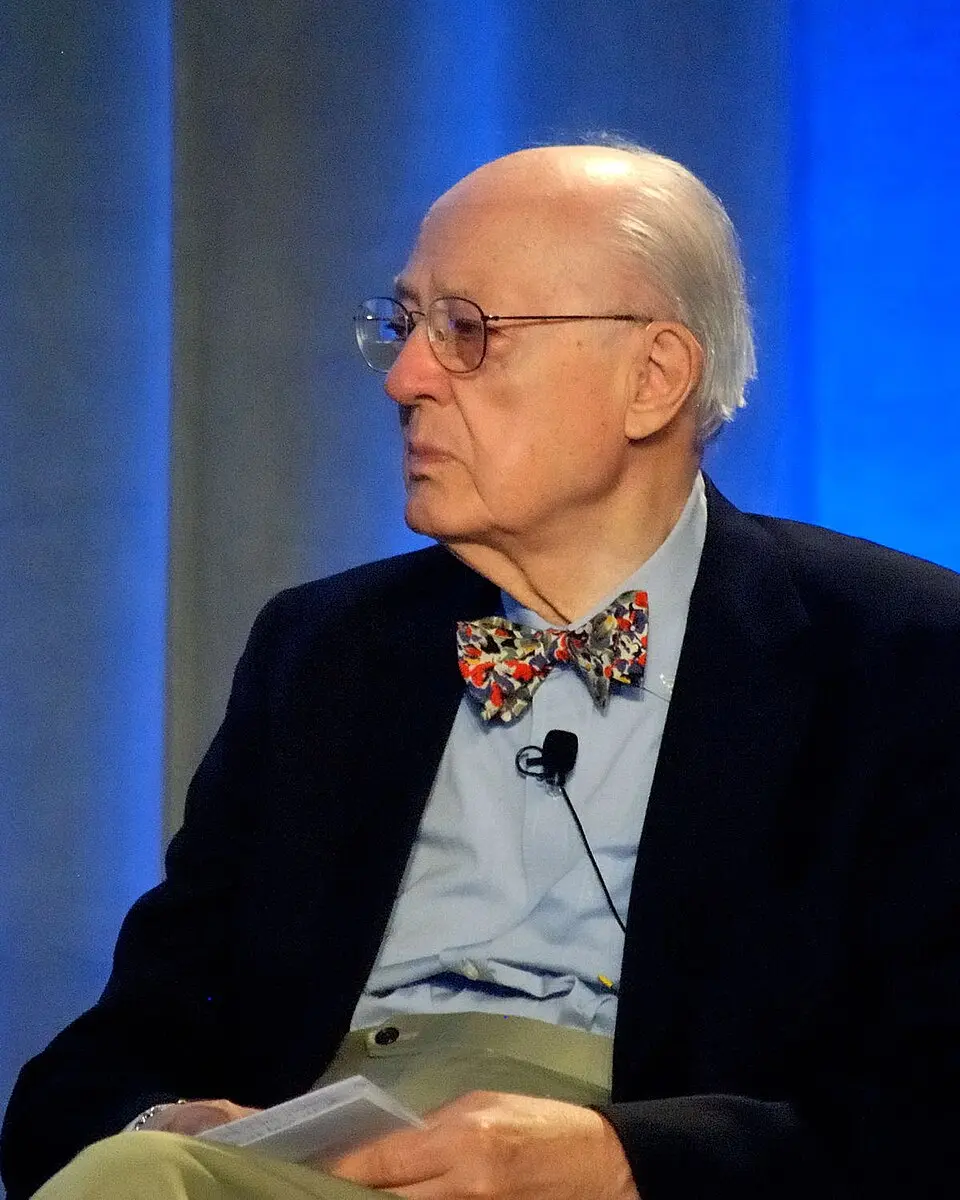
Charles W. Bachman
Designer of the Integrated Data Store (IDS), widely regarded as the first database management system. Born in Kansas in 1924, he served in Army antiaircraft artillery, studied mechanical engineering at Michigan State, and at Dow Chemical ran plant operations and set up the corporate data processing department. He moved to General Electric in 1960, built IDS, and helped turn it into the network data model through the CODASYL Data Base Task Group. In 1973 he became the first ACM Turing Award laureate without a PhD. At Honeywell he chaired the ISO subcommittee that produced the seven-layer OSI reference model, and in 1983 he founded Bachman Information Systems. He died in 2017.
Profile
- Born
- 1924
- Died
- 2017
- Span
- 93 years
- Appearances
- 02
- Name
- ENCharles W. BachmanJAチャールズ・バックマン
Charles William Bachman (11 December 1924 — 13 July 2017) spent his whole working life in industry, never earned a doctorate, and still received computing's highest academic honour. The historian Thomas Haigh, who interviewed him at length in 2004, sums up his career as one in which he "ran a chemical plant" before he ever designed software, and then went on to shape database management, data modelling and the layered model of computer networking. The database system he is famous for occupies only a few years of a working life that ran for more than half a century.
A Football Coach's Son Who Meant to Be an Engineer
Bachman was born in Manhattan, Kansas. His father was what Haigh calls a Hall of Fame football coach, and the family moved several times before settling in East Lansing, Michigan, where the elder Bachman worked at what was then Michigan State College. The boy played on several school teams and kept an interest in sport all his life. At eleven he won a local Soap Box Derby with a car he had built himself.
He decided early what he wanted to be. Interviewed by Haigh in 2004, he said: "I was never interested in anything else. I was always going to be an engineer."
Antiaircraft Guns, Night School and Wharton
The war came first. Bachman graduated from high school a semester early, spent the spring and summer of 1943 taking freshman courses at Michigan State, and then served two years in the Army's antiaircraft artillery in New Guinea, Australia and the Philippines. The guns of that era aimed with a simple mechanical computer that extrapolated an aircraft's straight-line path to predict where it would be. Haigh writes that the experience convinced Bachman both of the value of predictive control loops and of how hard it is to hit a future target.
He came back to Michigan State, finished a mechanical engineering degree in 1948, and went on to the University of Pennsylvania to study thermodynamics. Only on arrival did he discover that Penn's graduate engineering programme met at night and that his classmates all had day jobs. He filled his days with management courses at the Wharton School and completed most of the coursework for an MBA, though no joint degree existed. He married Connie Hadley, whom he had met at Michigan State, in the summer of 1949, and took his master's degree in 1950.
Ten Years at Dow Chemical
His first employer was Dow Chemical in Midland, Michigan. After nine months rotating through the plant's departments he became, in his words, an engineer at a drafting table in a room with more than a hundred others, working in the group responsible for Dow's water, steam and power systems. The work turned on economics more than design. On an internal effort called the Equivalent Capital Project he found himself reinventing ideas such as discounted cash flow, and by 1952 he was analysing the capital cost of all of Dow's plants, solving systems of equations on the accounting department's punched-card machines and wiring their plug boards himself.
In 1954 he priced agricultural chemicals. From 1955 he spent two years in production, first as a process engineer at the Saran plant and then as second-in-command of the Styron 475 plant. Haigh argues that this tour of the company taught him to see a business as one connected system.
In 1957 Dow decided to computerise, and the treasurer he had worked with on capital accounting recommended him to head a new corporate data processing department. Bachman chose an IBM 709 and by May 1958 had hired thirty people. Then Dow ran into economic trouble, cut ten of his positions, and finally cancelled the order. A computer room was built in the new headquarters and never received its computer.
SHARE, 9PAC and Data as Triples
The cancelled order nonetheless changed his career, because ordering a 709 had made Dow a member of SHARE, the IBM scientific users' group. Bachman quickly became a leader among the members who meant to use the machine for business work. At his second meeting he met Harry Tellier of General Electric's Hanford operation, whose report generator for the IBM 702 he saw at once would suit Dow. The two were founding members of SHARE's Data Processing Committee, which sponsored 9PAC, a report generator for the 709 that entered use in 1959. Bachman credits discussions with Russ McGee of the Hanford group for one of its key features: parent-child relationships inside a tape file, such as each customer record followed by that customer's orders.
He also sat on a SHARE committee on the theory of information handling, which tried to describe data apart from its physical form as a set of "triples", each a value, a name and an owner. Haigh notes that Bachman contributed to 9PAC without ever having written a data processing application or taken delivery of a computer.
The Integrated Data Store and the DBTG, in Brief
Bachman moved to General Electric in 1960, to a corporate production control services group in New York. There he designed the Integrated Data Store, which was running by 1963 and is widely called the first database management system; how it worked and how GE released it is on the IDS page. From 1966 to 1968 he was an active member of the CODASYL Data Base Task Group, whose reports turned the IDS design into the network data model; the reports themselves are covered on the DBTG page.
Phoenix: WEYCOS 2 and DataBASIC
In 1964 he transferred to GE's Computer Department in Arizona. He was first assigned to marketing, to help launch IDS by explaining its benefits to customers, but the department was in constant flux and over six years he worked in its project planning group and finally an advanced software group.
Two projects from these years matter for the history of the DBMS. For Weyerhaeuser's wood products division in Tacoma, a joint team built WEYCOS 2 between 1966 and 1968. Its most lasting result, Haigh writes, was that IDS was adapted so that one database could be shared by up to eight application programs running at the same time. The second was DataBASIC, built under Bachman's direction in 1967 and 1968, which added database commands to the Dartmouth BASIC language so that professionals who were not programmers could build and query their own databases. It had no record types and no predefined field names, and was little used.
A 1969 performance appraisal praised his technical leadership but noted, as Haigh quotes it, that "Charlie's primary interests are technical rather than managerial."
Honeywell, the Turing Award and the 1974 Debate
In 1970 Honeywell acquired GE's computer business, and in August Bachman moved to Boston to work on its new product line. He stayed at Honeywell as chief staff engineer until 1980.
In 1973 he became the eighth recipient of the ACM Turing Award. The ACM biography lists the firsts: the first laureate without a PhD, the first trained in engineering, the first to win for business computing, the first to win for a specific piece of software, and the first to spend his whole career in industry. He told Haigh the award did little for his career, though it made him curious about Turing, and he visited Turing's mother in an English nursing home. His lecture, "The Programmer as Navigator," appeared in Communications of the ACM in November 1973.
It also started a fight. When Bachman previewed the lecture at a meeting, Edgar Codd rose to congratulate him and then, as C. J. Date recalled to Haigh, declared that "what he is saying in his paper is dead wrong" and challenged him to a formal debate. It took up a full afternoon of the ACM SIGFIDET workshop in Ann Arbor, held 1 to 3 May 1974 — the same workshop at which SEQUEL was first presented. Bachman argued that the relational and network views were mathematically equivalent, leaving a choice of efficiency and style. Neither side convinced the other; no practical relational system yet existed. Bachman insisted the rivalry was friendly, and that he and Codd would go out to dinner afterwards.
He kept working on data models. In the late 1970s he proposed a "role data model" that tied together records describing the same real-world entity in different roles, published with M. Daya at the VLDB conference in 1977.
Two Committees: ANSI/SPARC and the OSI Seven Layers
Bachman was vice chairman of the ANSI/X3/SPARC Study Group on Database Systems, set up in 1972, and tried to draft a standard that preserved the concepts of IDS and the DBTG. No consensus came, which he blamed largely on IBM. The group's consolation prize, as Haigh calls it, was the three-level distinction between internal, conceptual and external schemas that database textbooks still teach.
His second committee had a wider reach. From 1978 to 1982 he chaired the subcommittee of the International Organization for Standardization on Open Systems Interconnection. The American submission grew out of the Honeywell Distributed System Architecture he had developed inside the company, and he estimated that "75% was based on my work at Honeywell." The subcommittee's lasting product was the seven-layer reference model, which by the early 1990s organised networking textbooks even though Internet protocols, not OSI's own, won the market.
Cullinane and Bachman Information Systems
In 1980, frustrated at Honeywell, he joined Cullinane Database Systems as a vice president (Haigh's biography gives the title as applied research, Bachman's own interview as product management). Cullinane's main product, IDMS, descended from his own IDS, but Bachman came to see the job as a figurehead's, and in 1983, as the firm tried to rebrand IDMS as relational, it let him go.
On 1 April 1983 he and Connie founded Bachman Information Systems. With $2 million from Venrock and Kleiner Perkins, it released its first product, Data Analyst, in 1987: a PC tool, priced at $15,000 a seat, that diagrammed data models and turned them into designs for mainframe databases. The company went public on NASDAQ and partnered with IBM, but the partnership soured, the company merged with another firm to form Cayenne Software, and in 1998 it was sold to Sterling Software for a fraction of its earlier value. Bachman called it the biggest disappointment of his career: "I wasn't the manager the company needed."
Consulting, Late Honours and Death
Past seventy he took up consulting, modelling data for clients including Constellar and Cbr Systems, operator of the Cord Blood Registry, and in 2004 Haigh found him prototyping a design in Microsoft Access 2003. He was also writing a book on data structure diagrams, which he regarded as a new algebra.
The British Computer Society made him a Distinguished Fellow in 1977. He received the National Medal of Technology and Innovation for 2012, "for fundamental inventions in database management, transaction processing, and software engineering," presented by President Obama at the White House in 2014. The Computer History Museum named him a Fellow in 2015, and Michigan State gave him an honorary doctorate of engineering the same year.
Bachman died in Lexington, Massachusetts, on 13 July 2017, aged 92. His papers are held at the Charles Babbage Institute. At the end of his oral history transcript he left a note that Haigh used to close both of his biographies: "My work has been my play."
Appearances
Questions this page answers
- Who invented the database management system?
- If one name is given, it is Charles W. Bachman, who designed the Integrated Data Store (IDS) at General Electric and had it running by 1963. He received the 1973 ACM Turing Award for it. The historian Thomas Haigh judges that he did more than anyone else to invent the DBMS as we know it.
- Did Charles Bachman have a PhD?
- No. He held a bachelor's degree in mechanical engineering from Michigan State (1948) and a master's in mechanical engineering from the University of Pennsylvania (1950). He was the first Turing Award laureate without a PhD.
- What did Charles Bachman have to do with the OSI model?
- He chaired the ISO subcommittee on Open Systems Interconnection from 1978 to 1982, which produced the seven-layer reference model. The American submission grew out of the distributed system architecture he had developed at Honeywell.
Sources
Early life, war service, Penn and Wharton, Dow Chemical, SHARE and 9PAC, WEYCOS 2, DataBASIC, Honeywell, the 1974 debate, ANSI/SPARC, OSI, Cullinane, Bachman Information Systems, later years
SecondaryCharles W. Bachman — A.M. Turing Award Laureate (biography by Tom Haigh)
Birth date, education, dated employment record, the Turing Award firsts, BCS Distinguished Fellow (1977)
PrimaryCharles Bachman — National Medal of Technology and Innovation, 2012 laureate
The award citation
Death on 13 July 2017 in Lexington aged 92, the 2014 White House presentation, the 2015 honorary doctorate
TertiaryCharles Bachman — Wikipedia
Last updated: