ORGANIZATION
Qualcomm
American semiconductor and wireless-technology company incorporated in California in 1985 and reincorporated in Delaware in 1991. It has two core businesses: QCT (Qualcomm CDMA Technologies), which designs and sells chips such as Snapdragon without owning wafer fabs, and QTL, which licenses its patents to device makers for royalties based on device prices. Competition authorities have challenged that combination: in South Korea most of the Fair Trade Commission's decision, fine included, stood when the Supreme Court dismissed both sides' appeals in 2023, while the European Commission's 2018 fine was annulled in full by the General Court in 2022 and the US FTC's case ended when a federal appeals court reversed the district court in 2020. Revenue for the fiscal year ended September 2025 was US$44.3 billion.
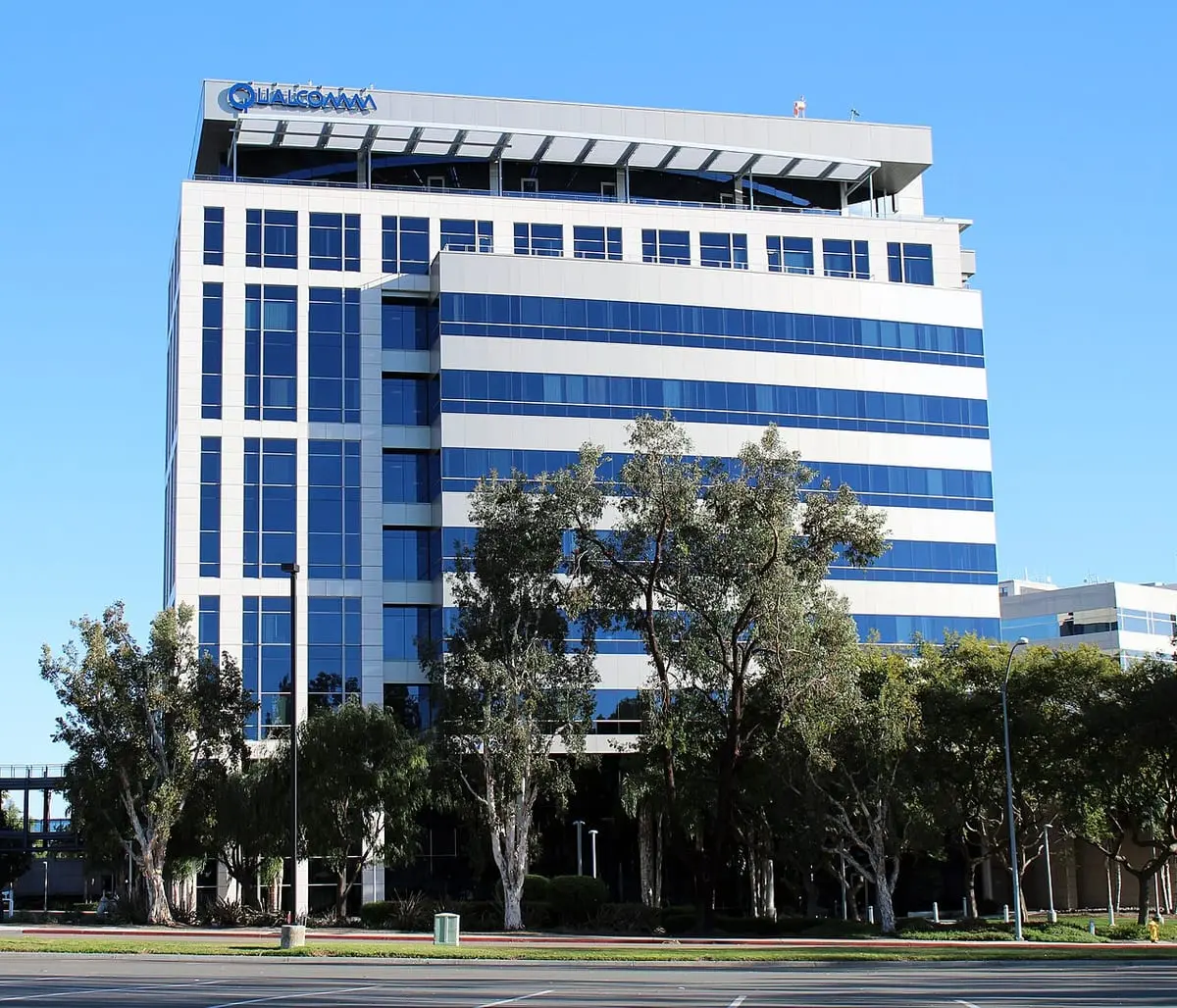
Organization
- Founded
- 1985
- Status
- Active
- Active
- 1985–
- Appearances
- 02
- Name
- ENQualcommJAクアルコム
Qualcomm is an American company incorporated in California in 1985 and reincorporated in Delaware in 1991. Its annual report on Form 10-K says that since its founding it has focused heavily on developing foundational technologies for the wireless industry. It is headquartered in San Diego and had approximately 52,000 full-time, part-time and temporary workers at the end of September 2025. Cristiano Amon has been President and Chief Executive Officer since June 2021.
Chips and patents, side by side
Qualcomm's shape is set by the combination of two businesses. Its semiconductor business is still called QCT (Qualcomm CDMA Technologies), keeping the name of the CDMA cellular standard. The district court in the 2019 FTC case also found that Qualcomm had monopoly power in the CDMA and premium-tier LTE modem chip markets (a ruling later reversed on appeal).
| Business | What it is (10-K) | Revenue, FY2025 | Pre-tax margin |
|---|---|---|---|
| QCT | Snapdragon and other chips with system software; fabless except for certain RF components | US$38.4bn | 30% |
| QTL | Licences to its patent portfolio, including patents essential to standards such as 4G and 5G; mostly per-unit royalties | US$5.6bn | 72% |
QTL royalties are generally a percentage of the licensee's wholesale selling price of the complete device. A company that sells chips also collects patent royalties, based on the price of the whole device, from the device makers that use those chips. That structure is exactly what competition authorities in several countries challenged.
Within QCT, handsets brought in US$27.8 billion, IoT US$6.6 billion and automotive US$4.0 billion in fiscal 2025. According to the 10-K, Apple, Samsung and Xiaomi each accounted for 10% or more of consolidated revenue. Its chips also appear in products such as the Meta Quest 2, with the Snapdragon XR2, and the first Copilot+ PCs, with the Snapdragon X Elite and X Plus. The company's reaction when Apple went 64-bit with the iPhone 5s is described in that entry.
The fights with competition authorities
The outcomes split by country and by court. The table draws on Qualcomm's 10-K and 10-Q filings and a press release of the Court of Justice of the European Union.
| Authority or court | Conduct at issue | Outcome |
|---|---|---|
| Korea Fair Trade Commission (KFTC) | Refusing or restricting patent licences to rival modem-chip makers, conditioning chip supply on licence agreements, and coercing terms on handset makers | Violation found in December 2016, with a fine of 1.03 trillion won (about US$927 million, paid in March 2017). In December 2019 the Seoul High Court cancelled part of the remedial orders and upheld the rest; on 12 April 2023 the Korea Supreme Court dismissed both sides' appeals, concluding the case |
| European Commission (payments to Apple) | Paying Apple significant amounts on condition that it use only Qualcomm baseband chipsets | Fine of €997 million in January 2018. On 15 June 2022 the EU General Court annulled the decision in its entirety; the Commission did not appeal and the case ended |
| European Commission (Icera complaint) | Predatory pricing: selling baseband chipsets below cost to two customers in 2009–2011 | Fine of about €242 million in July 2019. On 18 September 2024 the EU General Court upheld the finding and set the fine at about €238.7 million |
| US Federal Trade Commission (FTC) | Conditioning chip supply on licences, refusing licences to rivals, exclusive dealing with Apple and more | In May 2019 the US District Court for the Northern District of California ruled for the FTC and imposed an injunction; on 11 August 2020 the Ninth Circuit Court of Appeals reversed the judgment and vacated the injunction, and on 28 October 2020 it denied rehearing en banc |
According to Qualcomm's 10-K, the Ninth Circuit held that Qualcomm had no antitrust duty to license rival chip makers and that licensing its standard-essential patents only at the device-maker level does not violate the antitrust laws.
Key events
- 1985: Incorporated in California.
- 1991: Reincorporated in Delaware.
- December 2016: The Korea Fair Trade Commission finds a violation (final after the Supreme Court ruling of April 2023).
- January 2017: The US FTC sues in the Northern District of California.
- January 2018: European Commission fine of €997 million (annulled in June 2022).
- April 2019: Settlement with Apple, with a six-year patent licence and a multi-year chipset supply agreement.
- 11 August 2020: The Ninth Circuit reverses the district court in the FTC case.
- June 2021: Cristiano Amon becomes CEO.
- 31 August 2022: Arm sues Qualcomm and Nuvia in the US District Court for the District of Delaware.
- May 2024: The US Commerce Department revokes the licence for sales to Huawei.
- 20 December 2024: A jury in Arm's case returns a verdict favourable to Qualcomm.
Key figures
Fiscal year ended 28 September 2025, from the 10-K.
- Revenue: US$44.3 billion (up 14%; equipment and services US$37.9 billion, licensing US$6.4 billion)
- Gross margin: 55%
- Net income: US$5.5 billion, after a US$5.7 billion charge to establish a valuation allowance on deferred tax assets following US tax legislation (US$10.1 billion the year before)
Apple, Huawei and Arm
Selling both chips and patents complicates relations with the largest customers. Qualcomm and Apple fought over royalty payments until April 2019, when they dismissed all litigation. They signed a six-year global patent licence effective 1 April 2019, with an option to extend for two years, and a multi-year chipset supply agreement, and Qualcomm recognised US$4.7 billion of licensing revenue from the settlement that fiscal year. The 2025 10-K says Apple has begun using its own modem in its recent smartphones and expects it to do so increasingly. In China, the US Commerce Department revoked the licence for sales to Huawei in May 2024, and Qualcomm no longer expects product revenue from Huawei.
The other fight is with Arm, the supplier of the instruction set its CPUs use. In August 2022 Arm sued, alleging that Qualcomm and Nuvia, which Qualcomm had acquired, failed to honour the termination obligations of Nuvia's licence, and sought to have Qualcomm stop using and destroy technology developed under it. On 20 December 2024 a jury in the US District Court for the District of Delaware found that Qualcomm had not breached Nuvia's licence and that Qualcomm CPUs including Nuvia-derived designs are licensed under Qualcomm's own agreement; it could not reach a verdict on whether Nuvia had breached. On 30 September 2025 the court entered final judgment for Qualcomm, and Arm appealed to the Third Circuit. A separate case in which Qualcomm accused Arm of breaching its licence was tried in October 2026. According to Qualcomm's counsel, on 13 October the jury found that Arm had breached the licence and interfered with Qualcomm's business relationship with Meta, while finding for Arm on the claim under the technology licence agreement; issues including the duty to negotiate in good faith remain with the judge. The relationship as seen from Arm's side is in the entry on Arm.
Appearances
Questions this page answers
- How does Qualcomm make its money?
- Through two businesses: QCT, which sells chips such as Snapdragon, and QTL, which licenses patents. In the fiscal year to September 2025 QCT revenue was US$38.4 billion and QTL US$5.6 billion, but QTL's pre-tax margin was 72% against QCT's 30%. QTL earns mainly per-unit royalties based on the wholesale selling price of licensees' devices.
- How did FTC v. Qualcomm end?
- In May 2019 the US District Court for the Northern District of California found that Qualcomm had engaged in anticompetitive conduct and imposed an injunction. On 11 August 2020 the Ninth Circuit Court of Appeals reversed that judgment and vacated the injunction, and on 28 October 2020 it denied the FTC's petition for rehearing en banc.
- How did the dispute between Apple and Qualcomm end?
- They settled in April 2019 and dismissed all litigation. They also signed a six-year global patent licence effective 1 April 2019, with an option to extend for two years, and a multi-year chipset supply agreement; Qualcomm recognised US$4.7 billion of licensing revenue from the settlement in fiscal 2019.
- Where does the Arm v. Qualcomm litigation stand?
- In the case Arm filed in 2022, a jury in the US District Court for the District of Delaware found on 20 December 2024 that Qualcomm had not breached Nuvia's licence, and on 30 September 2025 the court entered final judgment for Qualcomm. Arm has appealed to the Third Circuit. A separate case brought by Qualcomm against Arm went to a jury trial in October 2026.
Sources
Incorporation in 1985 and reincorporation in Delaware in 1991, the QCT and QTL businesses and results, net income, headcount, major customers, Apple's in-house modem, the revocation of the Huawei export licence, and the Arm litigation
PrimaryQUALCOMM Incorporated, Quarterly Report on Form 10-Q for the quarter ended June 28, 2026 — SEC
Status of the two Arm cases (Arm's appeal and the trial schedule for Qualcomm's suit)
PrimaryQUALCOMM Incorporated, Annual Report on Form 10-K for the fiscal year ended September 27, 2020 — SEC
The KFTC's 2016 decision and fine, the Seoul High Court judgment, the European Commission's two decisions, and the FTC case's district court ruling and its reversal by the Ninth Circuit
PrimaryQUALCOMM Incorporated, Annual Report on Form 10-K for the fiscal year ended September 29, 2019 — SEC
The April 2019 settlement with Apple, the patent licence and chipset supply agreements, and the US$4.7 billion of revenue recognised
PrimaryQUALCOMM Incorporated, Annual Report on Form 10-K for the fiscal year ended September 25, 2022 — SEC
The General Court's annulment in full, on 15 June 2022, of the European Commission's 2018 decision, and the Commission's not appealing
PrimaryQUALCOMM Incorporated, Quarterly Report on Form 10-Q for the quarter ended March 26, 2023 — SEC
The Korea Supreme Court's dismissal, on 12 April 2023, of the appeals by both Qualcomm and the KFTC
The General Court setting the fine in the predatory-pricing case (T-671/19) at about €238.7 million
Qualcomm's counsel's account of the jury verdict of 13 October 2026 and the issues left for the judge
Last updated: