T1#enterprise#regulation
The Y2K Problem — Two-Digit Years and a Worldwide Fix
Metadata
- Date
- Decade
- 2000s
- Tier
- T1
- Sources
- 07
- Connections
- 00
- Tags
- #enterprise#regulation
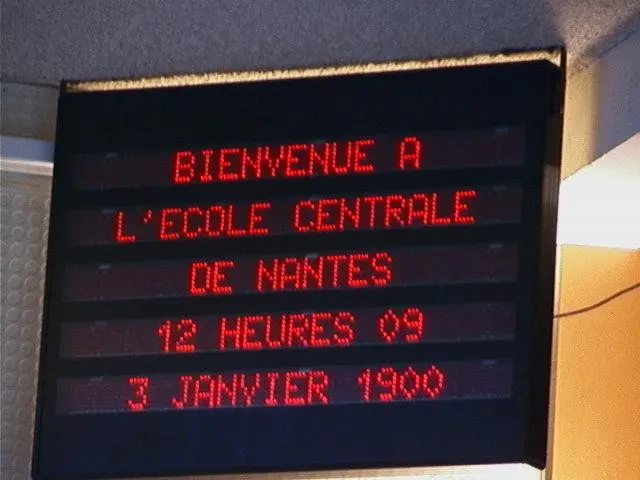
The Y2K problem (the Year 2000 problem, or millennium bug) was the risk that computers storing years as two digits would read the "00" of 2000 as 1900, and then calculate, compare or sort dates wrongly. The US General Accounting Office (GAO) explained in 1997 that for decades systems had written years as two digits, such as "97" for 1997, in order to conserve electronic data storage and reduce operating costs. With two digits, 2000 is indistinguishable from 1900, and 2001 from 1901.
Governments and companies spent heavily on fixes in the late 1990s; the US Senate's special committee put US spending at an estimated $100 billion. On 1 January 2000 there were scattered glitches, but in the committee's words no major problems were experienced in the US or worldwide. Whether that was because the fixes worked or because the danger had been overstated is still argued.
What the problem was
According to GAO, any program that uses dates to perform calculations, comparisons or sorting could produce incorrect results with years after 1999. If a system cannot tell someone born in 2000 from someone born in 1900, ages, interest, expiry dates and due dates all go wrong.
Two-digit years were not the only trap. 1900 was not a leap year; 2000 was. A system that mistook 2000 for 1900 would treat 29 February as a date that did not exist, which is why GAO's definition of Year 2000 compliance included leap-year calculations.
GAO also described why fixing it was hard. Many government systems had been designed 20 to 25 years earlier, were poorly documented, and were written in a wide variety of languages, many old or obsolete. A system could consist of tens or hundreds of programs, each with thousands to millions of lines, all of which had to be examined for date handling. Software stored in read-only memory, operating systems, communications applications and database software were all in scope.
The US response
| When | What happened |
|---|---|
| February 1997 | GAO designates Y2K a high-risk area for the federal government |
| May 1997 | First OMB report: 21% of the 24 major agencies' mission-critical systems compliant |
| 4 February 1998 | President Clinton signs Executive Order 13073, creating the President's Council on Year 2000 Conversion, chaired by John Koskinen |
| April 1998 | The Senate Special Committee on the Year 2000 Technology Problem is formed |
| October 1998 | $3.35 billion in emergency supplemental funding: $1.1 billion for Defense, $2.25 billion for civilian agencies |
| December 1999 | OMB reports 99.9% of those systems compliant |
| 29 February 2000 | The Senate committee issues its final report and disbands |
Executive Order 13073 opened by saying that, because of a design feature in many electronic systems, some would misinterpret the year "00" as 1900 rather than 2000, and that unless action was taken they could compute erroneously or simply not run.
What it cost
Nobody knows exactly. The Senate committee's final report said the worldwide cost of preparing for Y2K may never be known, and then listed the estimates.
| Estimate by | Scope | Amount |
|---|---|---|
| Office of Management and Budget | US federal government | $8.34 billion |
| US Department of Commerce | US government and businesses | about $100 billion |
| Gartner Group | United States | $150–225 billion |
| IDC (Project Magellan) | Worldwide ($134 billion of it in the US) | $320 billion |
| A Newsweek journalist | Worldwide | $500 billion |
The committee noted that one widely used way to estimate the work was one dollar per line of code to be assessed, remediated and tested.
What happened on 1 January 2000
The Senate committee titled its final report Y2K Aftermath — Crisis Averted. Its domestic examples were Medicare payment delays, double-billing by some credit card companies, degradation of a spy satellite system, 911 problems in several localities and a nuclear weapons plant system anomaly. Internationally it listed non-safety-related problems at a nuclear power plant, a Hong Kong Futures Exchange outage and a variety of biomedical device glitches. Despite these, it concluded, no major problems were experienced in the US or worldwide.
On embedded chips, the committee reported that analysis of testing in the last quarter of 1999 predicted a failure rate of .001%, against the 2–3% projected in late 1998 and early 1999.
Japan's response
In September 1998 Japan's Advanced Information and Telecommunications Society Promotion Headquarters adopted an action plan on the Year 2000 problem. A status review for the government's advisory council in April 1999 said that, apart from cases with unavoidable reasons, 92% of high-priority systems held by ministries and public corporations were due to finish simulation testing by June 1999.
According to the Ministry of Posts and Telecommunications' 2000 white paper, over the New Year the government ran an information network headed by a response office at the Prime Minister's residence and published reports on domestic and overseas incidents. In the ministry's own sectors, 1 January brought three glitches in telecommunications, one in broadcasting and one in postal services, all quickly fixed. On leap day, 29 February, about 1,200 postal savings ATMs failed to start because of a fault in a built-in chip; they were back by that afternoon.
The Senate report's appendix also lists Japanese incidents, among them a weather monitoring system at the Shika nuclear plant, back-office errors at the Tokyo Stock Exchange, and bankbook and ATM date displays at banks and credit cooperatives. The committee said it could not verify these reports first-hand and included only those from sources it considered reliable.
Was it overhyped?
There are two readings.
The Senate committee wrote that testimony and research in 1998 and early 1999 had convinced it the threat was very real, and that it was the committee's judgment that "the level of effort was justified and the expenditure of funds was indeed necessary." GAO's September 2000 lessons-learned report named federal leadership, commitment and coordination as major reasons for the government's success.
The best-known dissent is a 2004 paper by the Australian economist John Quiggin. He argued that problems had been insignificant even where little or no remediation was done, and that most of the money spent specifically on Y2K compliance was wasted; evidence available early in 1999, he wrote, should have justified a cheaper fix-on-failure approach.
Both positions involve inference, because the world in which nothing was fixed cannot be observed. What is on the record is both the hundreds of billions spent and the scarcity of serious failures.
What it left behind
The Senate committee said Y2K had spurred the modernisation of the US technology base and exposed how its systems depended on one another. The same report flagged the next date problem: in 2038 timers in some UNIX operating systems roll over. It also warned that software patched with a "pivot year" window, keeping two-digit years, could fail again later.
For the software background see the programming languages timeline; for the rest of that year, the overview timeline. Two months later, in March 2000, the US stock market's dot-com bubble peaked.
Questions this page answers
- What was the Y2K problem?
- It was the risk that computers recording years as two digits would read the '00' of 2000 as 1900 and then calculate, compare or sort dates wrongly. The US General Accounting Office explained that two-digit years had been used to conserve storage and cut operating costs. Because 2000 was a leap year and 1900 was not, 29 February 2000 was also a danger date.
- How much did fixing Y2K cost?
- No exact total exists. The US Senate's special committee listed estimates of $8.34 billion for the federal government (OMB), about $100 billion for US government and business (Commerce Department), and $320 billion (IDC) or $500 billion (a Newsweek journalist) worldwide.
- What actually happened on 1 January 2000?
- Scattered glitches. The Senate committee's report listed Medicare payment delays, double-billing by some credit card companies, degradation of a spy satellite system and a Hong Kong Futures Exchange outage, and concluded that no major problems were experienced in the US or worldwide. In Japan, the posts and telecommunications sectors logged five glitches on 1 January, all quickly fixed.
- Was Y2K overhyped?
- Opinions differ. The Senate committee judged the threat real and the level of effort justified. In a 2004 paper the economist John Quiggin argued that problems were insignificant even where little remediation was done and that most of the money was wasted. Since the unfixed world cannot be observed, both views involve inference.
Sources
Why two-digit years were used (storage and operating costs), 2000 versus 1900, old systems in many languages, and a compliance definition including leap years
The roughly $100 billion US estimate and other estimates, $3.35 billion in supplemental funds, incidents at home and abroad, embedded-chip failure rates, the committee's judgment, the Japan incident list and the 2038 problem
The 1997 high-risk designation, OMB's 21% to 99.9% progression, the supplemental appropriation and the reasons for success
Primary平成11年版 通信白書 コンピュータ西暦2000年問題への対応 — 郵政省(総務省)
The September 1998 action plan and the April 1999 advisory-council review (92% of priority systems to finish simulation tests)
Primary平成12年版 通信白書 コンピュータ西暦2000年問題への対応 — 郵政省(総務省)
The Prime Minister's residence response office, five glitches on 1 January, and about 1,200 postal savings ATMs on leap day
Last updated: