T1#launch#enterprise#labor#open-source
OpenAI Codex — A Software Engineering Agent Working in Parallel in the Cloud
Metadata
- Date
- Decade
- 2020s
- Tier
- T1
- Sources
- 09
- Connections
- 05
- Tags
- #launch#enterprise#labor#open-source
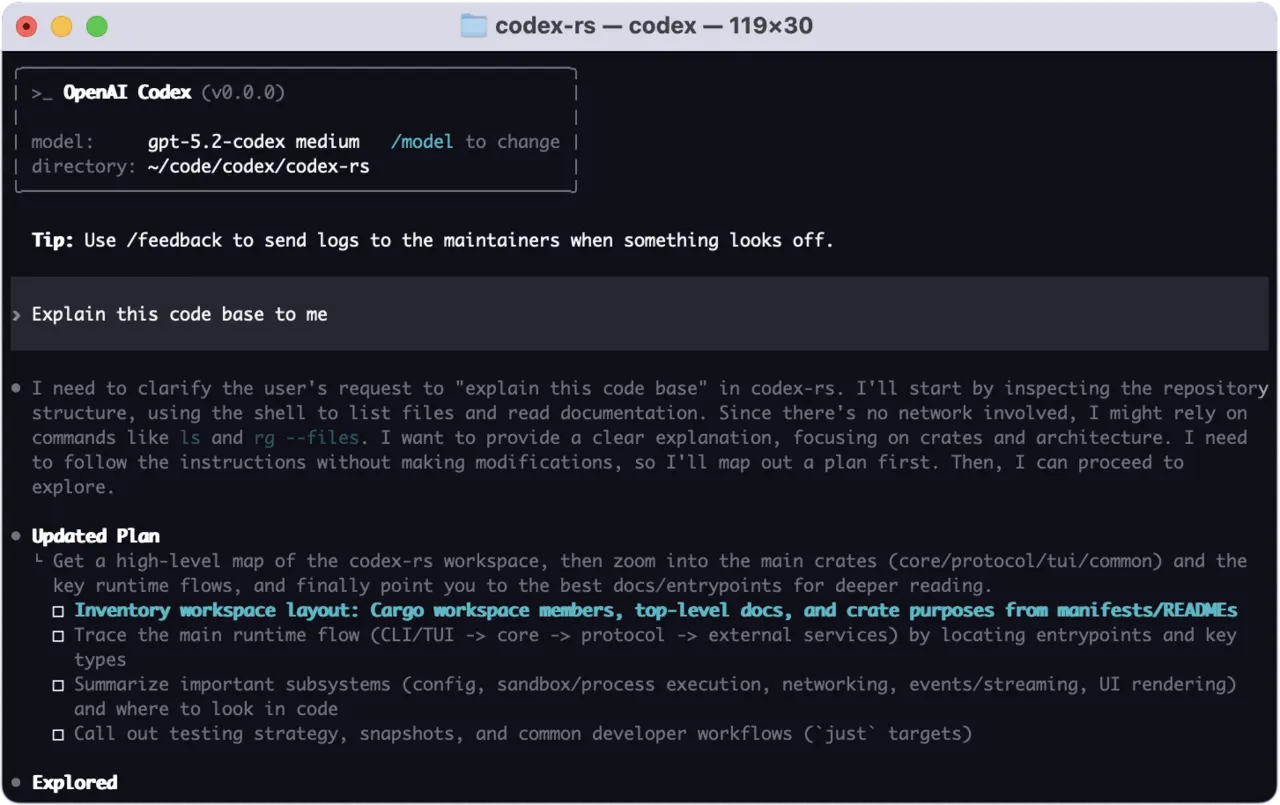
OpenAI Codex is OpenAI's software engineering agent. On 16 May 2025 OpenAI released Codex as a research preview: a cloud-based agent that works on many tasks in parallel. It writes features, answers questions about a codebase, fixes bugs and proposes pull requests, running each task in its own isolated sandbox preloaded with the user's repository. It rolled out globally to ChatGPT Pro, Enterprise and Business users and reached Plus users on 3 June. A month earlier, on 16 April 2025, OpenAI had already released Codex CLI, an open-source agent that runs in the terminal.
The name causes confusion, so it is worth settling first. In 2021 Codex was the name of the code-generation model behind GitHub Copilot. In 2025 Codex is the name of an agent product to which you hand whole tasks, and the model inside it is a different one.
Two Codexes
| Codex (2021) | Codex (2025) | |
|---|---|---|
| What it is | A code-generation model | A software engineering agent (a product) |
| Main use | Completions in GitHub Copilot | Delegating tasks in the cloud, the terminal (CLI), the IDE |
| Model inside | A GPT language model fine-tuned on code | codex-1 (a tuned OpenAI o3), later GPT-5-Codex and others |
| Unit of work | A suggestion for the next few lines | A task (feature, fix, pull request) |
Codex CLI: 16 April 2025
On 16 April 2025, the day it announced the reasoning models o3 and o4-mini, OpenAI released Codex CLI as "a new experiment": a lightweight coding agent that runs directly on the developer's own computer and can take screenshots or rough sketches alongside the local code. It was open-sourced on GitHub the same day under the Apache 2.0 licence, and OpenAI announced a $1 million initiative to support projects using Codex CLI with API credits.
Cloud Codex: 16 May 2025
The cloud version of Codex is used from the ChatGPT sidebar. You type a task and press "Code" to set it working, or "Ask" to ask about the codebase.
- codex-1: a version of OpenAI o3 optimised for software engineering, trained with reinforcement learning on real coding tasks to write code that mirrors human style and pull-request preferences and to keep running tests until they pass
- Isolation: each task runs in its own container preloaded with the repository; in the launch configuration internet access was disabled during the task
- Duration: tasks typically took between 1 and 30 minutes depending on complexity
- Evidence: it cites terminal logs and test outputs so the user can check what it did
- AGENTS.md: it reads instruction files in the repository to learn how to run tests and follow the project's conventions
OpenAI stated that it "remains essential for users to manually review and validate all agent-generated code before integration and execution," and said it had trained Codex to refuse requests aimed at developing malicious software. Early testers included Cisco, Temporal, Superhuman and the autonomous-driving company Kodiak. Superhuman reported that product managers could now contribute lightweight code changes without pulling in an engineer.
Availability in Japan
On launch day the cloud version rolled out "globally" to Pro, Enterprise and Business users. There was no regional restriction, so Japan was included from the start. Plus users gained access on 3 June 2025. The general-availability announcement of October 2025 named Rakuten among its users, alongside Duolingo, Vanta and Cisco.
General availability and growth
| Date | Event |
|---|---|
| 16 April 2025 | Codex CLI released as open source |
| 16 May 2025 | Cloud Codex released as a research preview |
| 3 June 2025 | Plus users added; optional internet access during tasks |
| 15 September 2025 | GPT-5-Codex, a model tuned for Codex, announced |
| 6 October 2025 | General availability; Slack integration and the Codex SDK |
| 9 December 2025 | AGENTS.md contributed to the Agentic AI Foundation under the Linux Foundation |
In the general-availability announcement OpenAI said daily usage of Codex had grown more than tenfold since early August and that GPT-5-Codex had served over 40 trillion tokens in the three weeks since its launch. Inside OpenAI, it said, nearly all engineers now used Codex, up from just over half in July, and they merged 70% more pull requests each week. These are OpenAI's own figures. In June 2026 Constellation Research reported OpenAI as saying Codex had more than 5 million weekly active users, 20% of them knowledge workers rather than developers.
How the work changes
In its launch post OpenAI described software engineering as one of the first industries to experience significant AI-driven productivity gains, and said it was working with partners to understand the implications of widespread agent adoption for developer workflows and for skill development across people, skill levels and geographies. It pictured developers driving the work they want to own and delegating the rest to agents.
How to measure the gains is disputed. In an experiment published by the research group METR in July 2025, experienced open-source developers took 19% longer with AI tools, contrary to their own impression (details on the Claude Code page). OpenAI's "70% more pull requests" is an internal figure that has not been independently checked. Effects on junior hiring are on the page on AI and entry-level jobs.
Competition sharpened as well. Anthropic's Claude Code had arrived first, in February 2025, and on 25 June 2025 Google released Gemini CLI as open source under Apache 2.0, free during the preview for up to 1,000 requests a day with a personal Google account. Within half a year all three large labs had a coding agent for the terminal. The common standard these agents use to reach outside tools is MCP. The surrounding events are on the AI timeline and the AI and society timeline.
Questions this page answers
- What is OpenAI Codex?
- It is OpenAI's software engineering agent. The cloud version was released as a research preview on 16 May 2025; it works on tasks in parallel, each in an isolated environment preloaded with the repository, writing features, fixing bugs, running tests and proposing pull requests. There is also Codex CLI for the terminal, and an IDE extension.
- Is it the same as the 2021 Codex?
- No. The 2021 Codex was a code-generation model that powered GitHub Copilot. The 2025 Codex is the name of an agent product, which ran first on codex-1, a tuned version of OpenAI o3, and later on models such as GPT-5-Codex.
- When was Codex CLI released?
- On 16 April 2025, alongside OpenAI o3 and o4-mini, as open source under the Apache 2.0 licence. It came a month before the cloud version of Codex.
- Is it available in Japan?
- The cloud version rolled out globally to ChatGPT Pro, Enterprise and Business users on 16 May 2025, without regional restrictions. The general-availability announcement of October 2025 named Rakuten among its users.
Sources
PrimaryIntroducing Codex — OpenAI, May 16, 2025
Research preview of the cloud agent; codex-1; isolated containers with internet disabled during tasks; AGENTS.md; Cisco, Temporal, Superhuman and Kodiak; Plus access from 3 June; Codex CLI updates
PrimaryIntroducing OpenAI o3 and o4-mini — OpenAI, Apr 16, 2025
Release of Codex CLI as open source; the $1 million grant initiative
Primaryopenai/codex — GitHub
Lightweight coding agent that runs in the terminal; Apache-2.0; Rust
PrimaryCodex is now generally available — OpenAI, Oct 6, 2025
General availability; Slack integration; Codex SDK; daily usage up more than 10x since early August; GPT-5-Codex served over 40 trillion tokens in three weeks; nearly all OpenAI engineers use it; 70% more pull requests merged; Duolingo, Vanta, Cisco and Rakuten
Last updated: