T1#ethics#regulation
Théâtre D'opéra Spatial — The AI-Made Picture That Won a State Fair
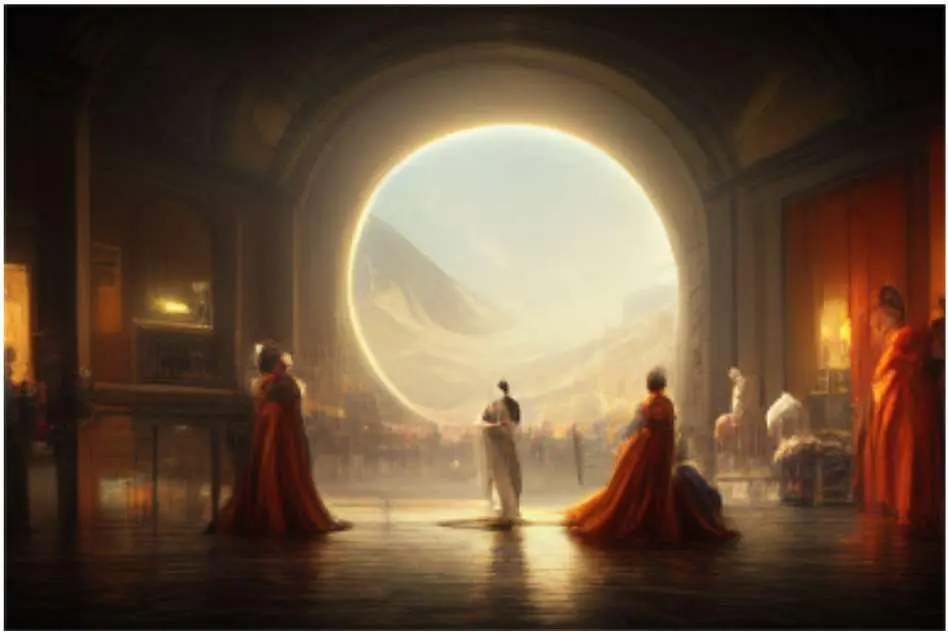
Metadata
- Date
- Decade
- 2020s
- Tier
- T1
- Sources
- 08
- Connections
- 02
- Tags
- #ethics#regulation
In the summer of 2022 a picture made with an image-generating AI won first place at an art competition. In the Colorado State Fair's fine-arts results dated 29 August 2022, first place in the Emerging Artist division's Digital Arts / Digitally-Manipulated Photography class went to Jason M. Allen's Théâtre D'opéra Spatial. Allen had generated the underlying image with Midjourney. What outlasted the prize was the question it raised — can a picture made with AI be copyrighted? On 5 September 2023 the US Copyright Office gave its final administrative answer for this work: not unless the AI-generated material is disclaimed.
What won
According to the fair's official results list, class 0005, "Digital Arts / Digitally-Manipulated Photography", in the Emerging Artist division had three placings, and Allen's piece took first. It was a division for emerging artists, not the professional one — a detail that often drops out of retellings.
Allen posted in Midjourney's Discord server, above photos of his canvases hanging at the fair, a message that began "I won first place". According to VICE's report of 31 August 2022, he said he had clearly labelled the entry as a Midjourney work and described his process: "I generate images with MJ, do passes with photoshop, and upscale with Gigapixel." He added: "I knew this would be controversial."
The backlash
The post spread to social media and drew an angry response. One post quoted by VICE read: "We're watching the death of artistry unfold before our eyes". For people who had spent years learning to draw and paint, an image obtained by typing prompts winning in the same arena called the value of the skill itself into question. Allen, for his part, said: "This win has only emboldened my mission."
According to the reporting summarised by English Wikipedia, the two judges said they had not known Midjourney was an AI but would have awarded the prize anyway, and from 2023 the Colorado State Fair required entrants to disclose AI use. The organisers closed the gap between a new tool and old rules by changing the rules first.
What the Copyright Office decided
On 21 September 2022 Allen applied to register the work as a two-dimensional artwork. His application did not mention AI, but the Office knew of the work because, as the Review Board later put it, it had garnered national attention, and the examiner asked how he had used Midjourney.
| Date | Event |
|---|---|
| 29 Aug 2022 | First place in the Colorado State Fair results |
| 21 Sep 2022 | Application filed with the US Copyright Office |
| 13 Dec 2022 | Initial refusal |
| 24 Jan 2023 | First request for reconsideration |
| 6 Jun 2023 | Refusal maintained (Photoshop edits accepted as registrable) |
| 12 Jul 2023 | Second request for reconsideration |
| 5 Sep 2023 | Review Board affirms the refusal |
| 26 Sep 2024 | Allen sues in the District of Colorado |
Allen told the Office that he "input numerous revisions and text prompts at least 624 times to arrive at the initial version of the image." The examiner asked him to exclude the features generated by Midjourney; he declined and claimed the whole image. The initial refusal said the deposit did not fix only his alleged authorship but included "inextricably merged, inseparable contributions" from both Allen and Midjourney.
The Review Board's decision of 5 September 2023 found that the work "contains more than a de minimis amount of content generated by artificial intelligence", which must be disclaimed in an application. Because Allen was unwilling to disclaim it, the work could not be registered as submitted. The Office had, however, accepted that Allen's human-authored visual edits in Photoshop contained enough original authorship to be registered. What it rejected was the claim that the whole picture was Allen's authorship — not the parts he made himself.
The decision relied on the Office's March 2023 registration guidance for works containing AI-generated material and on the district court's August 2023 ruling in Thaler v. Perlmutter that "human authorship is a bedrock requirement of copyright".
What followed
On 29 January 2025 the Copyright Office published Part 2 of its report on copyright and AI, concluding that AI output can be protected only where a human author has contributed sufficient expressive elements — "but not the mere provision of prompts."
In Thaler's case, where the AI was named as sole author, the D.C. Circuit upheld the Office on 18 March 2025, and on 2 March 2026 the Supreme Court denied review. The appellate ruling that a work authored solely by an AI cannot be registered thereby became final.
Allen's case raises the harder question: what if a human uses AI as a tool and directs it over and over? On 26 September 2024 he sued in the US District Court for the District of Colorado to set aside the refusal. A court order of 9 June 2026 notes that the briefing deadline expired on 27 February 2026; no ruling had been issued.
What it meant beyond the fair
The episode separated two questions about AI-generated images. One is whether AI-assisted work should compete on equal terms with work made by hand — a question for competitions and markets. The other is who owns a generated image — a question for law. Organisers answered the first with disclosure rules; the US Copyright Office answered the second with a working rule: register the human contribution, and require the AI-generated part to be disclaimed.
A third question — the rights of the people whose work trained the generators — is being fought over in the lawsuits around Stable Diffusion, whose weights went public the same August.
Questions this page answers
- Which competition did the AI-made picture win?
- The fine-arts exhibition of the 2022 Colorado State Fair. In the results list dated 29 August, Jason M. Allen's Théâtre D'opéra Spatial was first in the Emerging Artist division's Digital Arts / Digitally-Manipulated Photography class.
- Was the picture granted copyright?
- No. The US Copyright Office accepted that Allen's human edits in Photoshop could be registered but required the Midjourney-generated material to be excluded. Allen refused, and on 5 September 2023 the Review Board affirmed the refusal.
- How many prompts did Allen use?
- Allen told the Copyright Office he input revisions and text prompts at least 624 times to reach the initial version, then edited it in Photoshop and upscaled it with Gigapixel AI.
- Did it go to court?
- Allen sued in the US District Court for the District of Colorado on 26 September 2024 to set aside the refusal. A court order of 9 June 2026 notes that the briefing deadline passed on 27 February 2026; no ruling had been issued.
Sources
Primary2022 Fine Arts First, Second & Third — Colorado State Fair, Aug 29, 2022 (PDF)
Emerging Artist class 0005, Digital Arts / Digitally-Manipulated Photography: Allen Jason, Théâtre D'opéra Spatial, first place
The record from the application (21 Sep 2022) and refusal (13 Dec 2022) through the reconsideration requests (24 Jan and 12 Jul 2023); the 624 prompts; the duty to disclaim more than de minimis AI-generated content
Allen's Discord post and comments; reactions on social media
The conclusion that the mere provision of prompts does not establish authorship
PrimaryDocket No. 25-449, Thaler v. Perlmutter — Supreme Court of the United States
Petition denied on 2 March 2026
PrimaryAllen v. Perlmutter, No. 1:24-cv-02665 (D. Colo.) — CourtListener docket
Filed 26 September 2024 before Judge William J. Martinez; a 9 June 2026 order notes the briefing deadline expired on 27 February 2026
Last updated: