PERSON
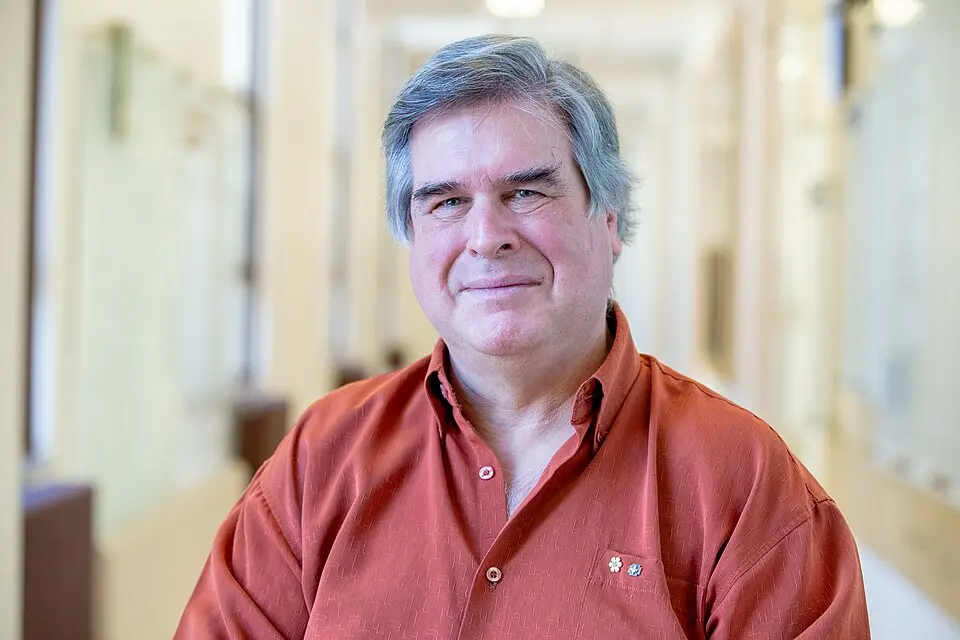
Gilles Brassard
Canadian computer scientist, born in Montréal in 1955. He entered the Université de Montréal at thirteen and took his PhD in theoretical computer science at Cornell in 1979 under John E. Hopcroft, himself a Turing laureate in 1986. That same year he met Charles H. Bennett at a conference in Puerto Rico; in 1984 the two published BB84, the first practical quantum key distribution protocol. He is also a co-author of quantum teleportation (1993) and entanglement distillation (1996), and held a Canada Research Chair from 2001 to 2021. Holder of the Wolf Prize in Physics and the Breakthrough Prize, he shared the 2025 ACM A.M. Turing Award with Bennett on 18 March 2026 — the eighth Canadian to win it, and the Université de Montréal's second laureate after Yoshua Bengio in 2018.
Profile
- Born
- 1955
- Status
- Living
- Span
- 1955–
- Appearances
- 01
- Name
- ENGilles BrassardJAジル・ブラサール
Gilles Brassard (b. 1955) is a computer scientist at the Université de Montréal and, with Charles H. Bennett, a recipient of the 2025 ACM A.M. Turing Award. ACM's own announcement describes him as the first person in the world to venture into quantum information science.
Montréal, Then Cornell
Brassard was born in Montréal in 1955. His university's account of his career notes that he began studying on its campus in 1968, at the age of thirteen, and that apart from the four years he spent on his doctorate he has spent his entire career there — forty-seven of those years as a professor, as of 2026.
He took his PhD in theoretical computer science at Cornell in 1979 under John E. Hopcroft, who would receive the Turing Award himself in 1986. The thesis was about cryptography before it was about quantum mechanics: he proved the theoretical existence of an oracle relative to which the security of public-key cryptography — then the newest thing in the field — could be demonstrated. The question he started from was therefore already the right one. What is the security of a cryptosystem actually grounded in?
Puerto Rico, and BB84
He presented those results at an international conference in Puerto Rico, where he met Bennett. In 1982 the two co-authored a first-of-its-kind quantum cryptography paper with Stephen Wiesner. In December 1984, at a conference in Bangalore, they presented "Quantum Cryptography: Public Key Distribution and Coin Tossing" — BB84, named for their initials and the year.
BB84's answer to Brassard's original question is that the grounding should not be computational at all. Quantum information cannot be measured or copied without disturbance, so an eavesdropper is detectable before any information is compromised. The guarantee survives an adversary with unbounded computing power.
In 1989 Brassard joined Bennett and John Smolin for the first physical demonstration of the protocol, running on a two-metre bench of mirrors, polarisers and photon detectors built in Bennett's office, driven by software Brassard and his students wrote.
Cryptography is not the whole of his record. He is a co-author of the 1993 quantum teleportation paper and of the 1996 work on entanglement distillation — the two results that made entanglement something engineers could plan around rather than merely marvel at.
Honours
Brassard holds the Wolf Prize in Physics, the Micius Quantum Prize, the BBVA Foundation Frontiers of Knowledge Award in Basic Sciences and the Breakthrough Prize in Fundamental Physics. He is an Officer of the Order of Canada and of the Ordre national du Québec, and a Fellow of the Royal Society. He held a Canada Research Chair from 2001 to 2021, supported over his career by Canada's federal research council, which awarded him its Gerhard Herzberg Gold Medal.
The Turing Award followed on 18 March 2026, for the 2025 award year. The Université de Montréal notes he is only the eighth Canadian to receive it since the award began in 1966, and its own second laureate after Yoshua Bengio in 2018 — few universities have two.
Thirty Years of Unfinished Homework
Given a microphone, Brassard used it to argue about migration rather than to accept congratulations. Speaking to his university, he said the world needs to wake up and stop relying solely on an obsolete cryptographic infrastructure that is supposed to protect us but that, since 1994, we have known will collapse the moment a full-power quantum computer becomes available.
1994 is the year Peter Shor published his quantum factoring algorithm. The interval between that demonstration and the still-incomplete replacement of the public-key infrastructure it undermines is, by Brassard's reckoning, more than thirty years of unfinished homework — and he had proposed one of the alternatives a decade before the problem was even announced.
Appearances
Sources
TertiaryGilles Brassard — Wikipedia
Last updated: