T1#pda#palm#mobile#stylus
Palm's Pilot 1000 and Pilot 5000 — The Palmtop That Defined the PDA Category
Metadata
- Date
- Decade
- 1990s
- Tier
- T1
- Sources
- 09
- Connections
- 00
- Tags
- #pda#palm#mobile#stylus#handheld
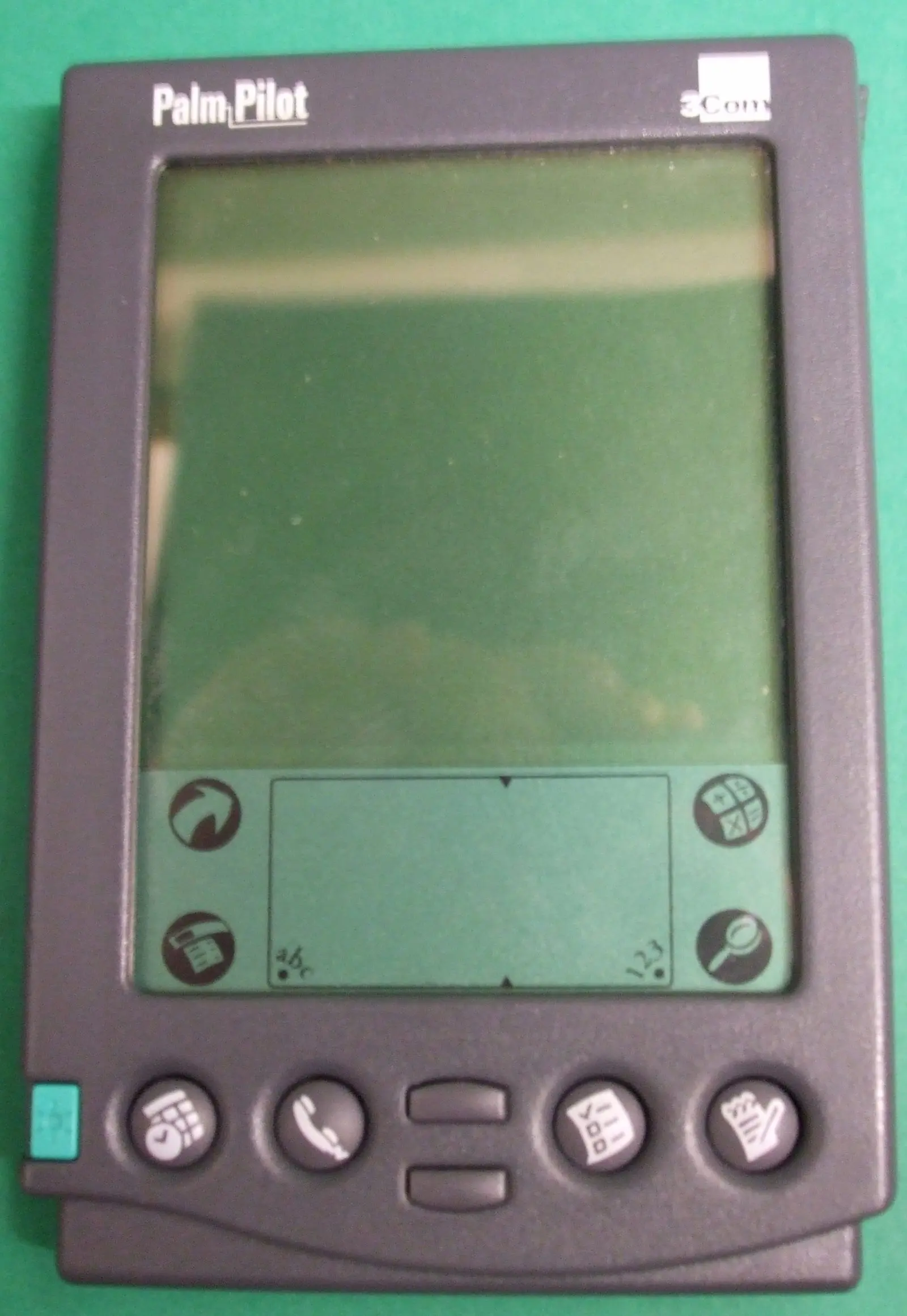
On 29 January 1996, at the Demo '96 conference in Palm Springs, the Palm Computing Division of U.S. Robotics unveiled two devices: the Pilot 1000 (128 KB of memory, street price US$299) and the Pilot 5000 (512 KB, US$369). The press release promised shipping in March and retail availability for Windows PCs in April. Just under twelve centimetres tall, 160 grams in weight, running for weeks on two AAA batteries, and fitting comfortably into a shirt pocket.
They were sold simply as the "Pilot" — the familiar name PalmPilot only arrived with the second generation in 1997, after the Pilot Pen Corporation sued over the trademark, and was later shortened again to plain Palm.
Until then, the "PDA" — Personal Digital Assistant, a term Apple's John Sculley coined in 1992 as the Newton was being previewed — had been a category of large, heavy machines with unreliable handwriting recognition at prices starting around US$700 and running well past US$1,000. The Apple Newton carried that triple burden to its grave in 1998. On that withered ground, Palm pushed through like a needle.
Why Palm Succeeded
The designer Jeff Hawkins had analysed the Newton's failure coldly. His conclusion was simple: a PDA is not a replacement for the PC; it is an accessory to one.
Every design decision flowed from that premise.
- Shirt-pocket size. Where the Newton was the size of a paperback, the Palm fit a business-card slot. During development, Hawkins carried a whittled block of wood in his shirt pocket as a physical ceiling — anything larger than that, he insisted, would fail.
- HotSync with the PC. Drop the device into its cradle, press one button, and the calendar and contacts synchronised both ways with the desktop. The PDA was reframed not as a stand-alone computer but as a portable terminal for PC data.
- Graffiti handwriting input. Palm gave up on free-form recognition and instead required users to learn Graffiti — a simplified alphabet drawn with a single stroke per character. There was a learning curve, but the accuracy was extraordinary: U.S. Robotics advertised entry "at up to 30 words per minute with 100% accuracy". This was the lesson learnt from the Newton's failure with "natural" handwriting.
- A bespoke OS and parsimonious power. No multitasking, no file system, applications installed from the PC. The platform was engineered around the constraint that two AAA cells would last weeks.
The US$299 price was, against a Newton MessagePad that had launched at US$699 and successors that pushed past US$1,000, shocking.
One Million Units in Eighteen Months, and the PDA Market Cornered
Growth was fast enough to be visible in the accounts. Palm booked about US$7 million of revenue in the eleven months to May 1996 — the first quarter or so of Pilot sales — and US$114 million in the fiscal year that ended May 1997. Cumulative shipments passed one million within roughly eighteen months of launch, an adoption curve steeper than the IBM PC's or the Macintosh's. By 1998, IDC put Palm at 68% of the worldwide handheld market: 72% in Europe, 59% in Asia.
| Asia | 59% | |
|---|---|---|
| Worldwide | 68% | |
| Europe | 72% |
A single-product run of that scale was rare in consumer electronics at the time. US Robotics was bought by 3Com in June 1997, and the Palm division kept developing autonomously within 3Com; 3Com announced the spin-off in September 1999, and Palm, Inc. became an independent public company in March 2000.
The Grid, the Cradle, and the SDK
The Palm Pilot was more than an electronic organiser. It moved the relationship between computer and person one step closer.
- "A computer always in your pocket." For a decade before the smartphone, Palm was the only mainstream product that offered the experience.
- The home-screen grid. The lattice of icons that Palm OS popularised became the UI vocabulary inherited by the iPhone home screen.
- A sync culture. HotSync laid down the idea — later inherited by iTunes, iCloud, Google Sync, and Microsoft Exchange — that personal data ought to remain consistent across multiple devices.
- A third-party ecosystem. Palm OS published an SDK early on, and a few thousand applications (free and paid) flowed through an autonomous ecosystem. It was the most successful precedent for a mobile application distribution channel before the App Store.
Why It Declined
Palm's ceiling appeared around 2001. The Treo line — launched in 2002 by Handspring, the rival founded by Hawkins and Dubinsky after they left Palm, and Palm's own only after it absorbed Handspring in 2003 — tried to fold in telephony and migrate toward "smartphone", but neither the 2007 iPhone nor the Android wave that followed could be resisted. The modernisation of Palm OS (Palm OS Cobalt) failed; the bet on webOS arrived too late. HP acquired Palm in 2010 and wound up the webOS hardware business in 2011; webOS itself went to LG in 2013, and the Palm trademark to China's TCL in 2014.
But the eventual decline does not erase the fact that, between 1996 and 2002, Palm invented the PDA category itself. Many of the conventions that later smartphone UIs took for granted — the pocket-sized form, the grid of applications, PC synchronisation, stylus or finger touch — stand on the vocabulary Palm had completed once.
Related Events
Three years earlier, in 1993, Apple had launched the Newton MessagePad, only to be rejected by the market over handwriting accuracy and price. Palm dissected that failure and shipped a different answer. The home-screen and application-distribution culture Palm defined was later re-implemented in different physical forms and operating systems with the original iPhone in 2007 and the release of Android 1.0 on the HTC Dream in 2008. For the wider lineage, see the history of mobile phones and smartphones.
Sources
TertiaryPilot 1000 — Wikipedia
TertiaryPalmPilot — Wikipedia
SecondaryA Brief History of Palm — PCWorld
Last updated: