ORGANIZATION
Oracle Corporation
Founded in June 1977 by Larry Ellison, Bob Miner, and Ed Oates as Software Development Laboratories; renamed Relational Software, Inc. in 1979, then Oracle Systems Corporation, and Oracle Corporation from 1995. Built on commercialising the relational database, it expanded by acquisition — PeopleSoft, Siebel, BEA, then Sun Microsystems in 2010 (bringing Java and MySQL) and Cerner in 2022. In the late 2020s it pivoted to AI cloud infrastructure: FY2026 revenue was US$67.4 billion and remaining performance obligations reached US$638 billion.
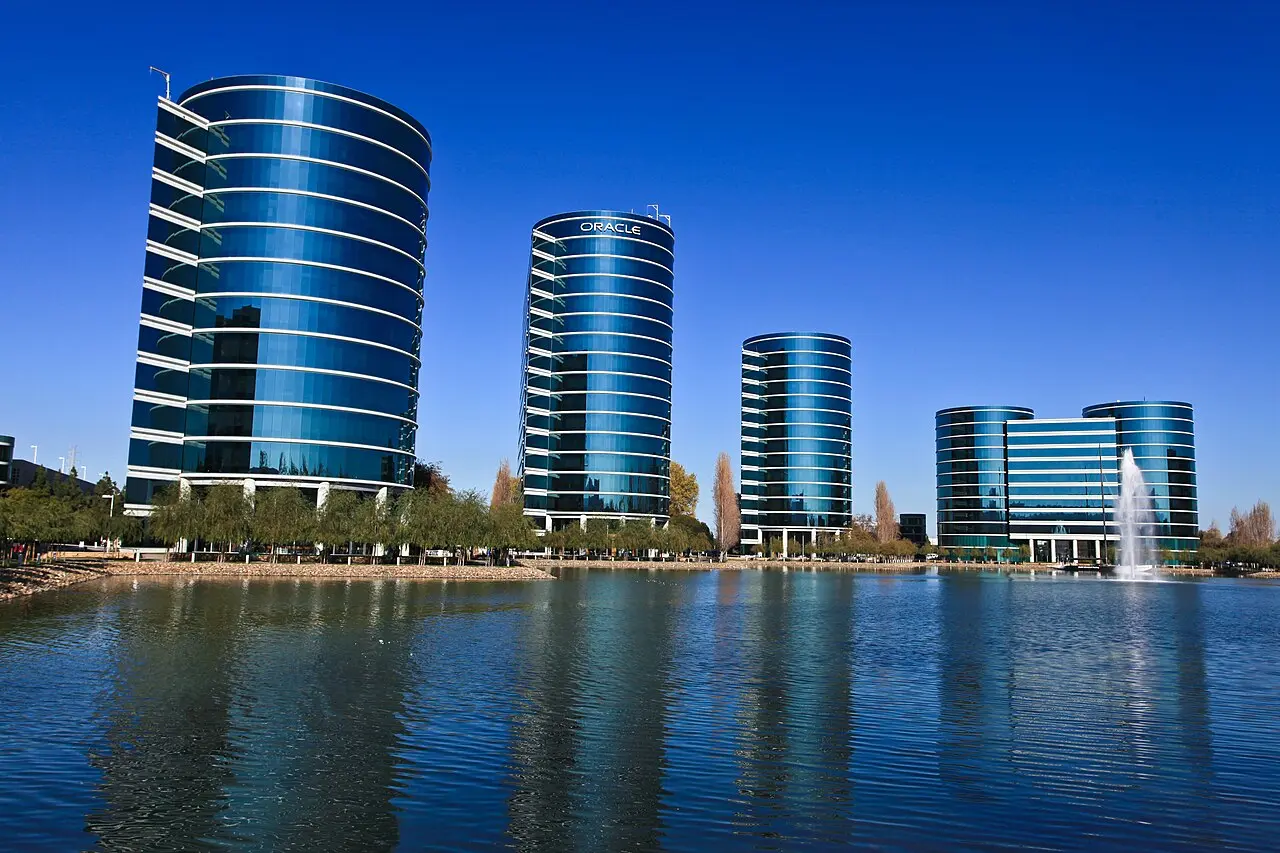
Organization
- Founded
- 1977
- Status
- Active
- Active
- 1977–
- Appearances
- 06
- Name
- ENOracle CorporationJAOracle
Oracle Corporation was founded in June 1977 by Larry Ellison, Bob Miner and Ed Oates as Software Development Laboratories. The name became Relational Software, Inc. in 1979, then Oracle Systems Corporation, and Oracle Corporation from 1995 — the present entity is a Delaware corporation formed in 2005 and, in its own filings, the successor to operations begun in June 1977. It is the company that turned Codd's relational model into the first commercial SQL relational database, and it is now, before it is a database company, a landlord of cloud capacity for AI training and inference. Headquarters: Austin, Texas.
Product, then acquisitions, then rented compute
Oracle's arc reads in three movements: in-house product generations, horizontal consolidation by acquisition, and a capital-intensive infrastructure business.
The first movement is the release history. V2, shipped in 1979, was the first release to reach customers; V1 ran on a PDP-11 under RSX in 128K of memory in 1978 but was never officially released. V3 (1983) was rewritten in C and, by Oracle's own account, was the first RDBMS to run on mainframes, minicomputers and PCs alike. V5 (1985) was among the first relational systems to work in client/server environments. Oracle went public on NASDAQ in March 1986 with 2.1 million shares, at which point it had 450 employees and US$55 million in annual revenue; the Redwood Shores headquarters followed in 1989. One detail is genuinely contested: Oracle's own thirtieth-anniversary timeline dates the rename from RSI to Oracle Systems to 1982, while most secondary accounts give 1983.
The second movement is the 2000s buying spree. After PeopleSoft (2005), Siebel (2006) and BEA (2008) assembled an applications portfolio, Oracle announced the acquisition of Sun Microsystems on 20 April 2009 at US$9.50 per share — about US$7.4 billion, or US$5.6 billion net of Sun's cash and debt. The joint press release called Java "the most important software Oracle has ever acquired". The deal closed on 27 January 2010, bringing Java, Solaris and MySQL under Oracle's control. Cerner followed in June 2022 at a total purchase price of US$28.2 billion per the FY2023 Form 10-K.
The third movement is happening now. Oracle came late to cloud, then bet the balance sheet on supplying compute for AI. In FY2026 (year ended 31 May 2026) remaining performance obligations closed at US$638 billion, up 363% year over year — while free cash flow was negative US$23.7 billion. The data centres come first, and Oracle raised US$43 billion of debt and US$5 billion of equity in that year alone to pay for them.
IaaS up 77 per cent while licences shrink
| Business | Representative products | FY2026 |
|---|---|---|
| Cloud Infrastructure (IaaS) | Oracle Cloud Infrastructure, GPU clusters for AI | US$18.1 bn (+77%); the growth engine |
| Cloud Applications (SaaS) | Fusion, NetSuite, Cerner (Oracle Health) | US$15.9 bn (+11%); down from 65% to 47% of total cloud revenue since FY2024 |
| Software licence and support | Oracle Database, MySQL, Java, middleware | US$24.5 bn (-1%) as customers migrate off-premise |
| Hardware and services | Oracle Engineered Systems, servers, storage, consulting | Hardware US$3.1 bn, services US$5.7 bn |
The FY2026 10-K describes Oracle AI Database and MySQL Database as "the world's most popular database management systems" and Java as "the computer industry's most widely used language for cloud-native development". Both are the company's own claims, not independent measurements.
Key events
- June 1977: Software Development Laboratories founded; Ellison is CEO from that month until September 2014.
- 1978-79: V1 (PDP-11 / RSX, assembly) is never released; V2 ships in 1979 and the company becomes Relational Software, Inc.
- 1982-83: renamed Oracle Systems (sources differ on the year). V3, rewritten in C, follows in 1983.
- March 1986: IPO on NASDAQ. Headquarters moves to Redwood Shores in 1989.
- 1992: Oracle7 brings stored procedures, triggers and declarative referential integrity.
- 2005-2008: PeopleSoft, Siebel and BEA acquired.
- 20 April 2009: Sun Microsystems acquisition announced (~US$7.4 bn).
- 27 January 2010: Sun deal closes; Java and MySQL pass to Oracle.
- September 2014: Ellison steps down as CEO to Executive Chair and CTO; Safra Catz becomes CEO.
- December 2020: Oracle announces the move of its headquarters from Redwood Shores to Austin (the FY2026 10-K lists Austin as its principal executive offices).
- 5 April 2021: the Supreme Court holds in Google LLC v. Oracle America that Android's copying of roughly 11,500 lines of the Java SE API was fair use.
- June 2022: Cerner acquisition closes (US$28.2 bn).
- 21 January 2025: Oracle is named as one of the backers of Stargate.
- 22 September 2025: Clay Magouyrk and Mike Sicilia become co-CEOs; Catz becomes Executive Vice Chair of the board.
- 22 January 2026: TikTok USDS Joint Venture LLC is formed to run TikTok in the US; Oracle holds a 15% interest as of 31 May 2026.
US$638 bn of backlog against negative free cash flow
- Revenue (FY2026, year ended 31 May 2026): US$67.4 bn (+17%) / GAAP operating income US$20.6 bn / GAAP net income US$17.0 bn
- Cloud revenue: US$34.0 bn (+39%) — IaaS US$18.1 bn (+77%), SaaS US$15.9 bn (+11%)
- Remaining performance obligations: US$638 bn, up 363% year over year and up US$85 bn in Q4 alone
- Operating cash flow US$32.0 bn (+54%), but free cash flow of negative US$23.7 bn
- Employees: about 141,000 as of 31 May 2026 (roughly 49,000 US, 92,000 international)
- FY2027 guidance: US$90 bn total revenue
Assets it could not keep control of, customers it depends on
Oracle's largest legacy is the market for treating data as a corporate asset you pay for. That the company which productised Codd's paper was not IBM but a small startup on a PDP-11 is still cited as the canonical gap between research and commercialisation. Its stewardship of acquired assets, however, has been contested repeatedly: MySQL had already forked into MariaDB before the Sun deal closed, and on 5 April 2021 the Supreme Court found Android's copying of the Java SE API to be fair use. Control over the assets Oracle bought has been eroded in court and by forking alike.
The current criticism is financial. US$638 billion of RPO is both a demand signal and a concentration of it: Oracle's own risk factors state that in certain OCI offerings it is more concentrated among a number of large customers. Much of the RPO growth came from large AI contracts in which the customer prepaid for GPUs or supplied them directly — Oracle puts the prepaid and customer-supplied hardware portions at US$75 billion. That lowers the capital Oracle must raise, but it also ties the quality of its revenue to its customers' ability to keep financing themselves. With a 15% stake in TikTok's US entity and a seat in Stargate, the business now runs directly through political decisions as well. A database company has become a company betting on power, GPUs and government approvals.
Appearances
- Oracle V2 Ships — The First Commercial SQL Relational Database
- Java Announced — Sun Microsystems
- MySQL's First Release — The Open RDB That Powered the LAMP Stack
- JavaScript Announced — Born of a Ten-Day Prototype
- The Trump AI Pivot — Biden's Order Rescinded, Stargate's $500 Billion Pledge
- TikTok's US Business Passes to a Joint Venture — The Divest-or-Ban Law Actually Fires
Questions this page answers
- What is the origin of Oracle?
- Larry Ellison, Bob Miner and Ed Oates founded it in June 1977 as Software Development Laboratories. It became Relational Software, Inc. in 1979, then Oracle Systems Corporation (sources differ between 1982 and 1983 for that rename), and Oracle Corporation from 1995.
- What was Oracle's first product?
- Oracle V2, shipped in 1979, which turned Codd's relational model into a commercial SQL relational database. V1 ran in 1978 but was never officially released.
- Why does Oracle own Java and MySQL?
- Oracle announced the purchase of Sun Microsystems for about US$7.4 billion on 20 April 2009, and when the deal closed on 27 January 2010, Java, Solaris and MySQL passed to Oracle.
- Where is Oracle headquartered, and who runs it?
- Its headquarters are in Austin, Texas. Ellison was CEO from 1977 until September 2014, and since 22 September 2025 Clay Magouyrk and Mike Sicilia have been co-CEOs.
Sources
TertiaryOracle Corporation — Wikipedia
Last updated: