ORGANIZATION
SAP
German software company founded in 1972 by five former IBM employees: Dietmar Hopp, Hasso Plattner, Claus Wellenreuther, Klaus Tschira and Hans-Werner Hector. It is the best-known supplier of enterprise resource planning (ERP) software, which ties a company's accounting, purchasing, HR, production and other operations into one system, and it has moved through generations from the mainframe-based R/2 to the client-server R/3 (1992) and S/4HANA (2015), rebuilt on the in-memory HANA database. Its first base was Weinheim; it moved its headquarters to Walldorf in 1977. In 2021 it launched RISE with SAP, a single package for moving core ERP to the cloud, and in 2025 cloud revenue reached €21.0 billion, more than half of total revenue of €36.8 billion. SAP says its generative-AI assistant Joule is becoming the new front end across its products.
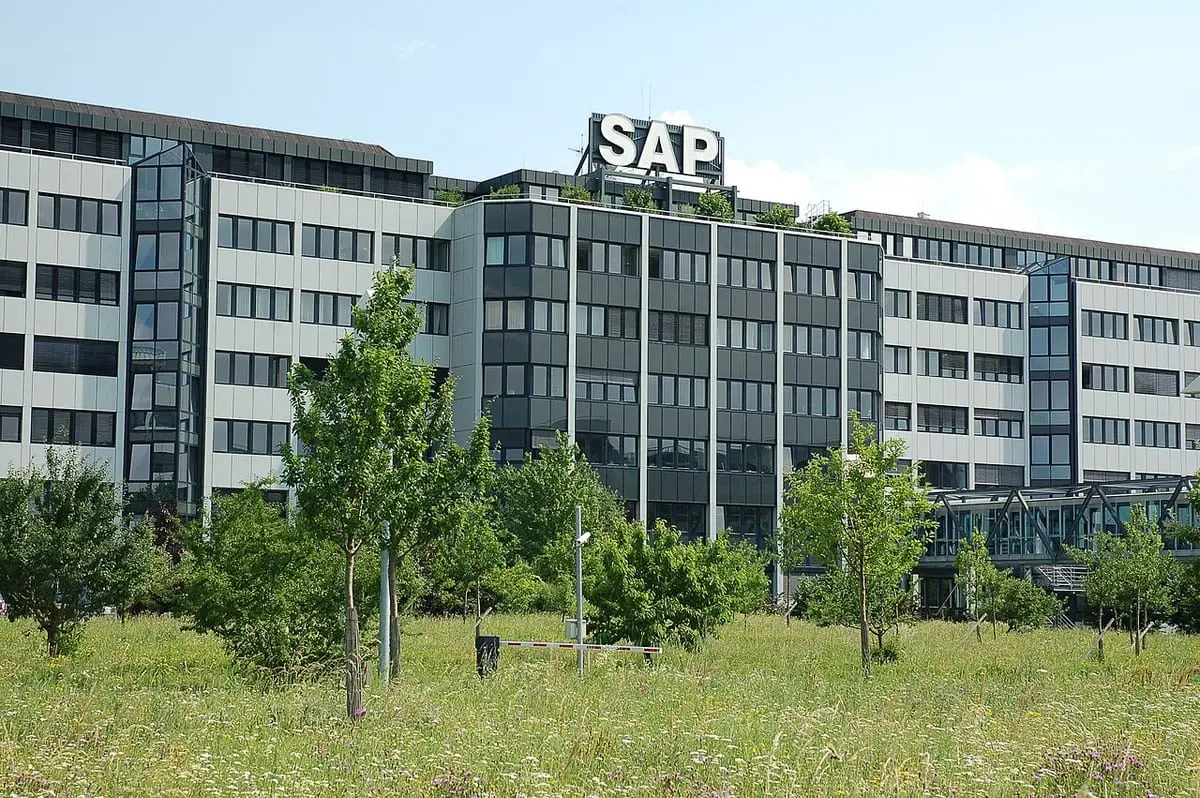
Organization
- Founded
- 1972
- Status
- Active
- Active
- 1972–
- Appearances
- 00
- Name
- ENSAPJASAP
SAP is a German software company founded in 1972 by five people who had left IBM: Dietmar Hopp, Hasso Plattner, Claus Wellenreuther, Klaus Tschira and Hans-Werner Hector. Its first name was Systemanalyse Programmentwicklung, "system analysis program development". According to the company's history, the aim was software that integrated business processes and made data available in real time. It was first based in Weinheim and moved its headquarters to Walldorf in 1977. The company marked 1 April 2022 as its 50th anniversary. Employees: 110,650 full-time equivalents as of 31 December 2025.
Business software, generation by generation
SAP's history reads as a succession of generations of enterprise resource planning (ERP) software, which ties a company's accounting, purchasing, HR, production and other operations into one system. Years and features follow the company's own history.
| Generation | Year | Platform and features |
|---|---|---|
| RF (later R/1) | 1973 | A financial accounting system; the R stood for "real time", processing data when needed instead of in overnight batches |
| R/2 | 1981 | Reconceived on the strength of SAP's experience with IBM's database and dialog control system; designed with international markets in mind |
| R/3 | 1992 | Client-server; a consistent graphical interface, dedicated use of relational databases, and support for servers from many vendors |
| S/4HANA | 2015 | Rebuilt to run entirely on SAP's own in-memory database, HANA; a cloud edition followed |
The five founders spent most of their time at the data centre of their first customer, the German subsidiary of Imperial Chemical Industries. Building business software that ran on the customer's computers was where SAP started, and it became the shape of the business. For R/3, SAP agreed in 1993 with Microsoft to port it to Windows NT, and it shipped a version supporting kanji to the Japanese market. On 3 August 1998 SAP listed on the New York Stock Exchange.
A cloud range filled out by acquisition
From the late 2000s SAP bought its way into the areas around its core software. In 2007 it unveiled Business ByDesign, aimed at midsized companies and SAP's first on-demand product, and in 2008 it completed the purchase of Business Objects. In 2011 the first HANA customers went live and SAP announced the €2.5 billion acquisition of SuccessFactors for HR in the cloud; it bought Ariba for procurement in 2012 and Concur for expenses in 2014. In 2021 it launched RISE with SAP, a single subscription offering for moving core ERP to the cloud.
The result shows in the revenue mix. Figures for 2025 are from the annual report on Form 20-F.
| 2025 | Amount | Change |
|---|---|---|
| Total revenue | €36.80 bn | +8% |
| Cloud revenue | €21.02 bn (57% of total) | +23% |
| of which Cloud ERP Suite | €18.12 bn | +28% |
| Software support | €10.53 bn | −7% |
| Software licences | €0.99 bn | −29% |
The 20-F attributes the decline in licence and support revenue to customers' accelerated move to the cloud. The current cloud backlog, contracted cloud revenue expected over the next 12 months, was €21.05 billion, and the total cloud backlog €77.29 billion. By region, revenue in the United States was €11.54 billion and in Japan €1.57 billion, up 13%.
What SAP says about AI
SAP announced its generative-AI assistant Joule in 2023 and created a unit for Business AI in 2024. In its 2025 20-F the company calls its approach "AI-First", meaning not adding AI to existing processes but changing how it develops products, and it presents Joule as an AI layer that navigates applications, executes transactions and orchestrates agents across SAP and non-SAP systems. These are SAP's own descriptions, not outside measurements of their effect.
Key events
- 1972: founded in Weinheim by five former IBM employees.
- 1973: financial accounting system RF (later R/1).
- 1977: headquarters moves to Walldorf.
- 1981: R/2.
- 1992: R/3 released.
- 1993: agreement with Microsoft; R/3 ported to Windows NT.
- 3 August 1998: listed on the New York Stock Exchange.
- 2011: HANA goes live; SuccessFactors acquisition announced.
- 2015: S/4HANA unveiled.
- 2021: RISE with SAP launched.
- 2023: generative-AI Joule announced.
Financials
Fiscal year ended 31 December 2025, per the 20-F.
- Total revenue: €36.80 bn (+8%)
- Cloud revenue: €21.02 bn (+23%)
- Cloud and software revenue: €32.54 bn (88% of total)
- Employees: 110,650 full-time equivalents (31 December 2025)
Questions this page answers
- When was SAP founded, and by whom?
- Five former IBM employees, Dietmar Hopp, Hasso Plattner, Claus Wellenreuther, Klaus Tschira and Hans-Werner Hector, founded it in 1972 as Systemanalyse Programmentwicklung (system analysis program development). It was based in Weinheim, and its first customer was the German subsidiary of Imperial Chemical Industries. SAP marked 1 April 2022 as its 50th anniversary.
- What is the difference between R/3 and S/4HANA?
- R/3, released in 1992, was client-server business software that ran on servers from many vendors and on relational databases. S/4HANA, unveiled in 2015, is its successor, rebuilt to run entirely on SAP's own in-memory database, HANA.
- How far has SAP's move to the cloud gone?
- In 2025 cloud revenue was €21.0 billion, up 23%, or 57% of total revenue of €36.8 billion. Software licence revenue fell to €990 million and software support revenue to €10.5 billion.
Sources
Founding in 1972 and Walldorf headquarters; 2025 total, cloud, Cloud ERP Suite, licence and support revenue and cloud backlog; revenue by region (US and Japan); headcount; the company's description of AI-First, Joule and Business AI
PrimaryHistory 1972-1980 — SAP (Wayback Machine archive)
The five founders and company name, the Weinheim base and first customer ICI, RF in 1973, and the 1977 move to Walldorf
PrimaryHistory 1981-1990 — SAP (Wayback Machine archive)
R/2 in 1981
PrimaryHistory 1991-2000 — SAP (Wayback Machine archive)
The 1992 release of R/3 and its features, the 1993 agreement with Microsoft and the Windows NT version, and the NYSE listing of 3 August 1998
PrimaryHistory 2001-2010 — SAP (Wayback Machine archive)
Business ByDesign in 2007 and completion of the Business Objects acquisition in 2008
PrimaryHistory 2011-2020 — SAP (Wayback Machine archive)
HANA in 2011, the SuccessFactors, Ariba and Concur acquisitions, and S/4HANA in 2015
PrimaryHistory 2021-present — SAP (Wayback Machine archive)
RISE with SAP in 2021, the 50th anniversary on 1 April 2022, Joule in 2023, and the Business AI unit in 2024
Last updated: