T1#research
The Four Color Theorem — When a Computer Carried Part of a Proof
Metadata
- Date
- Decade
- 1970s
- Tier
- T1
- Timelines
- AI and Mathematics: A History
- Sources
- 09
- Connections
- 00
- Tags
- #research
The four color theorem states that any map in the plane can be coloured with four colours so that regions sharing a border never get the same colour. Posed in 1852 and unsolved for more than 120 years, it was proved in 1976 by Kenneth Appel and Wolfgang Haken of the University of Illinois. MacTutor, the history-of-mathematics archive at the University of St Andrews, records that on 21 June 1976 the two announced that they had proved the four colour conjecture with the aid of a computer.
The proof matters less for its conclusion than for its shape. Its core was a computer check of nearly 1,500 "configurations", one at a time, and no human could verify the whole thing by hand. Whether a proof that nobody can read through deserves the name became a major controversy, and the question has carried over, half a century later, into the era in which AI systems write proofs.
An 1852 question and a proof that failed
According to MacTutor, the question goes back to Francis Guthrie in 1852. His brother Frederick put it to Augustus De Morgan, who wrote to William Rowan Hamilton the same day, 23 October 1852. De Morgan's letter opened: "A student of mine asked me today to give him a reason for a fact which I did not know was a fact."
| Year | Event |
|---|---|
| 1852 | Guthrie's question passes from De Morgan to Hamilton |
| 1879 | Alfred Kempe announces a proof (in Nature on 17 July) |
| 1890 | Percy Heawood exposes the flaw in Kempe's proof and proves five colours always suffice |
| 21 Jun 1976 | Appel and Haken announce a computer-aided proof |
| Sep 1976 | Announcement in the Bulletin of the AMS, promising two parts in the Illinois Journal of Mathematics |
| 1977 | Two papers in the Illinois Journal of Mathematics (the second with Koch) |
| 1997 | Second proof by Robertson, Sanders, Seymour and Thomas |
| 2005 | Gonthier and Werner formally verify the whole proof in Coq |
Kempe's proof stood for eleven years. MacTutor quotes Heawood's 1890 paper describing its aim as "rather destructive than constructive", since it set out to show a defect in what was then widely accepted. The four colour problem became known as a problem whose plausible proofs fall apart later.
Appel and Haken: unavoidable sets and reducibility
The proof combines two ideas that go back to Kempe. Build a set of configurations that must appear in every map (an unavoidable set), then show that every configuration in the set can be reduced to the colouring of a smaller map (that it is reducible). If both hold, no counterexample can exist.
The difficulty was the size of the set. The 1976 announcement, as quoted by MacTutor, says nearly fifteen hundred configurations were required, most of them not previously published, and that 1,200 hours of computer time were used for the reductions.
A University of Illinois profile says Haken became interested in the problem after hearing a lecture by Heinrich Heesch in 1949, worked on it in the 1960s, and concluded that a breakthrough would need a powerful computer. That led him to Appel, a colleague who was an expert in programming. Haken later said of their share: "We did the last 20 percent." He counted the pair as the fifth generation of people to work on the problem.
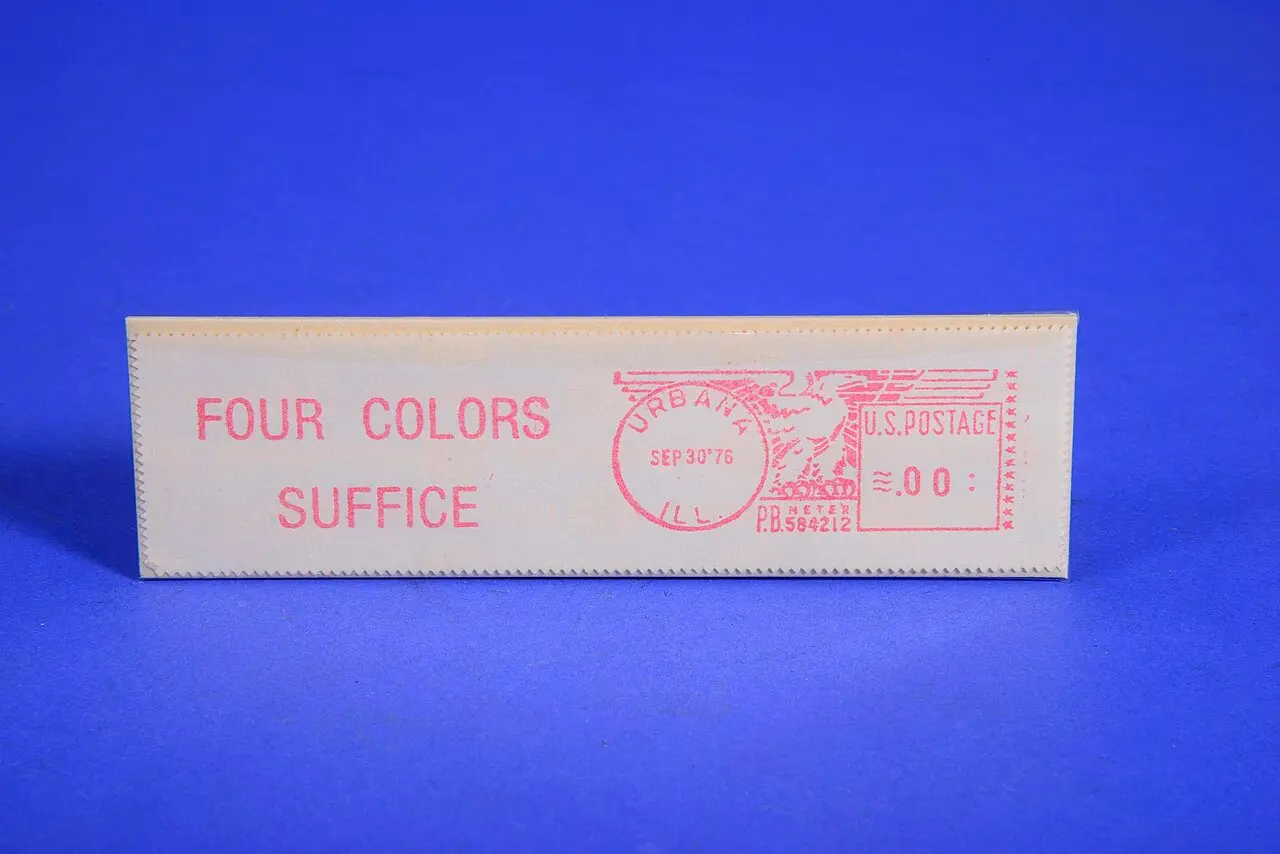
The Illinois mathematics department honoured the result by adding the words "Four Colors Suffice" to its postal meter. The image on this page is one of those strips, dated 30 September 1976.
Can a computer be part of a proof?
In the same profile Haken recalled that the announcement was greeted by some with enthusiasm and by others with scorn. While a documentary was being filmed at a New York college in 1981, one mathematics professor would not let his students talk to Haken or Appel at all. Haken remembered the objection put to him: "One person told me, quite correctly, 'How can a computer be part of a mathematical proof?'" and added, "A computer is a physical apparatus."
From philosophy, Thomas Tymoczko argued in the Journal of Philosophy in 1979 that a proof should be surveyable by the human mathematical community, and that the Appel–Haken proof substituted experiment for deduction. The debate moved beyond one theorem to the question of what a proof is.
Robin Thomas of Georgia Tech lists two concerns that remained. Part of the Appel–Haken proof uses a computer and cannot be verified by hand, and even the part that is supposedly hand-checkable is extraordinarily complicated and tedious.
A second proof and a machine-checked one
The second proof of 1997 answered those concerns. Neil Robertson, Daniel Sanders, Paul Seymour and Robin Thomas rebuilt the argument with 633 configurations and 32 discharging rules, against more than 300 in Appel and Haken's version, and published it in the Journal of Combinatorial Theory, Series B. A computer was still needed, but on a far smaller scale.
In 2005 Georges Gonthier and Benjamin Werner then verified the entire proof formally in the Coq proof assistant. Instead of trusting a program's output, another program checks every step against the rules of logic. The same approach was later used to settle the Kepler conjecture through the Flyspeck project (2014), a proof its referees could not fully certify.
What changed, and for whom
What changed was the working assumptions of mathematicians. MacTutor sums up that, despite initial worries, independent verification soon convinced everyone that the theorem had been proved. The price was a new set of questions about refereeing, about how checking is divided between people and machines, and about where certainty actually lives.
Those questions returned in a different form once AI began solving International Mathematical Olympiad problems in 2024. AI proofs checked in the Lean proof assistant are descendants of the Coq verification of the four colour theorem. And the question of what to do with proofs no human has read through became central again in the debate over Erdős problems and AI in 2026. The longer story of computers and mathematics is on the AI and mathematics timeline.
Questions this page answers
- What is the four color theorem?
- It states that any map in the plane can be coloured with four colours so that regions sharing a border never get the same colour; regions meeting at a single point do not count as neighbours. It was posed in 1852 and proved by Appel and Haken in 1976.
- Why was the proof of the four color theorem controversial?
- Because its core was a computer check of nearly 1,500 configurations, one by one. No human could verify the whole thing by hand, so people asked whether the output of a physical machine could count as part of a mathematical proof. Haken later recalled being told exactly that.
- Is the proof now considered secure?
- In 1997 Robertson, Sanders, Seymour and Thomas published a second proof with 633 configurations, whose computer parts have been independently verified, and in 2005 Gonthier and Werner formally verified the entire proof in the Coq proof assistant.
Sources
The announcement of the proof, saying it would appear in two parts in the Illinois Journal of Mathematics (quoted in MacTutor's Appel biography)
SecondaryKenneth Ira Appel — MacTutor History of Mathematics, University of St Andrews
Nearly fifteen hundred configurations, about 1,200 hours of computer time for reductions, the two-part publication
Secondary21 June — On this day, MacTutor History of Mathematics
21 June 1976: Appel and Haken announce a computer-aided proof of the four colour conjecture
SecondaryThe four colour theorem — MacTutor History of Mathematics
De Morgan's 1852 letter, Kempe's flawed 1879 proof, Heawood's 1890 critique and five colour theorem
SecondaryThe Color of Controversy — College of LAS, University of Illinois, April 1, 2009
Haken's recollections (we did the last 20 percent; the objection that a computer is a physical apparatus)
PrimaryThe Four Color Theorem — Robin Thomas, Georgia Institute of Technology
The 1997 second proof (633 configurations, 32 discharging rules) and the two concerns about the Appel–Haken proof
PrimaryTheorem Proof Gains Acclaim — Microsoft Research, October 11, 2012
Gonthier and Werner completed a formal proof of the four colour theorem in Coq in 2005
TertiaryNon-surveyable proof — Wikipedia
Last updated: